
Rare Earth Permanent Magnets Market Update (2026-W15): Procurement Signals Buyers Should Act On Now
A buyer-focused March-April 2026 update on NdFeB grades, Sm-containing supply, trade-policy signals, and practical sourcing actions for US, EU, Latin America, and global industrial teams.
One-Line Decision (Week 15, 2026): Treat the March 2026 upstream announcements as a grade-allocation signal, not a generic price drop. If your 2026 programs depend on high-temperature NdFeB or Sm-containing magnet pathways, lock specification-qualified backup supply now.
Snapshot date: April 10, 2026. Coverage is United States + European Union + Latin America + global industrial markets.
Interpretation statements are marked as buyer guidance; source-backed facts are listed in the Sources section.
What Changed (Last 30 Days)
| Date | Verified change | Affected grades / applications | Buyer implication in next 1-2 quarters |
|---|---|---|---|
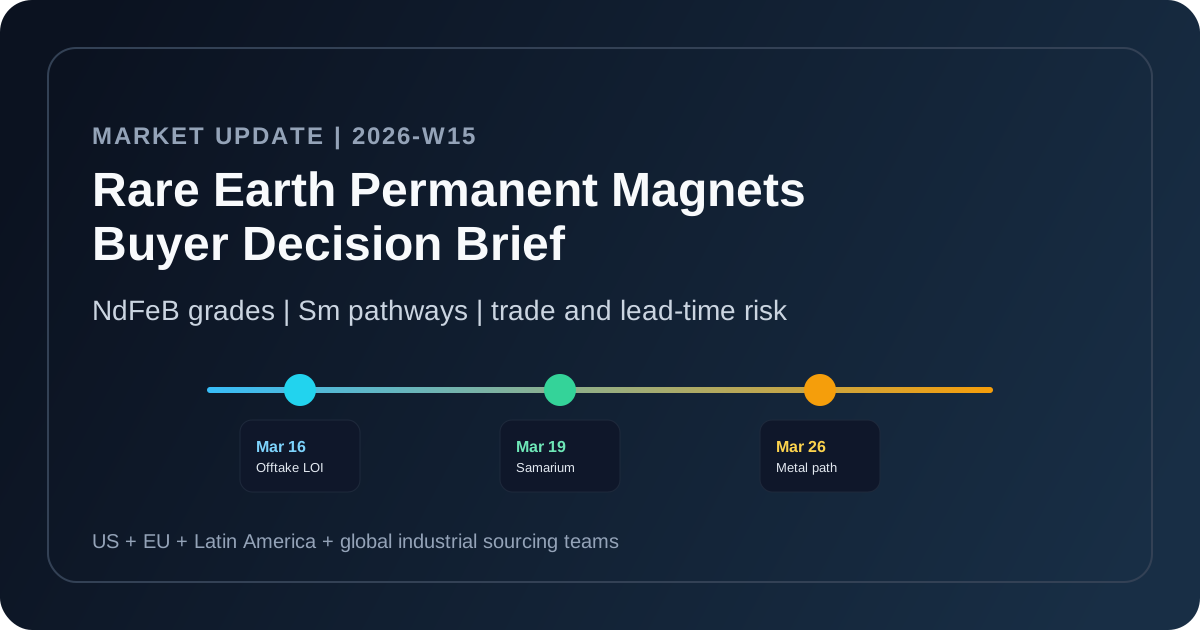
| 2026-03-16 | Lynas announced a binding Letter of Intent with the U.S. DoW: about US$96 million offtake allocation and US$110/kg NdPr oxide floor price over 4 years. | NdFeB feedstock planning (especially defense-adjacent and strategic programs). | A non-China supply stream is being contract-prioritized; do not assume spot-like flexibility for premium grades. |
| 2026-03-19 | Lynas announced first samarium oxide production at Lynas Malaysia, ahead of its stated April 2026 schedule. | Sm-containing magnet value chains, high-performance electronics/aerospace pathways. | Early milestone improves confidence in separated HRE/LRE portfolio depth, but does not remove qualification lead time. |
| 2026-03-26 | Lynas and LS Eco Energy announced a framework for rare-earth metal making in Vietnam; Samarium metal listed as first priority; cross-subscription of convertible instruments (~AUD$30m each) announced. | Metallised NdPr, Sm, Dy/Tb-containing pathways for magnet production. | Midstream conversion capacity signals improve diversification narrative; buyers still need contract-specific delivery commitments. |
| 2026-03-04 | Council of the EU adopted a position to reinforce raw-material security of supply and circularity for EU industry. | EU-bound magnet products and compliance-heavy supply programs. | EU sourcing documentation pressure continues to increase; engineering BOM transparency becomes a practical requirement. |
| 2026-04-08 | IEA published rare-earth supply-chain update and highlighted persistent concentration in mining/refining/magnet making. | All NdFeB/SmCo procurement exposed to concentrated midstream and magnet manufacturing. | Multi-source strategies remain mandatory; single-region dependence remains high-risk for lead-time stability. |
| 2026 (baseline) | USGS 2026 summary reports U.S. mine output growth but continued import dependence and volatile NdPr context. | U.S. buyers expecting immediate full domestic replacement. | Domestic progress is real, but not sufficient to remove import-risk management in 2026 planning cycles. |
Supply-Chain Signal Map for Magnet Buyers
| Grade family | Signal strength (30-day window) | What changed for buyers | Procurement action |
|---|---|---|---|
| Standard sintered NdFeB (N35-N52) | Medium | Upstream diversification narrative improved, but concentrated conversion + magnet making remains structural. | Keep dual-source RFQ active; avoid single-quote awards for full-year demand. |
| High-temperature NdFeB (H/SH/UH/EH/AH) | High | Any Dy/Tb-sensitive pathway remains exposed to concentrated heavy-rare-earth processing and conversion capacity. | Reserve capacity early and attach substitution rules in contract annexes. |
| Sm-containing pathways (including SmCo-adjacent supply concerns) | High | Samarium oxide/metal signals improved in March, but downstream conversion qualification still takes time. | Lock pilot lots now for Q3/Q4 programs needing thermal stability certainty. |
| Bonded NdFeB | Medium | Still benefits from broader NdPr access, but pricing/lead-time can move with polymer + powder conversion constraints. | Keep MOQ and shelf-life terms explicit in frame agreements. |
| Defense / aerospace magnet programs | High | Government-linked offtake and secure-supply prioritization can redirect availability during tight windows. | Build priority clauses, expediting paths, and approved alternates before shortage windows reopen. |
Pricing, Lead-Time, and Trade Impact by Market
| Market | Pricing signal in current window | Lead-time signal | Trade / compliance signal | Buyer interpretation |
|---|---|---|---|---|
| United States | The Lynas-DoW LOI includes a stated US$110/kg NdPr floor for that agreement (not a market-wide spot benchmark). | Lead-time risk remains for specialty/high-temperature pathways despite supply diversification progress. | Strategic/government-linked demand can absorb non-China tonnage quickly. | Keep two price layers in negotiation: contract-indexed floor signals vs. open-market procurements. |
| European Union | CRMA policy direction is tightening security-of-supply and circularity expectations. | Compliance-heavy industrial buyers may face longer supplier onboarding cycles. | Documentation and supplier concentration controls are becoming operational, not optional. | Prepare stronger traceability fields in RFQs now. |
| Latin America (export-oriented buyers/distributors) | No standalone regional price reset signal in this 30-day window. | Lead-time depends on whether final demand is tied to US/EU compliance and qualification windows. | Exposure is indirect: transnational OEM qualification and customs/compliance requests from destination markets. | Build quote versions by destination market (US/EU/other), not one global template. |
| Global industrial OEM programs | IEA reports concentration remains high across refining and magnet production. | Bottlenecks remain concentrated in midstream and magnet making. | Diversification projects are growing but not yet enough to eliminate dependence risk. | Keep safety stock + dual qualification for critical SKUs through H2 2026. |
Who Should Act Now (Buyer Checklist)
- Procurement teams: Split commodity assumptions by grade family (standard NdFeB vs high-temp NdFeB vs Sm-containing pathways), then update supplier scorecards this month.
- OEM engineering teams: Revalidate acceptable grade substitutions and thermal derating limits before approving cost-down changes.
- Distributors: Segment inventory policy by destination compliance profile (US vs EU) and by application criticality.
- Sourcing managers: Require suppliers to disclose oxide-to-metal pathway and conversion location for strategic programs.
- Program managers: Add lead-time trigger points (for example, automatic alternate-source release when committed dates slip).
- Commercial teams: Avoid using a single headline number in customer offers; separate floor-price references from transactable quote terms.
Related practical guides:
- NdFeB vs SmCo Magnets: Complete Comparison
- NdFeB Magnet MOQ Guide
- How to Choose Magnet Supplier in China
- Contact our sourcing team
Risks and Limits (Evidence Gaps and Boundaries)
| Risk / boundary | What is known | What is not yet known | How buyers should handle it |
|---|---|---|---|
| Interpreting contract floor price as market price | A published floor price exists in one specific announced offtake framework. | Actual transaction spreads by region, grade, volume, and incoterm are not public in that announcement. | Treat floor prices as directional supply-priority signals, not direct quote replacement. |
| Converting oxide milestone into finished magnet availability | Samarium oxide and metal-making milestones were publicly announced. | Timing of broad finished-magnet output ramp by grade/customer is not fully public. | Keep staged qualification with pilot, PPAP-equivalent checks, and fallback sourcing. |
| Assuming policy text instantly changes delivered lead time | EU and global policy signals are strengthening diversification and traceability pressure. | Real factory-level throughput changes often lag policy by quarters. | Keep a rolling 90-day and 180-day risk review instead of one-time policy response. |
| Latin America demand translation | LATAM programs are often linked to US/EU final markets and standards. | No single LATAM-wide magnet policy shift was identified in this 30-day window. | Use destination-driven compliance and customs logic in contracts and forecasts. |
Recommended Next Actions by Region
United States
- Re-open 2026 blanket POs for high-temperature NdFeB and Sm-containing programs.
- Attach alternate grade and alternate source clauses before Q3 allocation cycles.
European Union
- Add traceability fields for permanent magnets and recycled-content disclosures where relevant.
- Align sourcing documentation with CRMA-driven transparency expectations.
Latin America
- For exporters serving US/EU OEM chains, create destination-specific compliance packs.
- Pre-negotiate lead-time buffers with upstream suppliers for regulated end markets.
FAQ
Is the announced US$110/kg number a universal NdPr market price?
No. It is a floor price disclosed in a specific announced offtake framework. It should not be used as a universal spot quotation for every buyer.
Does this update mean high-temperature NdFeB will become easy to source immediately?
No. High-temperature pathways remain sensitive to heavy-rare-earth processing and conversion bottlenecks.
Are Sm-containing magnet pathways improving?
Yes, the announced March milestones are positive. But broad, repeatable finished-part availability still depends on downstream conversion and customer qualification cycles.
Should EU buyers wait for final legislation before changing sourcing documents?
No. The direction of travel is already clear enough to start adding traceability and supplier-concentration controls to RFQs now.
What should LATAM distributors do if they sell to multiple export destinations?
Use destination-based quote and compliance templates. A single global template hides risk when buyers ship into US/EU-controlled value chains.
What is the biggest operational mistake right now?
Treating all NdFeB purchasing decisions as one commodity decision. Grade, thermal profile, and conversion path now change both price confidence and lead-time reliability.
Sources
- LYNAS AND US DoW SIGN LETTER OF INTENT FOR RARE EARTH SUPPLY — Lynas Rare Earths (ASX announcement), 16 March 2026
https://wcsecure.weblink.com.au/pdf/LYC/03068512.pdf - LYNAS MALAYSIA PRODUCES FIRST SAMARIUM OXIDE — Lynas Rare Earths (ASX announcement), 19 March 2026
https://wcsecure.weblink.com.au/pdf/LYC/03069968.pdf - LYNAS TO DEVELOP METAL MAKING PARTNERSHIP WITH LS ECO ENERGY — Lynas Rare Earths (ASX announcement), 26 March 2026
https://wcsecure.weblink.com.au/pdf/LYC/03072369.pdf - New projects, partnerships and policies are needed to address supply chain risks for rare earth elements — International Energy Agency (News), 08 April 2026
https://www.iea.org/news/new-projects-partnerships-and-policies-are-needed-to-address-supply-chain-risks-for-rare-earth-elements - Rare earth elements: Pathways to secure and diversified supply chains — International Energy Agency (Event/report launch), 08 April 2026
https://www.iea.org/events/rare-earth-elements-pathways-to-secure-and-diversified-supply-chains - Rare Earth Elements: Pathways to secure and diversified supply chains (Executive summary) — International Energy Agency (Report), 2026
https://www.iea.org/reports/rare-earth-elements/executive-summary - Raw materials: Council adopts position to reinforce the security of supply and the circularity of EU industry — Council of the European Union (Press release), 4 March 2026
https://www.consilium.europa.eu/en/press/press-releases/2026/03/04/raw-materials-council-adopts-position-to-reinforce-the-security-of-supply-and-the-circularity-of-eu-industry/ - Rare Earths — U.S. Geological Survey, Mineral Commodity Summaries 2026, 2026
https://pubs.usgs.gov/periodicals/mcs2026/mcs2026-rare-earths.pdf
Author

Categories
More Posts
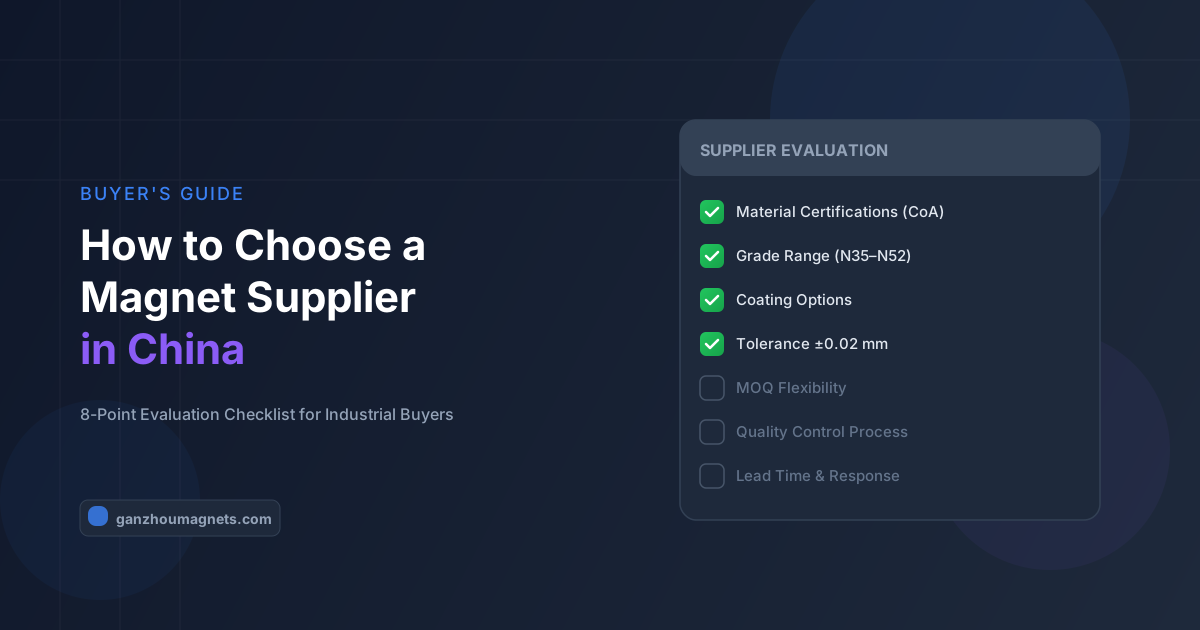
How to Choose a Custom Magnet Supplier in China: A Buyer's Checklist
A practical guide for industrial buyers evaluating Chinese magnet suppliers. Covers factory vs. trading company, quality certifications, MOQ expectations, and red flags to avoid.
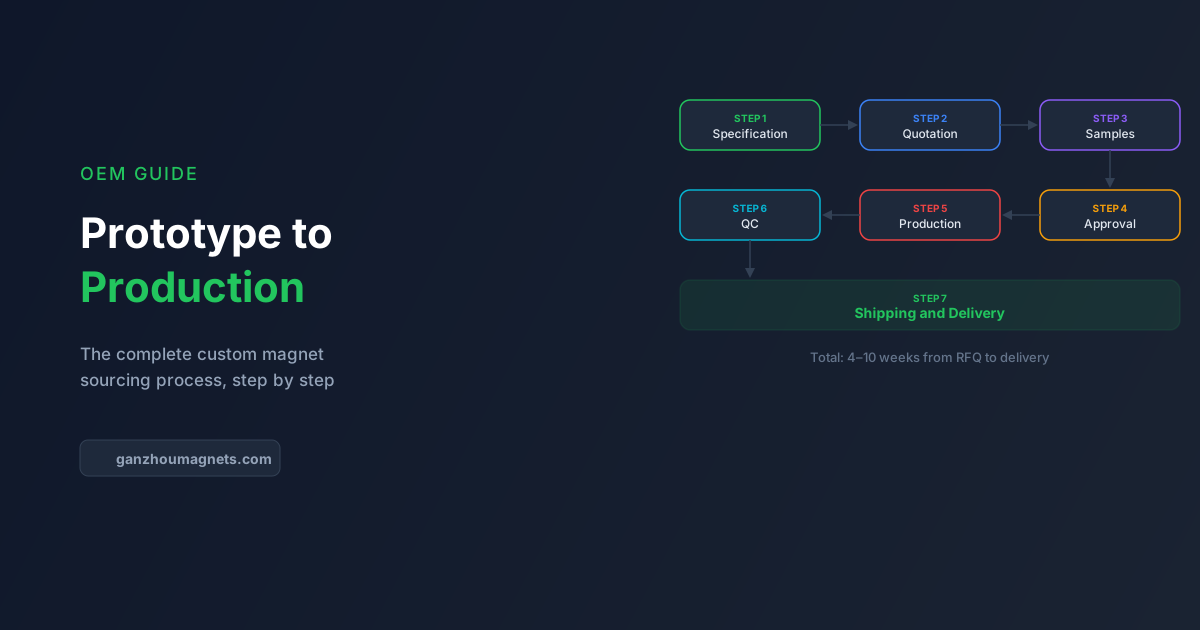
From Prototype to Mass Production: The OEM Custom Magnet Guide
Step-by-step guide for first-time buyers sourcing custom magnets from China. Covers the 7-step process from specification to mass production, including MOQ, testing, certifications, and logistics.
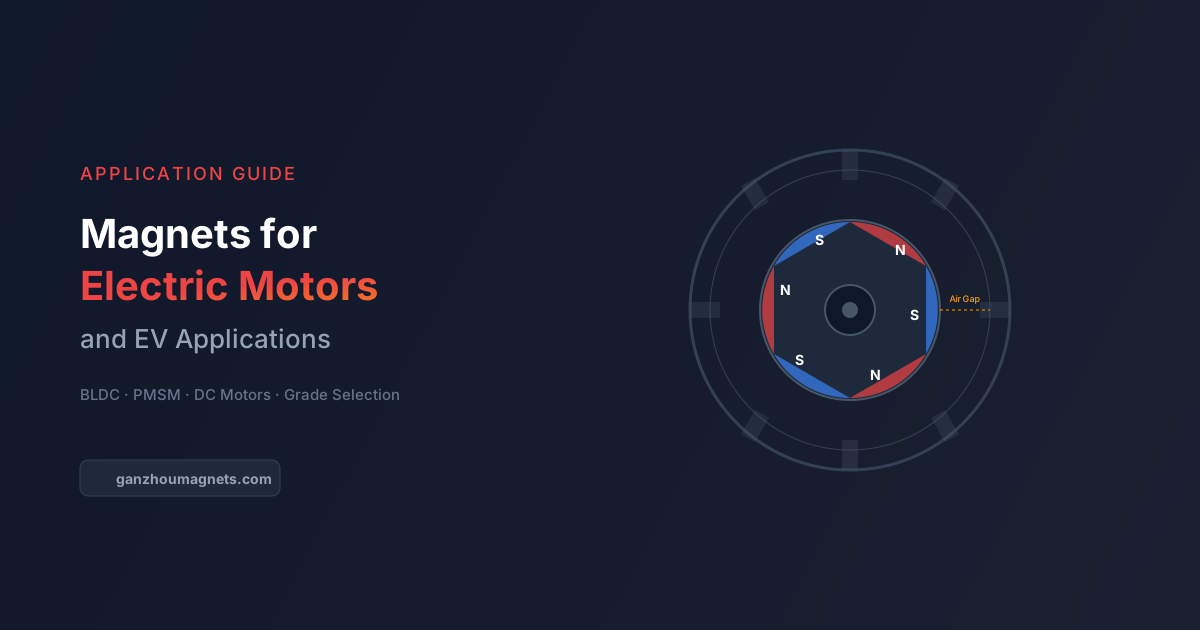
Custom Magnets for Electric Motors and EV Applications: Selection Guide
Engineering guide for selecting NdFeB and SmCo magnets for BLDC, PMSM, and DC motors. Covers grade selection, demagnetization analysis, thermal management, and sourcing from prototype to volume production.