
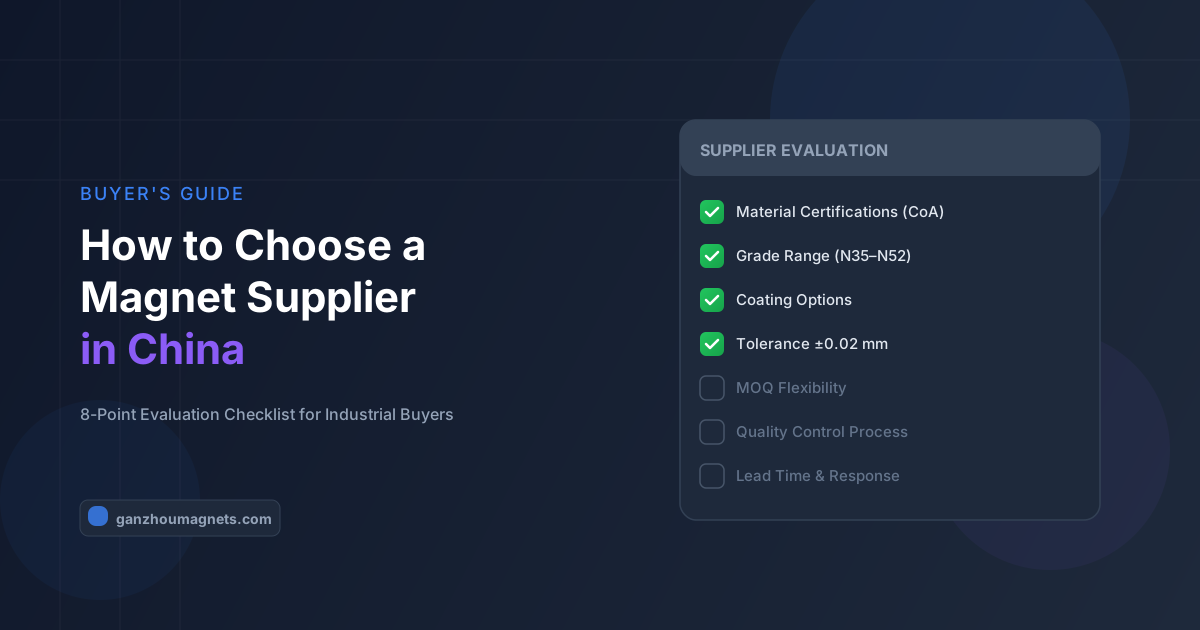
How to Choose a Custom Magnet Supplier in China: A Buyer's Checklist
A practical guide for industrial buyers evaluating Chinese magnet suppliers. Covers factory vs. trading company, quality certifications, MOQ expectations, and red flags to avoid.
Why China Dominates the Magnet Supply Chain
China produces over 90% of the world's rare earth magnets. The city of Ganzhou in Jiangxi province sits at the heart of this supply chain — it is the largest rare earth processing hub globally, with direct access to raw materials, sintering facilities, and coating lines within a 50 km radius.
For industrial buyers sourcing NdFeB (neodymium) or SmCo (samarium cobalt) magnets, choosing the right supplier in China is the single most important decision affecting cost, quality, and lead time.
This guide provides a structured checklist based on real sourcing experience.
Factory vs. Trading Company: Know Who You're Dealing With
The first question to answer is whether your supplier is a manufacturer (factory) or a trading company.
| Factor | Factory | Trading Company |
|---|---|---|
| Pricing | Direct, typically 15–30% lower | Markup added |
| Customization | Full control over tooling and process | Relays requirements to factory |
| Quality control | In-house QC, direct floor access | Depends on factory relationship |
| Communication | May have language barriers | Usually better English support |
| MOQ flexibility | Less flexible on small orders | More willing to combine orders |
| Best for | Volume production (1,000+ pcs) | Small batches, multi-product sourcing |
Tip: Ask for factory photos showing the sintering furnace, slicing machines, and coating line. A genuine factory will have these readily available. Trading companies often provide stock photos.
The 8-Point Supplier Evaluation Checklist
1. Material Certifications
Verify that the supplier can provide:
- Certificate of Analysis (CoA) for each shipment — showing BH(max), Hcj, Br values
- RoHS compliance documentation
- REACH declaration if shipping to the EU
- MSDS (Material Safety Data Sheet) for the magnet grade
2. Grade Range
A capable supplier should offer the full NdFeB grade spectrum:
- Standard grades: N35 to N52
- High-temperature grades: N35M through N52SH (up to 150°C) and N35EH through N48UH (up to 200°C)
- SmCo grades: SmCo5 and Sm2Co17 series
If a supplier only offers a narrow range, they may be reselling from another factory.
3. Coating Options
Industrial applications typically need more than basic NiCuNi plating. Ask about:
- NiCuNi (nickel-copper-nickel) — standard corrosion protection
- Zinc — cost-effective for indoor use
- Epoxy — excellent chemical resistance
- Parylene — thin-film conformal coating for medical/aerospace
- Gold or Tin — for soldering applications
4. Tolerance Capabilities
Standard tolerances for sintered NdFeB:
- Dimensions: ±0.05 mm standard, ±0.02 mm precision
- Magnetic properties: within 5% of specified BH(max)
Ask for tolerance reports from previous production runs.
5. Minimum Order Quantity (MOQ)
Typical MOQs from Chinese magnet suppliers:
| Scenario | Expected MOQ |
|---|---|
| Standard shapes (disc, block) | 100–500 pcs |
| Custom shapes with tooling | 500–1,000 pcs |
| Sample orders | 5–50 pcs (higher unit cost) |
| Magnetic assemblies | 50–200 pcs |
Important: Reputable suppliers will offer sample orders at a premium before committing to production volumes. If a supplier refuses samples, consider it a red flag.
6. Quality Control Process
A professional supplier should have:
- Incoming raw material inspection
- In-process dimensional checks
- 100% magnetic property testing (Gaussmeter or Helmholtz coil)
- Salt spray testing reports for coated magnets
- Final inspection before packing
7. Lead Time
Typical production lead times:
- Standard grades with common coatings: 2–3 weeks
- Custom shapes or special grades: 3–4 weeks
- Magnetic assemblies: 4–6 weeks
- Sample orders: 1–2 weeks
8. Communication and Response Time
Test the supplier's responsiveness before placing an order:
- Do they respond within 24 hours to initial inquiries?
- Can they provide a detailed quote (not just unit price) within 2–3 days?
- Do they ask technical questions about your application? (This is a positive sign — it shows engineering capability.)
Red Flags to Watch For
- No factory photos or reluctance to share production facility images
- Extremely low prices that undercut market rates by 50%+ (likely inferior grade or recycled material)
- No sample policy — refusing to produce 5–20 pcs for validation
- Vague specs — cannot specify exact grade, tolerance, or coating thickness
- No CoA — unable to provide magnetic property test data per batch
- Copy-paste responses — generic answers that don't address your specific application
- Pressure to skip samples — pushing you to go directly to production order
Factory Audit: 10 Questions to Ask Before Ordering
Whether visiting in person or conducting a virtual audit, these questions reveal a factory's true capability:
-
"Can you show me your sintering furnace and its capacity?" — A real factory will have vacuum sintering furnaces. Ask about furnace quantity, max temperature, and annual sintering capacity.
-
"What Gaussmeter or Helmholtz coil do you use for magnetic testing?" — The answer tells you if they do in-house magnetic property testing or outsource it.
-
"What is your raw material source?" — Ganzhou factories typically use local rare earth alloy suppliers. Ask for alloy supplier certificates.
-
"Can I see a CoA from your last 3 shipments?" — This reveals testing consistency and whether they actually measure every batch.
-
"What is your annual production tonnage?" — Factories below 500 tonnes/year may struggle with large or complex orders.
-
"How do you handle out-of-spec parts?" — Professional answer: 100% inspection with reject segregation. Red flag: "we don't have rejects."
-
"What coating equipment do you have in-house?" — Many small factories outsource coating. This adds lead time and reduces quality control.
-
"Can you provide customer references in my industry?" — A factory serving automotive or medical customers has demonstrated higher QC standards.
-
"What happens if a shipment fails incoming inspection at my facility?" — Look for: replacement at factory's cost, root cause analysis, corrective action plan.
-
"Can I see your production floor on video call right now?" — The willingness (and ability) to show a live factory floor is the strongest authenticity signal.
How to Verify Certifications
Fake or expired certificates are common in B2B sourcing. Here's how to verify:
| Certification | How to verify | What to check |
|---|---|---|
| ISO 9001 | Search certificate number at the issuing body's website (e.g., SGS, TÜV, Bureau Veritas) | Expiry date, scope of certification, company name match |
| RoHS | Request the test report (not just declaration) — check that it's from an accredited lab (SGS, Intertek, TÜV) | Test date within 2 years, your specific material type covered |
| REACH | Request SVHC test report or declaration of non-applicability | Substances tested match current REACH candidate list |
| IATF 16949 | Verify at IATF's official database (iatfglobaloversight.org) | Active status, site address match |
Pro tip: Ask for the certificate number and issuing body, then verify directly. A legitimate factory will provide this information immediately.
Payment Terms: What to Expect and How to Negotiate
| Payment method | Typical usage | Risk level for buyer | Best for |
|---|---|---|---|
| T/T 30/70 | Most common — 30% deposit, 70% before shipment | Medium | Orders $1,000–$50,000 |
| T/T 100% before | Small/sample orders | Higher (no leverage) | Orders under $1,000 |
| L/C (Letter of Credit) | Large orders with new suppliers | Low (bank-guaranteed) | Orders above $50,000 |
| PayPal | Sample orders only | Low (buyer protection) | Sample or trial orders |
| O/A (Open Account) | Established relationships only | Low | Repeat customers with history |
Negotiation Tips
- First order: Accept T/T 30/70 — this is standard and reasonable
- After 3+ successful orders: Request T/T 20/80 or 30-day payment terms
- For large programs: Use L/C to protect both sides
- Always: Get a Proforma Invoice (PI) with specs, price, quantity, delivery, and payment terms before wiring any funds
- Never: Wire 100% upfront to a new supplier you haven't verified
Screening Suppliers on B2B Platforms
Most buyers find Chinese magnet suppliers through these platforms:
| Platform | Best for | Watch out for |
|---|---|---|
| Alibaba | Initial discovery, contact info | Many trading companies disguised as factories; "Gold Supplier" badge is paid, not verified |
| Made-in-China | Verified manufacturers | Smaller supplier pool than Alibaba |
| GlobalSources | Verified exporters, trade shows | Fewer small/medium factories |
| Direct website | Suppliers with established export business | Harder to discover, but often higher quality |
Quick Verification Checklist for Platform Listings
- Does the listing show actual product photos (not stock images)?
- Is the company name consistent across listing, website, and certificates?
- Does the supplier respond to technical questions about grades and tolerances?
- Can they provide a factory video showing production equipment?
- Do they have trade show attendance history (Canton Fair, etc.)?
Price Benchmarking: What's a Fair Price?
To avoid overpaying or falling for suspiciously low quotes, understand approximate market pricing for standard NdFeB magnets:
| Magnet type | Grade | Approximate price range (FOB China) |
|---|---|---|
| Disc Ø10 × 3mm | N42 | $0.08–$0.15/pc (5,000+ pcs) |
| Block 20 × 10 × 5mm | N42 | $0.15–$0.30/pc (5,000+ pcs) |
| Ring Ø20 × Ø10 × 5mm | N42 | $0.20–$0.40/pc (2,000+ pcs) |
| Arc segment (motor) | N42SH | $0.50–$2.00/pc (1,000+ pcs, geometry dependent) |
| Disc Ø10 × 3mm | N52 | $0.12–$0.22/pc (5,000+ pcs) |
| Custom shape | N42SH | Quote required (tooling + per-piece) |
Prices fluctuate with rare earth oxide costs. Above ranges are approximate for 2025–2026.
If a quote is 40%+ below these ranges, investigate before ordering — the supplier may be using lower-grade alloy, thinner coating, or recycled material.
Why Ganzhou Suppliers Have an Advantage
Ganzhou's unique position in the magnet supply chain:
- Raw material proximity — Ganzhou sits on the world's largest ionic rare earth deposits
- Integrated supply chain — from ore processing to finished magnets within one region
- Cost efficiency — lower logistics costs compared to coastal manufacturing hubs
- Specialized workforce — decades of rare earth industry expertise
- Government support — designated national rare earth industry zone with R&D facilities
- Heavy rare earth advantage — direct access to dysprosium and terbium for high-temperature grades
Next Steps
Once you've identified a qualified supplier, the typical procurement flow is:
- Submit RFQ with drawings, grade target, coating, and quantity
- Receive quotation with unit price, tooling cost (if applicable), and lead time
- Verify credentials — check certificates, request factory video, ask the 10 audit questions
- Order samples (5–20 pcs) for dimensional and magnetic validation
- Approve samples and place production order with agreed payment terms
- Receive QC documentation — review CoA, dimensional reports, and coating test data
- Pre-shipment inspection — review QC reports before dispatch
Need help sourcing custom magnets from Ganzhou? Request a quote with your specifications and we'll coordinate supplier quotes within 24 hours.
Author

Categories
More Posts
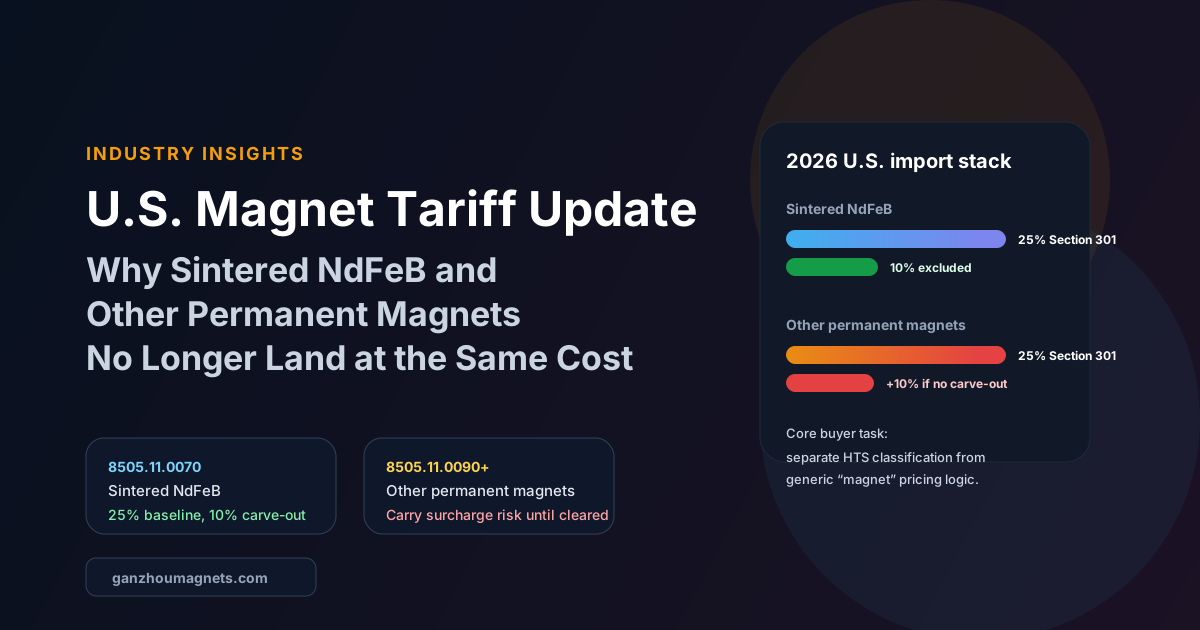
April 2026 U.S. Magnet Tariff Update: Sintered NdFeB Has a Different Surcharge Path
What U.S. importers should do now that the 2026 temporary import surcharge excludes HTS 8505.11.0070 sintered NdFeB magnets, while the broader 2026 Section 301 tariff on permanent magnets remains in force.
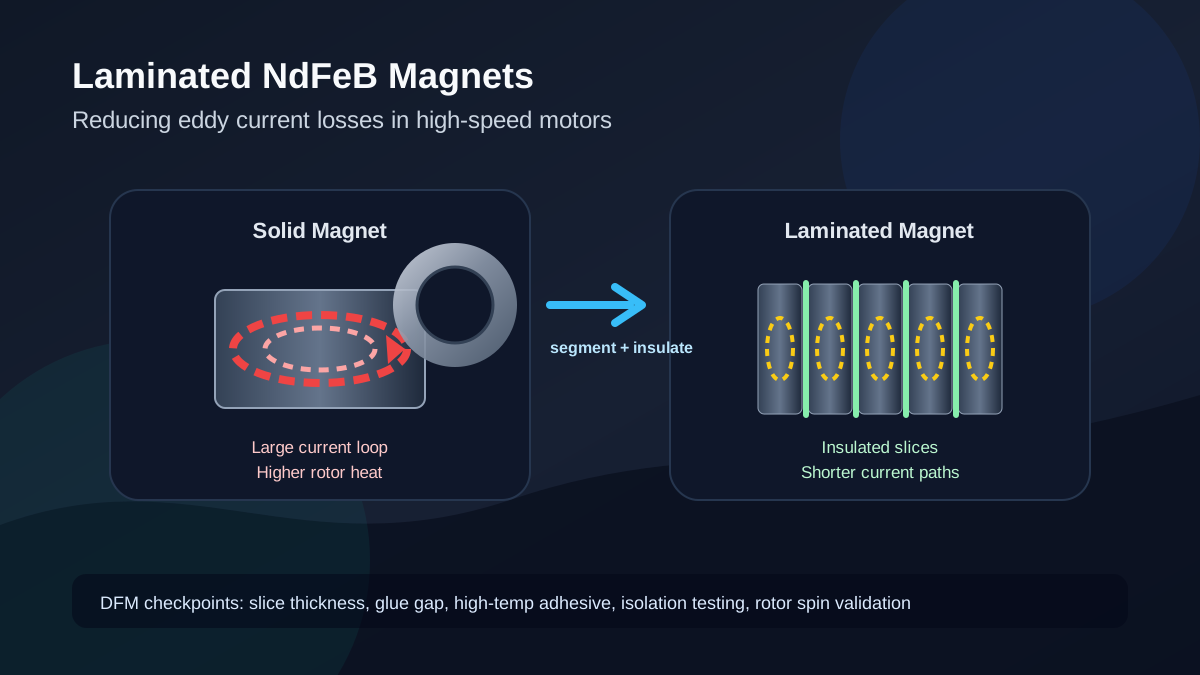
Laminated NdFeB Magnets for High-Speed Motors
Laminated NdFeB magnets guide for high-speed motors: compare eddy current loss, slice thickness, QA tests, cost trade-offs, and RFQ specs. Contact us.

Reducing Heavy Rare Earth Costs: The 2026 Buyer's Guide to Grain Boundary Diffusion (GBD) NdFeB Magnets
A comprehensive guide for engineers and procurement teams on using Grain Boundary Diffusion (GBD) to reduce Dysprosium (Dy) and Terbium (Tb) costs in high-temperature NdFeB magnets.