
NdFeB vs SmCo Magnets: Complete Comparison Guide for Engineers
Detailed comparison of neodymium (NdFeB) and samarium cobalt (SmCo) magnets covering magnetic performance, temperature stability, corrosion resistance, cost, and application-specific recommendations.
Overview: Two Families of Rare Earth Magnets
Both NdFeB and SmCo are rare earth permanent magnets — the strongest class of commercial magnets available. However, they differ significantly in composition, performance characteristics, and optimal use cases.
NdFeB (Neodymium Iron Boron, Nd₂Fe₁₄B) was developed in the 1980s and dominates the market due to its superior energy product and lower cost.
SmCo (Samarium Cobalt) was developed in the 1970s and remains the preferred choice for extreme environments where temperature and corrosion resistance outweigh cost considerations.
Head-to-Head Comparison
| Property | NdFeB | SmCo |
|---|---|---|
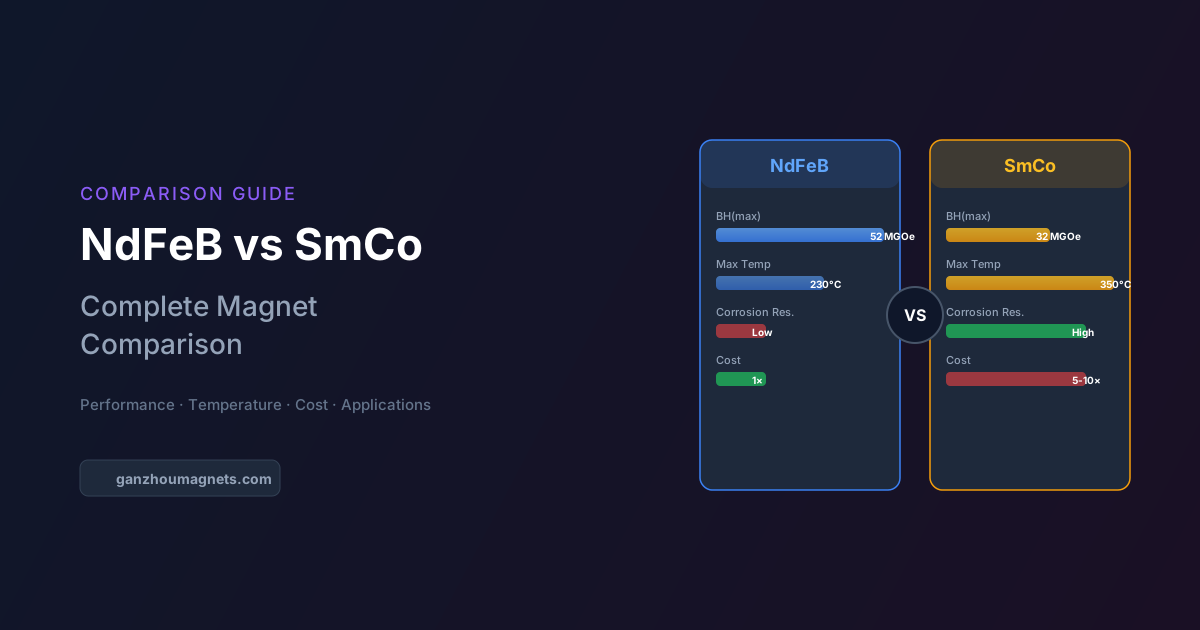
| Maximum energy product (BH)max | 52 MGOe (N52) | 32 MGOe (SmCo 2:17) |
| Remanence (Br) | 1.0–1.45 T | 0.85–1.15 T |
| Coercivity (Hcj) | 12–30 kOe | 15–30 kOe |
| Max operating temperature | 80–230°C (grade dependent) | 250–350°C |
| Curie temperature | 310–340°C | 700–800°C |
| Temperature coefficient of Br | -0.11 to -0.13 %/°C | -0.03 to -0.04 %/°C |
| Corrosion resistance | Poor (requires coating) | Excellent (often used bare) |
| Mechanical strength | Brittle | Brittle (slightly more so) |
| Density | 7.4–7.6 g/cm³ | 8.2–8.5 g/cm³ |
| Relative cost | 1× (baseline) | 5–10× higher |
Temperature Performance: The Critical Differentiator
Temperature stability is the single most important factor in choosing between NdFeB and SmCo.
NdFeB Temperature Classes
| Grade suffix | Max operating temp | Typical applications |
|---|---|---|
| N (Standard) | 80°C | Consumer electronics, speakers |
| M | 100°C | General industrial |
| H | 120°C | Automotive sensors |
| SH | 150°C | EV motors, servo motors |
| UH | 180°C | Aerospace actuators |
| EH | 200°C | Downhole tools |
| AH | 230°C | Extreme industrial |
SmCo Temperature Classes
| Series | Max operating temp | Typical applications |
|---|---|---|
| SmCo5 | 250°C | High-temp sensors |
| Sm2Co17 | 300–350°C | Turbine generators, military |
Key insight: NdFeB grades above SH (150°C) require heavy rare earth additions (Dy, Tb), which significantly increase cost — narrowing the price gap with SmCo. Above 200°C, SmCo often becomes more cost-effective.
Corrosion Resistance
NdFeB contains iron, making it inherently susceptible to oxidation. Without coating, NdFeB magnets will corrode rapidly in humid environments. Standard coatings include:
- NiCuNi (most common, 200+ hours salt spray)
- Zinc (cost-effective, 48–96 hours salt spray)
- Epoxy (500+ hours salt spray)
- Parylene (excellent for medical/aerospace)
SmCo has inherent corrosion resistance and is often used without any surface coating. This makes SmCo the preferred choice for:
- Marine and subsea environments
- Chemical processing equipment
- Medical implants (where coating integrity is critical)
- Long-lifetime applications where coating degradation is a concern
Cost Analysis
NdFeB is significantly cheaper than SmCo on a per-kilogram basis. However, the total cost comparison depends on several factors:
| Factor | NdFeB advantage | SmCo advantage |
|---|---|---|
| Raw material cost | ✅ 5–10× cheaper | — |
| Coating cost | — | ✅ Often no coating needed |
| High-temp grades | — | ✅ Cheaper above 200°C |
| Machining | ✅ Slightly easier | — |
| Long-term reliability | — | ✅ No coating degradation |
| Size for same flux | ✅ Smaller volume needed | — |
Rule of thumb: For applications below 150°C in non-corrosive environments, NdFeB is almost always the better value. Above 200°C or in harsh environments, SmCo should be seriously evaluated.
Application Decision Matrix
Use NdFeB When:
- Operating temperature is below 150°C
- Maximum magnetic strength per volume is critical
- Cost is a primary concern
- Coating is acceptable (or environment is benign)
- Applications: EV motors, wind turbines, consumer electronics, MRI machines, speakers, sensors
Use SmCo When:
- Operating temperature exceeds 200°C
- Corrosion resistance is critical (no coating desired)
- Temperature coefficient must be minimal (precision sensors)
- Long-term stability is more important than initial cost
- Applications: aerospace actuators, military systems, downhole drilling tools, high-temp sensors, marine equipment
Consider Either When:
- Operating temperature is 150–200°C (compare high-temp NdFeB vs. SmCo cost)
- Application requires moderate corrosion resistance (evaluate coated NdFeB vs. bare SmCo)
Demagnetization Risk
Both magnet types can be demagnetized by:
- Exceeding maximum operating temperature
- Exposure to opposing magnetic fields exceeding the coercivity
- Physical shock (more of a concern with SmCo due to higher brittleness)
NdFeB has a lower Curie temperature (310–340°C vs. 700–800°C for SmCo), meaning it loses magnetism more readily at elevated temperatures. For applications with thermal cycling or temperature spikes, SmCo provides a much larger safety margin.
Sourcing Considerations
| Factor | NdFeB | SmCo |
|---|---|---|
| Global supply | 90%+ from China | 70%+ from China |
| Lead time | 2–3 weeks (standard) | 3–5 weeks |
| MOQ | 100–500 pcs typical | 200–500 pcs typical |
| Grade availability | Wide range stocked | More limited, often made to order |
| Raw material volatility | Nd price fluctuates | Co and Sm prices more stable |
Frequently Asked Questions
Can I replace SmCo with a high-temp NdFeB grade?
In many cases, yes. Grades like N42SH (150°C) or N35UH (180°C) can replace SmCo in applications where the temperature allows. However, carefully evaluate the temperature coefficient — SmCo maintains flux much more consistently across temperature ranges.
Which is stronger?
NdFeB has a higher maximum energy product (52 MGOe vs. 32 MGOe), so for the same volume, NdFeB produces a stronger magnetic field. However, "stronger" depends on the application — if you need stable performance at 300°C, SmCo is effectively "stronger" because NdFeB would be demagnetized at that temperature.
Which is better for motors?
For most motor applications below 150°C (including EV motors), NdFeB is preferred due to higher energy product and lower cost. For motors operating above 200°C (e.g., aerospace or industrial), SmCo is the standard choice.
Need help selecting between NdFeB and SmCo for your application? Send us your operating conditions and we'll recommend the optimal material with a detailed technical rationale.
Author

Categories
More Posts
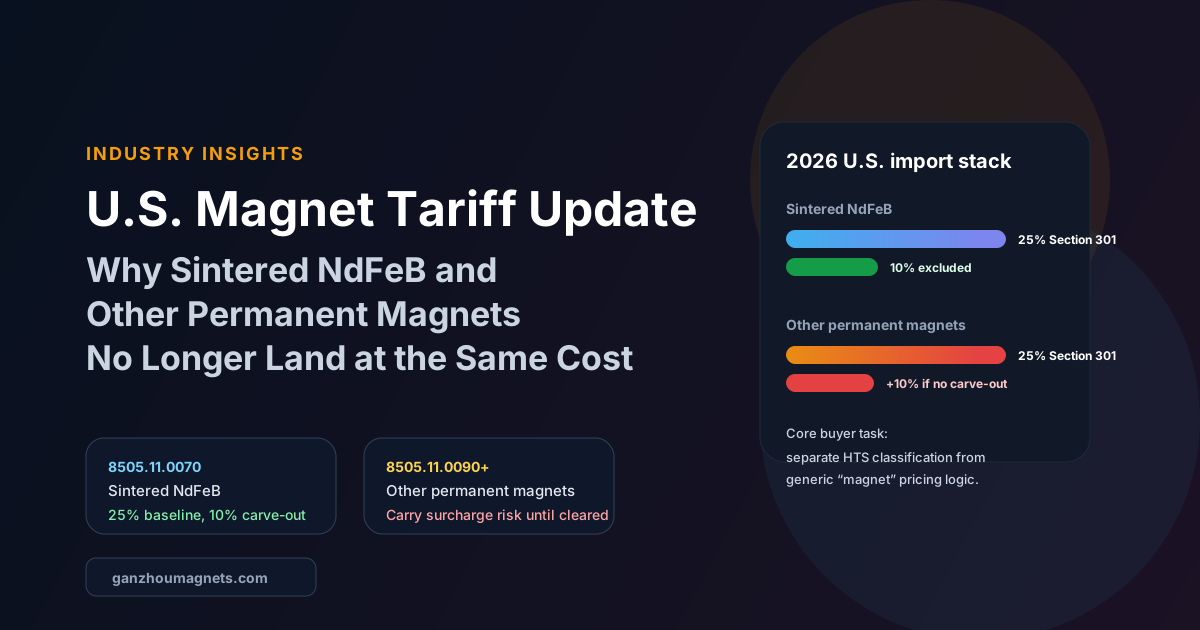
April 2026 U.S. Magnet Tariff Update: Sintered NdFeB Has a Different Surcharge Path
What U.S. importers should do now that the 2026 temporary import surcharge excludes HTS 8505.11.0070 sintered NdFeB magnets, while the broader 2026 Section 301 tariff on permanent magnets remains in force.

From Prototype to Mass Production: The OEM Custom Magnet Guide
Step-by-step guide for first-time buyers sourcing custom magnets from China. Covers the 7-step process from specification to mass production, including MOQ, testing, certifications, and logistics.
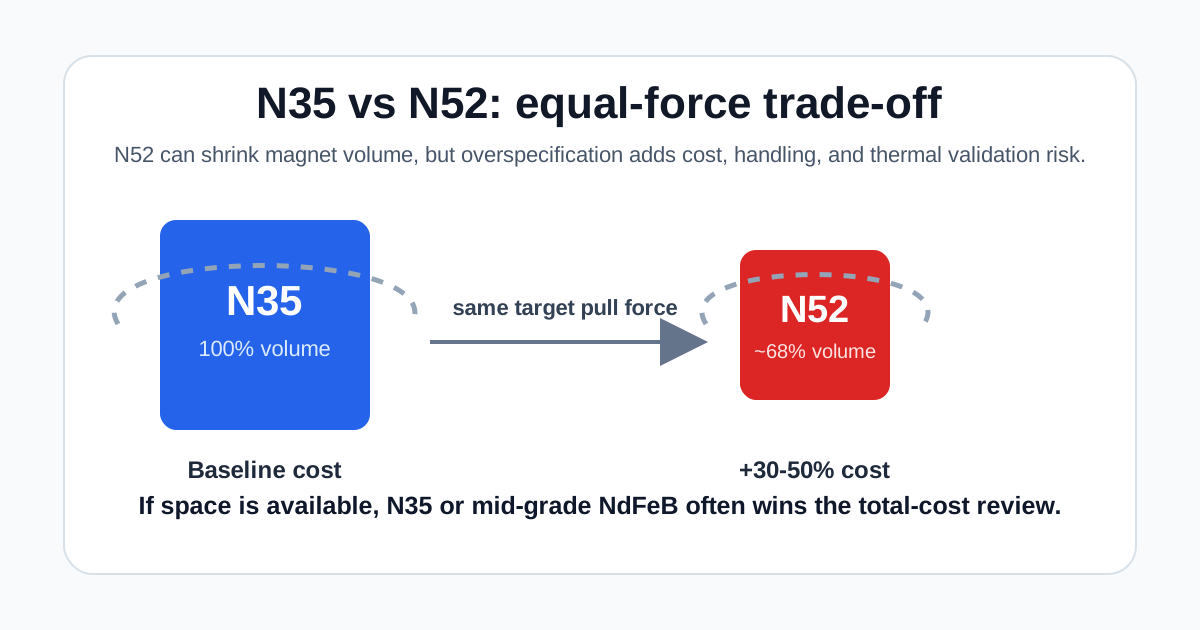
N35 vs N52 Neodymium Magnets: The Hidden Costs of Over-Specification
A comprehensive guide for engineers and procurement teams comparing N35 and N52 neodymium magnets. Learn how to avoid the hidden costs of over-specification.