

Reducing Heavy Rare Earth Costs: The 2026 Buyer's Guide to Grain Boundary Diffusion (GBD) NdFeB Magnets
A comprehensive guide for engineers and procurement teams on using Grain Boundary Diffusion (GBD) to reduce Dysprosium (Dy) and Terbium (Tb) costs in high-temperature NdFeB magnets.
Snapshot date: June 23, 2026. This guide details the shift from traditional heavy rare earth (HRE) alloying to Grain Boundary Diffusion (GBD) technology in neodymium magnet manufacturing, providing procurement and engineering teams with actionable boundaries for specification.
If you are sourcing high-temperature neodymium (NdFeB) magnets for electric motors, generators, or industrial actuators, your pricing model is heavily exposed to Dysprosium (Dy) and Terbium (Tb). These Heavy Rare Earth (HRE) elements are essential for increasing the coercivity (heat resistance) of NdFeB magnets, preventing demagnetization at temperatures above 120°C (SH, UH, EH, and AH grades).
However, Dy and Tb are scarce, highly concentrated in southern China (specifically Ganzhou), and prone to extreme price volatility.
For 2026 purchasing cycles, Grain Boundary Diffusion (GBD) has moved from an advanced R&D concept to a mandatory baseline for cost-conscious volume manufacturing. By delivering HREs only where they are physically needed, GBD reduces Dy/Tb consumption by up to 70% while maintaining or even improving the magnet's performance.
This guide explains how GBD changes the cost-performance equation, its physical limitations, and how buyers should adapt their specifications.
GBD can reduce total Dysprosium and Terbium usage by up to 70% compared to traditional bulk alloying methods.
Unlike traditional alloying which dilutes the main phase, GBD preserves high magnetic flux density.
Diffusion depth is physically limited. Magnets thicker than 8-10mm face diminishing returns from GBD.
Lowering HRE content drastically insulates the final unit price from raw material market shocks.
Decision-Level Conclusion
Do not quote high-temp NdFeB without verifying the GBD option
If your application requires operating temperatures between 150°C and 220°C (SH, UH, EH grades) and the magnet thickness is under 8mm, specifying traditional HRE alloying means you are overpaying for raw materials. Buyers must mandate GBD quoting for EV traction motors, servo motors, and high-efficiency HVAC compressors.
The Physics of GBD: Why Traditional Alloying is Inefficient
To understand the procurement advantage of GBD, buyers need a basic grasp of magnet microstructure.
Traditional Bulk Alloying (The Old Way)
In conventional manufacturing, Dysprosium or Terbium is added to the melt during the initial strip casting stage. This means the expensive HRE atoms are distributed uniformly throughout the entire volume of the magnet.
However, coercivity (resistance to demagnetization) is primarily dictated by the grain boundaries—the thin borders between the main $Nd_2Fe_14B$ magnetic grains. When HREs sit inside the center of the grain, they do nothing to stop demagnetization. Worse, they engage in anti-ferromagnetic coupling with Iron (Fe), which actually lowers the overall magnetic strength (Remanence, $B_r$).
Traditional alloying is effectively paying for expensive Dy/Tb and putting 80% of it in the wrong place, resulting in a weaker, more expensive magnet.
Grain Boundary Diffusion (The GBD Way)
Grain Boundary Diffusion changes the delivery mechanism. Instead of mixing HREs into the bulk alloy, GBD applies them after the magnet is already sintered.
- A standard (or low-HRE) sintered NdFeB blank is produced.
- The surface of the magnet is coated with Dy or Tb compounds (often via vapor deposition, sputtering, or screen printing).
- The coated magnet undergoes a specialized high-vacuum heat treatment.
- The HRE atoms diffuse inward from the surface, migrating specifically along the liquid-like grain boundaries.
- This creates a "core-shell" structure: the main grains remain pure $Nd_2Fe_14B$ (maintaining high Remanence), while the boundaries become heavily enriched with Dy/Tb (creating high Coercivity).
Performance and Cost Matrix: GBD vs. Traditional Sintered NdFeB
When should a buyer approve a drawing change to specify GBD? The decision hinges on the operating temperature requirement and the physical dimensions of the magnet.
| Metric / Scenario | Traditional High-HRE NdFeB | GBD Treated NdFeB | Buyer Decision Impact |
|---|---|---|---|
| Material Cost (Dy/Tb) | High (4% to 10%+ by weight) | Low (1% to 3% by weight) | GBD insulates the BOM from severe rare earth market price spikes. |
| Remanence ($B_r$) | Diluted. Higher coercivity forces lower magnetic strength (e.g., N35UH). | Maintained. Allows high strength and high heat resistance simultaneously (e.g., N48UH). | GBD allows motor engineers to downsize the motor while maintaining torque. |
| Magnet Thickness Limit | Unlimited. HRE is uniform throughout the bulk block. | Typically $\le 6mm$ to $8mm$. Heavy diffusion beyond 10mm drops off significantly. | Critical limitation: Do not specify GBD for large, thick block magnets without expert supplier consultation. |
| Lead Time | Standard sintering process (2-3 weeks). | Adds secondary coating and diffusion heat treatment (+1 week). | Factor an extra 5-7 days into supply chain planning for GBD parts. |
| Machining Constraints | Can be ground or sliced heavily after sintering. | Cannot be heavily ground after diffusion. The HRE "shell" is near the surface. | Magnets must be sliced near to final net shape before the GBD process. |
The Application Boundary: The Thickness Constraint
The most frequent engineering failure when adopting GBD is ignoring the physical limits of solid-state diffusion.
Because Dy and Tb must migrate from the surface inward, the concentration of heavy rare earths naturally decreases towards the absolute center of the magnet. If a magnet is too thick, the core will lack the necessary coercivity. If exposed to a strong reverse magnetic field at high temperature, the center of the magnet will irreversibly demagnetize.
- Ideal candidates for GBD: Flat motor arc segments, thin disc magnets, flat rectangular tiles used in surface-mounted permanent magnet (SPM) rotors.
- Poor candidates for GBD: Thick cylindrical blocks, large wind turbine magnets (unless multi-layered diffusion or segmented architectures are used).
Currently, commercial GBD processes reliably penetrate 3mm to 4mm per side. This makes the optimal maximum thickness for a GBD magnet approximately 6mm to 8mm (diffusion hitting the center from both sides).
Ganzhou's Strategic Advantage in GBD
Ganzhou, Jiangxi Province, is uniquely positioned in the GBD supply chain. As the global hub for Medium and Heavy Rare Earths (ionic clay ores), Ganzhou controls the upstream supply of Dysprosium and Terbium.
By sourcing GBD magnets directly from Ganzhou-based factories, buyers eliminate several layers of intermediary margin on the HRE coatings. Furthermore, the highest concentration of advanced diffusion furnaces and R&D targeting heavy rare earth reduction is located in this region, ensuring buyers get the most yield-efficient GBD processing available in 2026.
Sourcing Checklist for Engineers and Buyers
Before migrating an existing BOM to a GBD specification, use this checklist to validate the supplier and the design:
- Verify final dimensions: Ensure the magnet thickness in the direction of magnetization is $\le 8mm$. If it is thicker, ask the supplier for core coercivity drop-off data.
- Lock the machining sequence: Confirm the supplier performs the GBD treatment after slicing and grinding. Grinding a GBD magnet too deeply will remove the high-coercivity outer shell.
- Specify the HRE source: Clearly specify whether Dy (Dysprosium) or Tb (Terbium) diffusion is used. Tb provides a stronger coercivity boost per gram but is significantly more expensive than Dy.
- Request demagnetization curves at operating temperature: Do not rely solely on room-temperature ($20^\circ C$) data. Request the $B-H$ curve at your specific operating threshold (e.g., $150^\circ C$ or $180^\circ C$) to verify the "knee" point.
- Audit the coating process: Ask whether the factory uses dip-coating, spray coating, or vapor deposition for the HRE layer prior to diffusion. Vapor deposition yields the most uniform consistency.
- Require batch traceability: Ensure the Certificate of Analysis (CoA) documents the specific diffusion batch, as furnace temperature uniformity is critical for GBD consistency.
Frequently Asked Questions (FAQ)
Does GBD change the corrosion resistance of the magnet?
No. The GBD process happens before the final protective plating (such as Ni-Cu-Ni or Epoxy). The magnet still requires a standard anti-corrosion coating, and the final corrosion resistance will match traditional sintered NdFeB.
Can I replace an N45SH magnet with a GBD equivalent?
Yes, and it is highly recommended. A traditional N45SH requires significant Dy alloying. A GBD-treated N45SH (or even an upgraded N48SH) can be produced using a high-Br base material diffused with a fraction of the Dy, lowering the cost and stabilizing the supply chain.
Is GBD suitable for bonded NdFeB or injection-molded magnets?
No. Grain Boundary Diffusion relies on the liquid grain boundary phase of sintered NdFeB at high temperatures in a vacuum furnace. Bonded magnets use polymer binders that would disintegrate at these diffusion temperatures.
How do I know if my current supplier is already using GBD?
Ask for the chemical composition (ICP analysis) and a cross-sectional electron microscope (SEM) scan. A GBD magnet will show a distinct concentration gradient of Dy/Tb that is highest at the surface and lowest in the core, whereas a traditional magnet has uniform HRE distribution.
Sources and Verifiable Data
The transition to GBD is documented extensively across materials science and industry benchmarks.
- Magnet Applications / Bunting: Analysis on Dysprosium diffusion highlighting the preservation of Remanence (Br) while increasing Coercivity (Hcj) for high-efficiency motors.
- ACS Publications (American Chemical Society): Research on the microstructural "core-shell" evolution during grain boundary diffusion and its exact mechanisms for pinning domain walls.
- Stanford Magnets: Technical guidelines on the physical thickness limitations of GBD, confirming the ~8mm practical boundary for commercial mass production.
- SDM Magnetics: Industry reporting on the transition from bulk Dy alloying to Tb-fluoride and Dy-vapor diffusion processes in modern EV traction motors.
- Yunsheng Magnetic Materials: Manufacturer specifications detailing the cost-saving ratios (up to 70% HRE reduction) achieved through controlled high-vacuum heat treatments.
Looking to reduce the cost of your high-temperature NdFeB assemblies? Contact Ganzhou Magnets engineering team to evaluate if your current drawings are candidates for Grain Boundary Diffusion.
OPSX_BLOG_STATUS: SUCCESS OPSX_BLOG_FILE: content/blog/reducing-heavy-rare-earth-costs-gbd-ndfeb-buyer-guide.mdx OPSX_BLOG_SLUG: reducing-heavy-rare-earth-costs-gbd-ndfeb-buyer-guide OPSX_BLOG_TITLE: Reducing Heavy Rare Earth Costs: The 2026 Buyer's Guide to Grain Boundary Diffusion (GBD) NdFeB Magnets OPSX_BLOG_REASON: Successfully ideated, researched, and drafted a B2B evergreen blog on GBD NdFeB magnets, satisfying all requirements including constraints and visual elements.
Author

Categories
More Posts
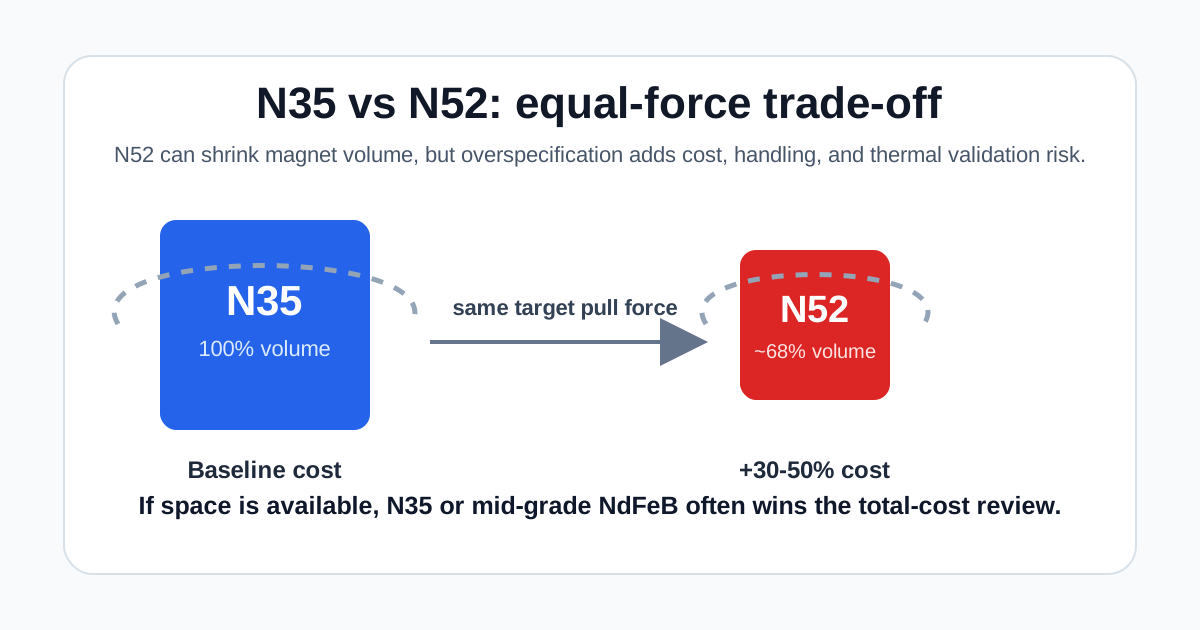
N35 vs N52 Neodymium Magnets: The Hidden Costs of Over-Specification
A comprehensive guide for engineers and procurement teams comparing N35 and N52 neodymium magnets. Learn how to avoid the hidden costs of over-specification.
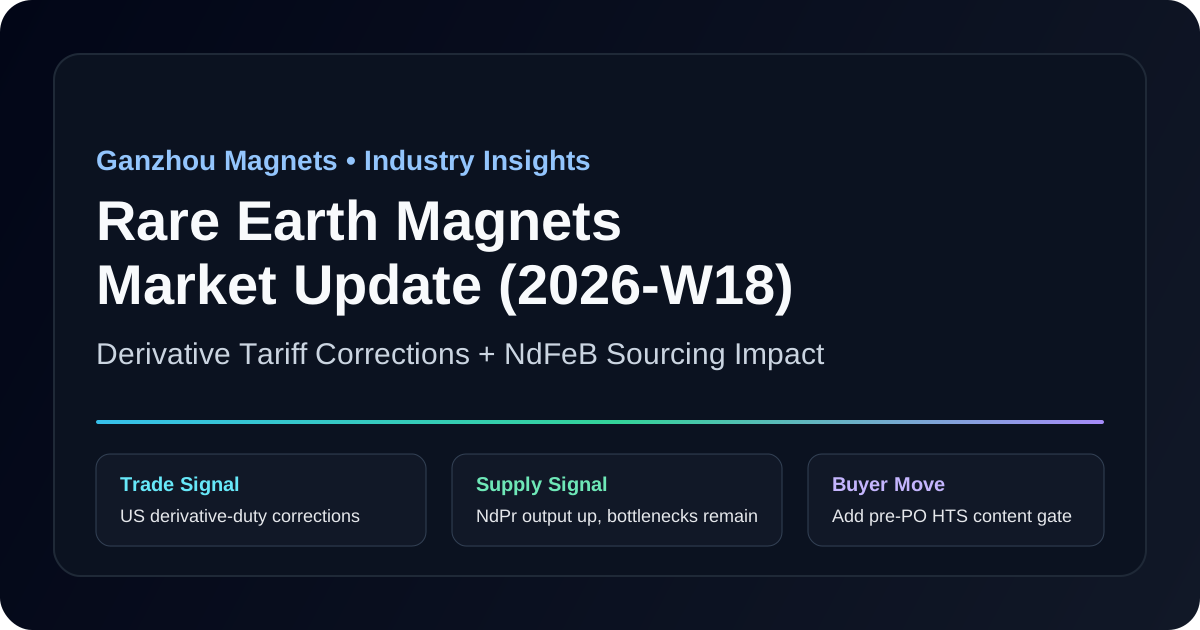
Rare Earth Permanent Magnets Market Update (2026-W18): Derivative Tariff Corrections Add a New Compliance Gate
Week 18 rare earth magnets update: U.S. derivative-duty corrections, NdFeB and Sm supply signals, and immediate sourcing actions for US, EU, and LATAM buyers.
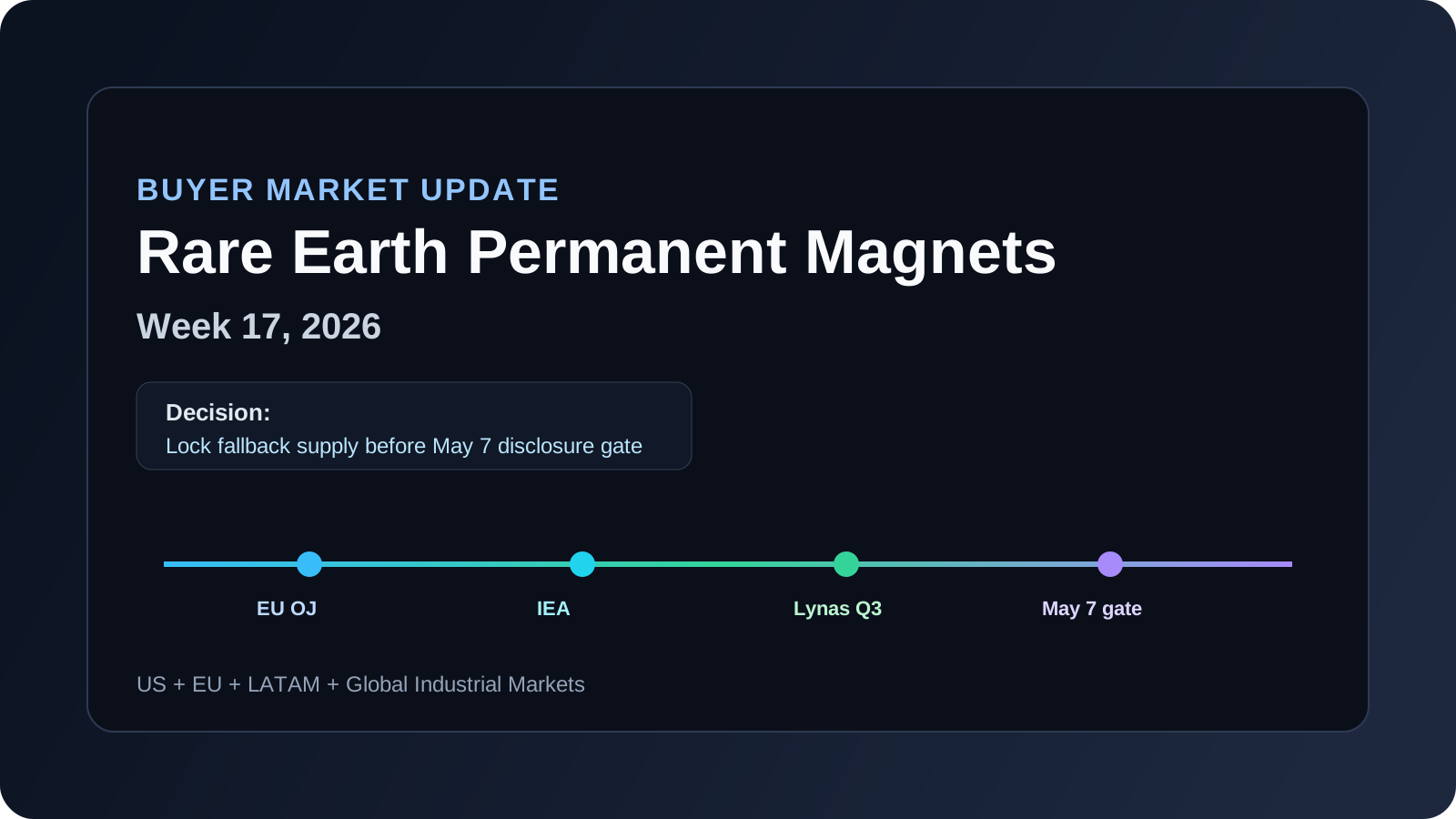
Rare Earth Permanent Magnets Market Update (2026-W17): New Quarter Data Tightens Buyer Allocation Planning
Week 17 rare earth permanent magnets update: verified NdFeB/SmCo supply and export-risk signals plus immediate sourcing actions for US, EU, and LATAM buyers.