
N35 vs N52 Neodymium Magnets: The Hidden Costs of Over-Specification
A comprehensive guide for engineers and procurement teams comparing N35 and N52 neodymium magnets. Learn how to avoid the hidden costs of over-specification.
Snapshot date: July 25, 2026. This guide provides an in-depth comparison of N35 and N52 grade Neodymium (NdFeB) magnets, highlighting the thermal, mechanical, and financial implications of over-specification in industrial and commercial applications.
In the realm of magnetic assembly design, one of the most common and costly mistakes occurs at the very beginning of the engineering phase: the default selection of the "strongest" available magnet grade. For Neodymium-Iron-Boron (NdFeB) magnets, this typically manifests as an engineer selecting N52 from a drop-down menu in their CAD software, rather than the industry standard N35.
While it is true that N52 is the strongest commercially available grade of neodymium magnet, specifying it when it is not strictly required triggers a cascade of hidden costs, supply chain vulnerabilities, and even premature mechanical failures. For procurement teams and engineering managers, understanding the precise differences between N35 and N52—and knowing when to push back on an N52 specification—is a critical skill that can reduce bill of material (BOM) costs by up to 40%.
This comprehensive guide dissects the physical, thermal, and economic realities of N35 vs. N52 magnets, providing you with the exact boundaries and frameworks needed to optimize your magnetic assemblies.
Scope, Assumptions, and Use Case Boundaries
This guide is a screening framework for sintered NdFeB N-grade magnets in industrial, commercial, and OEM assemblies as of July 25, 2026. It compares common N35 and N52 trade-offs using public grade tables, datasheet conventions, and procurement review patterns. It does not replace finite-element magnetic modeling, load-line demagnetization analysis, coating qualification, or a drawing-level RFQ.
Use it when you need to challenge an N52 callout before supplier quoting. Do not use it as the final authority for bonded NdFeB, Halbach arrays, medical implants, aerospace-certified designs, or high-temperature suffix grades such as N52H, N52SH, N35UH, or N35EH without application-specific validation. If a drawing already specifies N52, send the operating temperature, geometry, coating, and target pull-force test to Ganzhou Magnets before locking the BOM.
N52 magnets typically cost significantly more than N35 due to tighter manufacturing tolerances and higher scrap rates.
N52 offers roughly 45-50% more Maximum Energy Product (BHmax) compared to a standard N35 magnet of identical volume.
Maximizing remanence (Br) in N52 often comes at the expense of intrinsic coercivity, making them more prone to thermal demagnetization.
The immense attractive forces of N52 make handling, assembly, and bonding significantly more hazardous and prone to shattering.
Decoding the Grades: What Do N35 and N52 Actually Mean?
Before diving into the procurement implications, it is essential to understand the nomenclature of NdFeB magnets.
The letter "N" simply stands for Neodymium (technically referring to the NdFeB alloy). The number that follows—35 or 52—represents the magnet's Maximum Energy Product, denoted as (BH)max, measured in MegaGauss-Oersteds (MGOe).
- N35: Has a Maximum Energy Product of approximately 35 MGOe.
- N52: Has a Maximum Energy Product of approximately 52 MGOe.
The (BH)max is an indicator of the overall "strength" or magnetic energy density of the material. A higher number means the magnet can generate a stronger magnetic field for a given volume. Therefore, an N52 magnet is mathematically about 48% stronger than an N35 magnet of the exact same dimensions.
However, magnetic pull force is not entirely linear. The actual pull force you experience depends heavily on the geometry of the magnet (e.g., a thin disc vs. a tall cylinder) and the interaction with the ferromagnetic target (e.g., steel thickness). In real-world applications, upgrading from N35 to N52 might yield a 40% increase in pull force, but it will never double it.
The Visual Reality of Flux Density
To understand why N52 is specified, we must look at magnetic flux density. N52 is designed for miniaturization. When physical space is the absolute bottleneck—such as in smartphone speakers, microscopic sensors, or high-performance aerospace actuators—you must squeeze the maximum possible magnetic flux out of a microscopic volume.
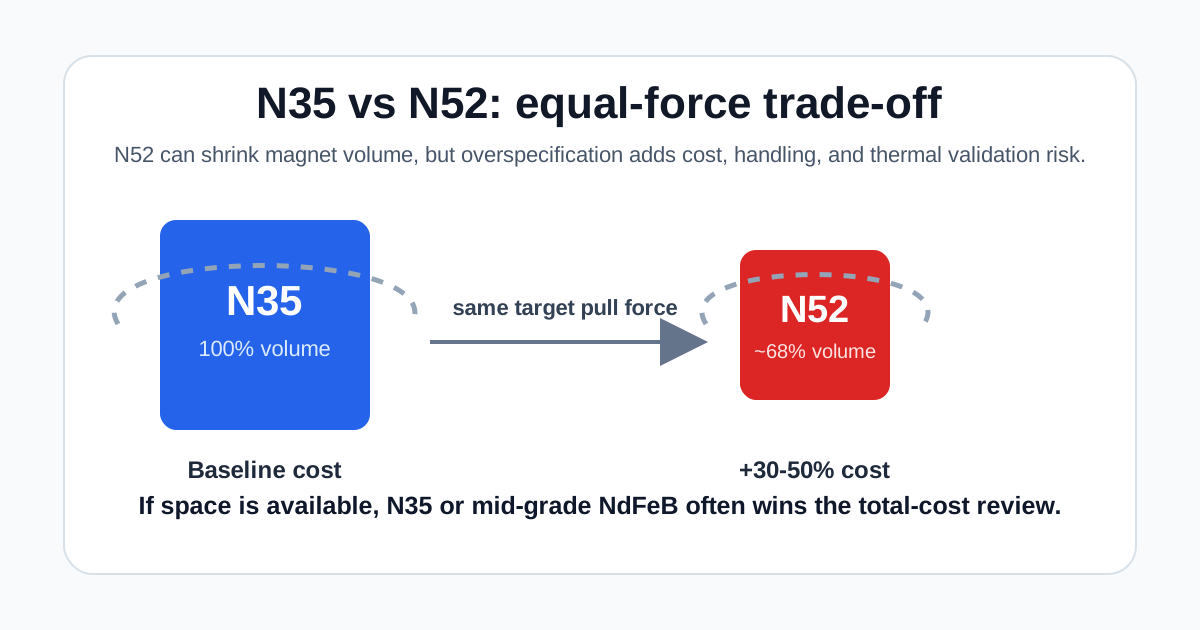
If your application has room for a magnet that is 2mm thicker or 3mm wider, you can achieve the exact same holding force using N35 as you would with a smaller N52, while saving significant costs.
The 4 Hidden Penalties of Specifying N52
When an N52 magnet is specified unnecessarily, the organization pays four distinct penalties.
1. The Raw Material and Yield Cost Penalty
Manufacturing an N52 magnet is not simply a matter of pouring a different mixture. Achieving a 52 MGOe energy product requires the highest purity of raw neodymium, precise stoichiometric balance, and virtually flawless alignment of the magnetic domains during the pressing and sintering process.
Because N52 pushes the absolute theoretical limits of the NdFeB alloy structure, the manufacturing yield rate (the percentage of magnets that successfully pass QC without internal defects, cracks, or subpar flux density) is lower than that of N35.
Procurement Reality: You are not just paying for more raw neodymium; you are paying for the manufacturer's higher scrap rate. This results in a price premium of 30% to 50% over N35.
2. The Thermal Demagnetization Penalty (The Coercivity Trade-off)
This is the most critical engineering trap. In magnetic materials, there is an inherent inverse relationship between Remanence (Br)—which dictates the maximum strength (MGOe)—and Intrinsic Coercivity (Hcj)—which dictates the magnet's resistance to demagnetization from heat or opposing magnetic fields.
To push an NdFeB magnet to N52, manufacturers must maximize Remanence. Consequently, standard N52 magnets often have less intrinsic coercivity margin than lower-energy or high-temperature suffix grades.
- Standard un-suffixed N35 and N52 datasheets are commonly listed around 80°C (176°F) maximum operating temperature.
- That number is a guideline, not a guarantee: thin geometry, a weak load line, adhesive or coating cure heat, and opposing magnetic fields can make an N52 design require validation well below the nominal maximum.
If an engineer specifies N52 for an electric motor or a sensor that sits in a hot industrial environment, the magnet may permanently weaken once operating temperature and opposing field stress exceed the design's load-line margin. To fix this, you must specify an N52M, N52H, or higher-temperature suffix variant, which can require Heavy Rare Earth additions such as Dysprosium or Terbium and push the cost up sharply. Alternatively, an N35SH or N42SH route may solve the thermal problem with lower material and yield risk.
3. The Brittleness and Assembly Penalty
All neodymium magnets are sintered ceramics, making them inherently brittle. However, N52 magnets pose a uniquely hazardous assembly challenge. Their extreme pull force means that if two N52 magnets are allowed to jump together, or if an N52 magnet snaps against a steel stator, the impact velocity is vastly higher than N35.
This results in a high incidence of chipped coatings and shattered magnets on the assembly line. A microscopic chip in the Nickel-Copper-Nickel coating exposes the inner NdFeB alloy to oxygen and moisture, leading to rapid corrosion, swelling, and eventual catastrophic failure of the assembly.
4. The Supply Chain and MOQ Penalty
N35 is the global workhorse. It is produced in millions of tons, widely stocked by every major magnet factory, and easily sourced with low Minimum Order Quantities (MOQs). N52, while common, is considered a premium grade. Manufacturers generally produce it on-demand for specific client orders. This translates to longer lead times and significantly higher MOQs.
Structural Comparison: N35 vs. N52 Data Table
The following table provides a quantifiable comparison for procurement and design engineers to utilize during the specification review phase.
| Specification / Attribute | N35 Grade (Industry Standard) | N52 Grade (Premium High-Strength) |
|---|---|---|
| Max Energy Product (BHmax) | 33 - 36 MGOe | 49 - 53 MGOe |
| Residual Magnetic Flux (Br) | 11,700 - 12,200 Gauss | 14,200 - 14,800 Gauss |
| Intrinsic Coercivity (Hcj) | ≥ 12,000 Oersteds | ≥ 11,000 Oersteds (Often lower than N35) |
| Standard Max Operating Temp | Commonly listed around 80°C (176°F) | Commonly listed around 80°C, but needs geometry and load-line validation |
| Relative Cost (Volume Basis) | Baseline (1.0x) | 1.3x to 1.5x Premium |
| Machining & Yield Scrap Rate | Standard / Low | Higher due to strict tolerance limits |
| Ideal Application Scenario | General industrial, closures, sensors, consumer goods | Micro-motors, aerospace, high-end electronics |
(Note: Values represent typical commercial averages. Exact parameters vary by manufacturer and specific testing conditions).
The Procurement & Engineering Pushback Checklist
When an engineering drawing crosses the procurement desk calling for an "N52 Neodymium Magnet," buyers should not blindly send it out for RFQ. Use this checklist to initiate a constructive review with the engineering team.
N52 Specification Audit Checklist
- 1. Is the design strictly volume-constrained? Ask Engineering: "Can we increase the magnet's diameter by 2mm or thickness by 1mm? If yes, we can achieve the same force with N35 and save 35% on part cost."
- 2. What is the maximum ambient operating temperature? Ask Engineering: "Does this assembly exceed 60°C in the field? If so, standard N52 might suffer irreversible demagnetization. We should look at N42SH or N35UH instead."
- 3. Have we considered the "Sweet Spot" grades (N42 or N45)? Ask Engineering: "If N35 isn't strong enough, can we model N42 or N45? These grades offer a significant strength boost without the extreme yield-cost penalties of N52."
- 4. What is the assembly and handling protocol? Ask Engineering: "N52 magnets are highly prone to shattering during automated or manual assembly. Have we accounted for increased scrap rates on the production floor?"
- 5. Does the application involve opposing magnetic fields? Ask Engineering: "In motor applications, opposing fields can demagnetize the magnet. Have we checked the loadline and required intrinsic coercivity (Hcj)? N52 might be the wrong choice entirely."
FAQ: Common Misconceptions About Magnet Grades
Q: Will an N52 magnet last longer than an N35 magnet? A: No. Permanent magnets lose only a fraction of a percent of their magnetism every 10 years under normal conditions. N52 does not have a longer "lifespan"; it simply has a higher initial energy density. In fact, if exposed to heat, an N52 might fail faster than an N35 due to its lower thermal stability.
Q: Can I replace an N35 magnet directly with an N52 of the same size to upgrade my product? A: You can, and the magnetic pull will increase by roughly 40-50%. However, this can cause unintended mechanical issues. For example, if you replace the N35 magnets in a magnetic clasp or holding fixture with N52, the force required by the user to pull them apart might become ergonomically impossible, or the extreme force could rip the magnets out of their adhesive housing.
Q: Why don't they make N60 or N70 neodymium magnets? A: The theoretical maximum energy product for the Nd2Fe14B crystal structure is estimated to be around 64 MGOe. Currently, N54 and N55 are the absolute highest commercially achievable grades, but they are incredibly expensive, fragile, and sensitive to temperature. Breaking past this requires discovering an entirely new magnetic alloy.
Optimize Your Magnetic Assembly
Stop Overpaying for N52 Magnet Specifications
Are you experiencing high raw material costs or unexpected thermal demagnetization in your electric motors, sensors, or magnetic assemblies? Our engineering team specializes in grade optimization. By analyzing your flux density requirements, we can often recommend geometry changes or alternative grades (like N42 or N35SH) that drastically reduce your BOM costs without sacrificing performance.
Sources & References
To ensure the highest level of engineering accuracy, the performance metrics and thermal limitations discussed in this guide are corroborated by the following industry standards:
- Arnold Magnetic Technologies: Neodymium Magnets (NdFeB) - Grade table data for Br, HcB, HcJ, BHmax, and maximum operating temperature across available Neo grades.
- Arnold Magnetic Technologies: N52 material datasheet - N52 demagnetization curve notes and the reminder that magnetic properties vary by product shape and size.
- Eclipse Magnetics: NdFeB Neodymium Iron Boron standard range datasheet - Temperature suffix classes and guidance that operating-temperature ratings are guideline values.
Author

Categories
More Posts
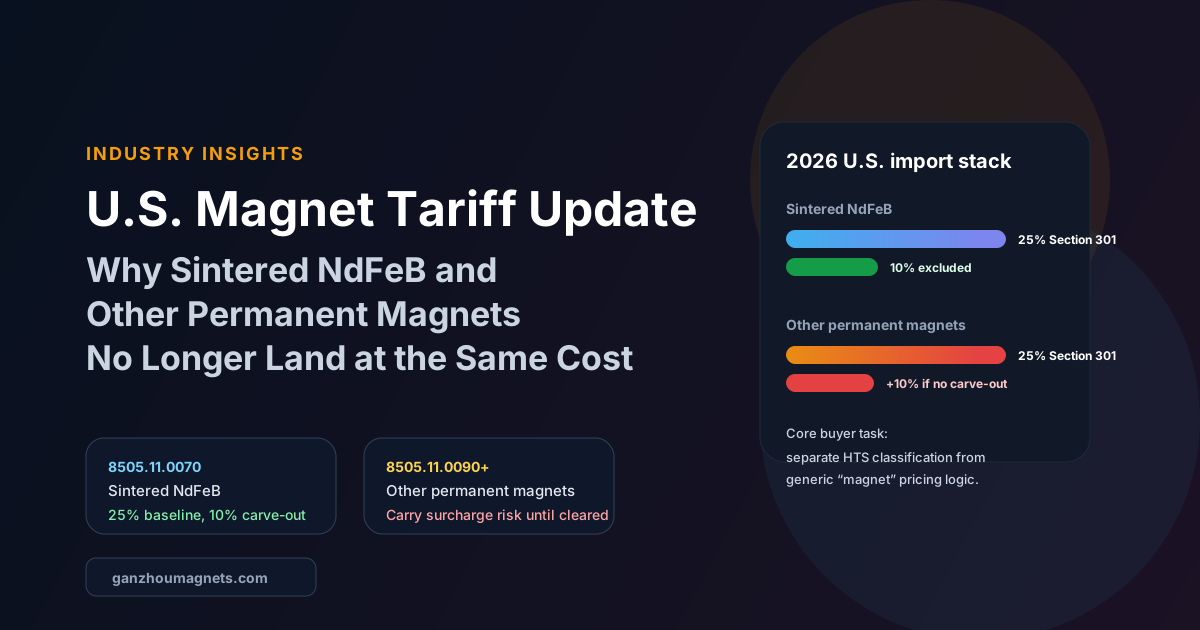
April 2026 U.S. Magnet Tariff Update: Sintered NdFeB Has a Different Surcharge Path
What U.S. importers should do now that the 2026 temporary import surcharge excludes HTS 8505.11.0070 sintered NdFeB magnets, while the broader 2026 Section 301 tariff on permanent magnets remains in force.

Reducing Heavy Rare Earth Costs: The 2026 Buyer's Guide to Grain Boundary Diffusion (GBD) NdFeB Magnets
A comprehensive guide for engineers and procurement teams on using Grain Boundary Diffusion (GBD) to reduce Dysprosium (Dy) and Terbium (Tb) costs in high-temperature NdFeB magnets.
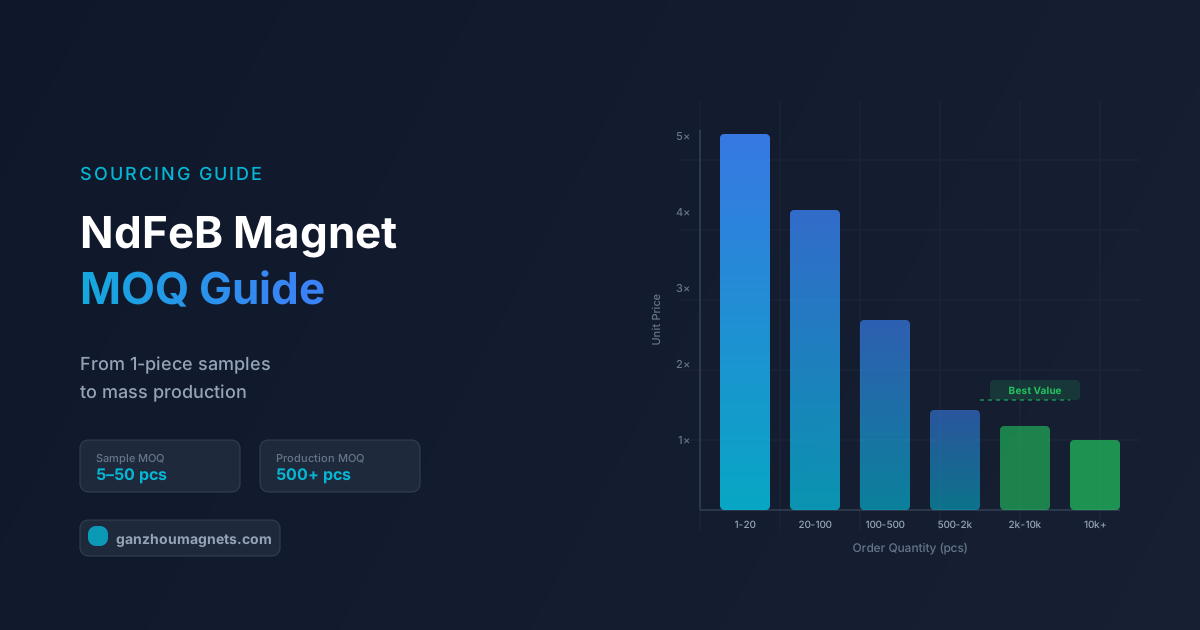
Guía de MOQ para imanes NdFeB: De muestras de 1 pieza a producción en masa
Comprenda las cantidades mínimas de pedido para imanes de neodimio personalizados de proveedores chinos. Incluye pedidos de muestra, prototipos y puntos de precio por volumen.