
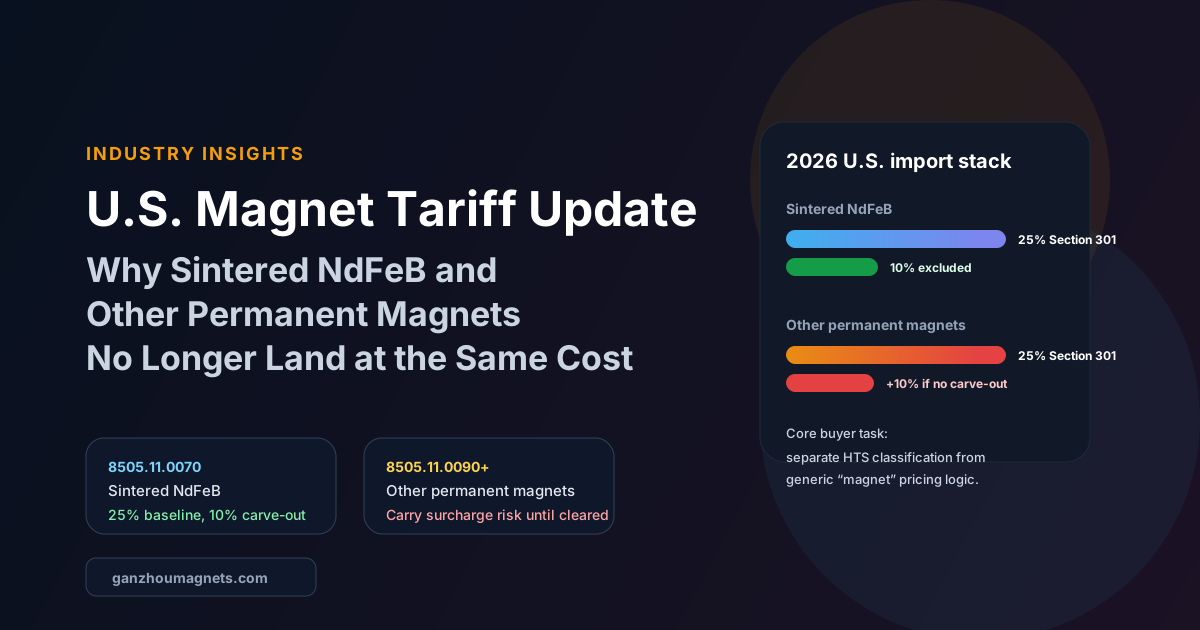
April 2026 U.S. Magnet Tariff Update: Sintered NdFeB Has a Different Surcharge Path
What U.S. importers should do now that the 2026 temporary import surcharge excludes HTS 8505.11.0070 sintered NdFeB magnets, while the broader 2026 Section 301 tariff on permanent magnets remains in force.
Snapshot date: April 3, 2026. This page uses official or issuer-primary sources. Where the page moves from source text to a sourcing recommendation, that recommendation is labeled as interpretation.
If you import magnets into the United States, the most important April 2026 signal is not a generic rare-earth price headline. It is a tariff classification split:
- the 2026 Section 301 tariff on permanent magnets under
8505.11.00is already active - the temporary 10% import surcharge effective February 24, 2026 does not apply to every product in the same way
- Annex II to the White House proclamation specifically lists
8505.11.0070for sintered neodymium-iron-boron magnets
That means buyers should stop talking about "magnet tariffs" as if all NdFeB imports now land at the same cost.
USTR says permanent magnets under 8505.11.00 move to a 25% tariff rate in 2026.
The White House temporary import surcharge took effect on February 24, 2026 for 150 days.
Annex II explicitly lists sintered NdFeB magnets among products not covered by the temporary surcharge.
MP Materials has started U.S. NdFeB production, but broad replacement capacity still lags near-term buying cycles.
Decision-Level Conclusion
Do not quote all permanent magnets as if the same 2026 surcharge stack applies
If your part is truly classified as 8505.11.0070, the temporary 10% surcharge has a different treatment than many buyers assume. If your part falls under a different permanent-magnet line, especially 8505.11.0090, your landed-cost model may still be carrying both the 2026 Section 301 burden and the temporary surcharge unless another exemption applies.
What changed, exactly
| Question | Source-backed answer | Why it changes a buyer decision |
|---|---|---|
| When did the new temporary surcharge start? | The White House proclamation says the 10% ad valorem surcharge became effective February 24, 2026 for 150 days. | Quotes after late February need a new duty assumption, not a January-only tariff model. |
| Does Annex II matter for magnets? | Yes. Annex II states that listed HTSUS provisions are not covered by the action, and it explicitly lists 8505.11.0070 Sintered neodymium-iron-boron magnets. | Buyers should split quote logic by tariff line, not by the generic word "magnet." |
| Are permanent magnets still at 25% under Section 301? | Yes. USTR says permanent magnets under 8505.11.00 move to 25% in 2026, applicable for entries on or after January 1, 2026. | The surcharge carve-out does not erase the broader 2026 Section 301 burden. |
| Can U.S. domestic supply fully replace imports right now? | Not yet. The 2023 Commerce/BIS report says the United States was essentially 100% dependent on imported sintered NdFeB and highly dependent on imported bonded NdFeB; MP Materials' 2025 annual report shows domestic magnet production has started, but scaled expansion targets extend into 2028. | Buyers still need a 2026 import strategy, even while U.S. alternatives become more credible. |
The real commercial split is not "magnets" versus "non-magnets"
It is sintered NdFeB under 8505.11.0070 versus other permanent magnets inside or adjacent to the same buying family.
The White House proclamation says the temporary 10% surcharge does not apply to products detailed in Annexes I and II, and Annex II explicitly lists 8505.11.0070. The same Annex also warns that product descriptions are informational only and that only products properly classified in the listed HTSUS provisions are excluded.
That means classification discipline is no longer a back-office formality. It now changes the commercial answer a buyer gets.
Interpretation, not customs advice
If your part is truly classified as 8505.11.0070, your 2026 landed-cost stack is different from a buyer importing a permanent magnet that falls outside that listed line.
If your part is closer to 8505.11.0090 or another non-listed path, the working assumption should be that the temporary surcharge still needs to be carried until your customs broker or CBP confirms otherwise.
Why this is buyer-level material, not policy trivia
The source stack behind the split
1. Section 301 already raised the 2026 baseline
USTR's September 18, 2024 notice says tariff increases for 2025 and 2026 products apply for entries on or after January 1 of the corresponding year. In the permanent-magnets discussion, USTR says the President directed a 25% tariff in 2026 and that the agency determined to impose additional tariffs on products under 8505.11.00.
That is the first layer of the 2026 duty story.
2. Section 122 added a second layer, but not evenly
The White House proclamation dated February 2026 says the United States imposed a 10% temporary import surcharge effective February 24, 2026 for a period of 150 days.
The same proclamation says the surcharge does not apply to products detailed in Annexes I and II, and Annex II lists 8505.11.0070 Sintered neodymium-iron-boron magnets.
So the second layer is not flat across the entire permanent-magnet buying category.
3. The code boundary matters because the product boundary matters
The 2023 Commerce/BIS NdFeB magnet report makes the tariff-code distinction explicit:
8505.11.0070covers sintered NdFeB magnets8505.11.0090covers other permanent magnets of metal, including bonded NdFeB
The same report also explains why the split matters commercially:
- sintered NdFeB is the dominant share of the market
- bonded NdFeB is a smaller, more substitutable segment
- the United States remained essentially 100% dependent on imports of sintered NdFeB
That is why a carve-out for 0070 can change buyer behavior even when the broader permanent-magnet policy still looks restrictive.
What this means for landed cost
| Scenario | What is clearly source-backed | Working commercial interpretation |
|---|---|---|
China-origin 8505.11.0070 sintered NdFeB | 25% Section 301 in 2026; temporary surcharge carve-out verified in Annex II | Your quote should not automatically carry the extra 10% if the classification is correct and no other issue changes treatment |
China-origin 8505.11.0090 or other non-listed permanent magnet path | 25% Section 301 baseline on permanent magnets is source-backed; no matching Annex II exclusion was verified in this review | Carry the 10% temporary surcharge in the working model until broker/CBP confirms a different treatment |
| Buyer treats all NdFeB the same | Not source-backed | This is now the most common quoting mistake |
Why "U.S. domestic capacity is coming" does not erase the 2026 problem
MP Materials' 2025 annual report says it commenced the manufacturing of NdFeB permanent magnets in December 2025 at Independence. The filing also says:
- the Independence facility represents 3,000 MTs per year of magnets
- the 10X facility is expected to begin commissioning in 2028
- combined capacity would reach 10,000 MTs per year after scaling
That is meaningful progress. It is not the same thing as a broad 2026 replacement for every U.S. buyer currently importing China-origin sintered magnets.
For 2026 purchasing, the right reading is:
- U.S. domestic supply is now real enough to qualify
- but not mature enough to erase code-level import strategy
- and not broad enough to justify sloppy tariff assumptions on live orders
A better 2026 buying checklist
- Put the exact HTS line on every quote review.
- Ask suppliers to state whether the magnet is sintered NdFeB or another permanent-magnet path.
- Separate duty assumptions into:
2026 Section 301temporary 10% surcharge- any separate brokerage or customs interpretation notes
- If the part is claimed as
8505.11.0070, get broker confirmation before promising the landed number. - Start qualification of at least one non-China path, but do not pretend that current U.S. output has already solved your 2026 allocation risk.
- For high-temperature grades, treat code classification and supply assurance as two different questions. A good tariff outcome does not automatically mean a secure delivery outcome.
Secondary watchpoint for EU buyers
This page is primarily about the U.S. landed-cost split. A separate March 2026 signal is that the EU Raw Materials Mechanism's first diversification round is taking place in March 2026 and explicitly covers permanent magnets. That does not change a U.S. customs bill today, but it does tell buyers that upstream magnet supply is becoming more policy-managed on both sides of the Atlantic.
Sources
- White House, Imposing a Temporary Import Surcharge To Address Fundamental International Payments Problems, February 2026: https://www.whitehouse.gov/presidential-actions/2026/02/imposing-a-temporary-import-surcharge-to-address-fundamental-international-payments-problems/
- White House, Annex II, line item for
8505.11.0070 Sintered neodymium-iron-boron magnets: https://www.whitehouse.gov/wp-content/uploads/2026/02/2026Section122.prc_.ANNEX2_.Final_.pdf - USTR / Federal Register, Notice of Modification: China's Acts, Policies and Practices Related to Technology Transfer, Intellectual Property and Innovation, September 18, 2024: https://www.federalregister.gov/documents/2024/09/18/2024-21217/notice-of-modification-chinas-acts-policies-and-practices-related-to-technology-transfer
- BIS / Federal Register, Publication of a Report on the Effect of Imports of NdFeB Permanent Magnets on the National Security of the United States, February 14, 2023: https://www.federalregister.gov/documents/2023/02/14/2023-03078/publication-of-a-report-on-the-effect-of-imports-of-neodymium-iron-boron-ndfeb-permanent-magnets-on
- MP Materials, Annual Report for fiscal year ended December 31, 2025, filed February 2026: https://www.sec.gov/Archives/edgar/data/1801368/000180136826000008/mp-20251231.htm
- European Commission, Online webinar: EU Raw Materials Mechanism, February 11, 2026 event page: https://single-market-economy.ec.europa.eu/events/online-webinar-eu-raw-materials-mechanism-2026-02-11_en
OPSX_NEWS_STATUS: SUCCESS OPSX_NEWS_FILE: content/blog/april-2026-us-ndfeb-tariff-gap.mdx OPSX_NEWS_SLUG: april-2026-us-ndfeb-tariff-gap OPSX_NEWS_TITLE: April 2026 U.S. Magnet Tariff Update: Sintered NdFeB Has a Different Surcharge Path OPSX_NEWS_REASON: 已核验美国 2026 永磁体税则分化信号,足以支撑面向买方的窄边界市场更新
Author

Categories
More Posts
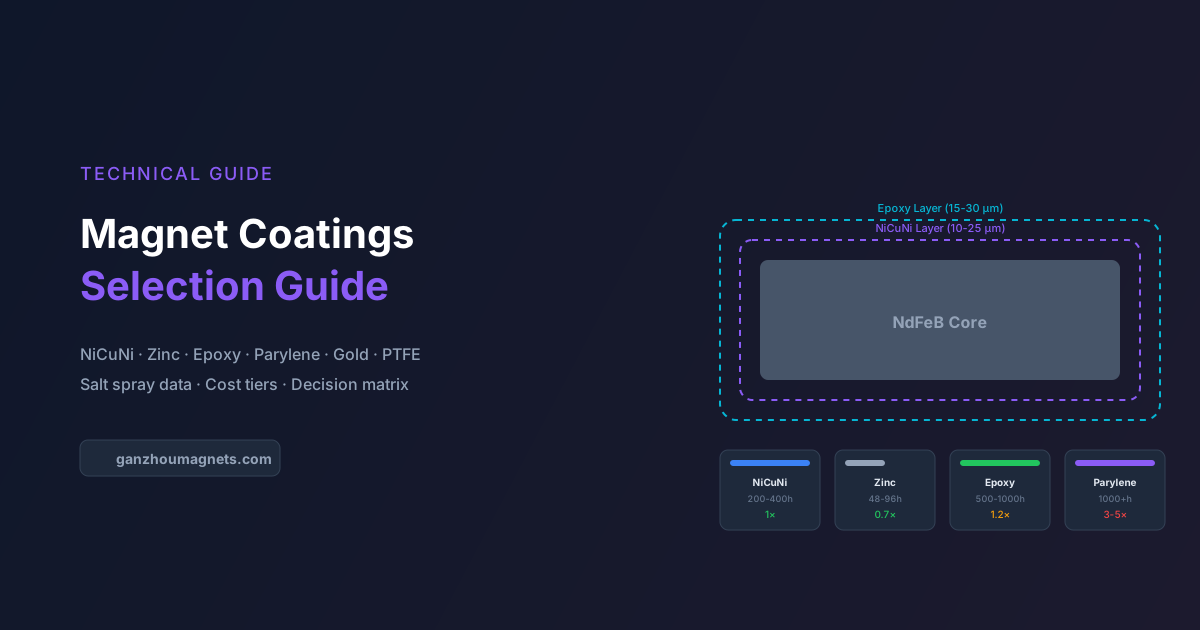
Recubrimientos y tratamientos superficiales de imanes: Guía completa de selección
Comparación detallada de recubrimientos para imanes NdFeB — NiCuNi, zinc, epoxi, parileno, oro y PTFE. Incluye datos de niebla salina, niveles de costo y recomendaciones por aplicación.
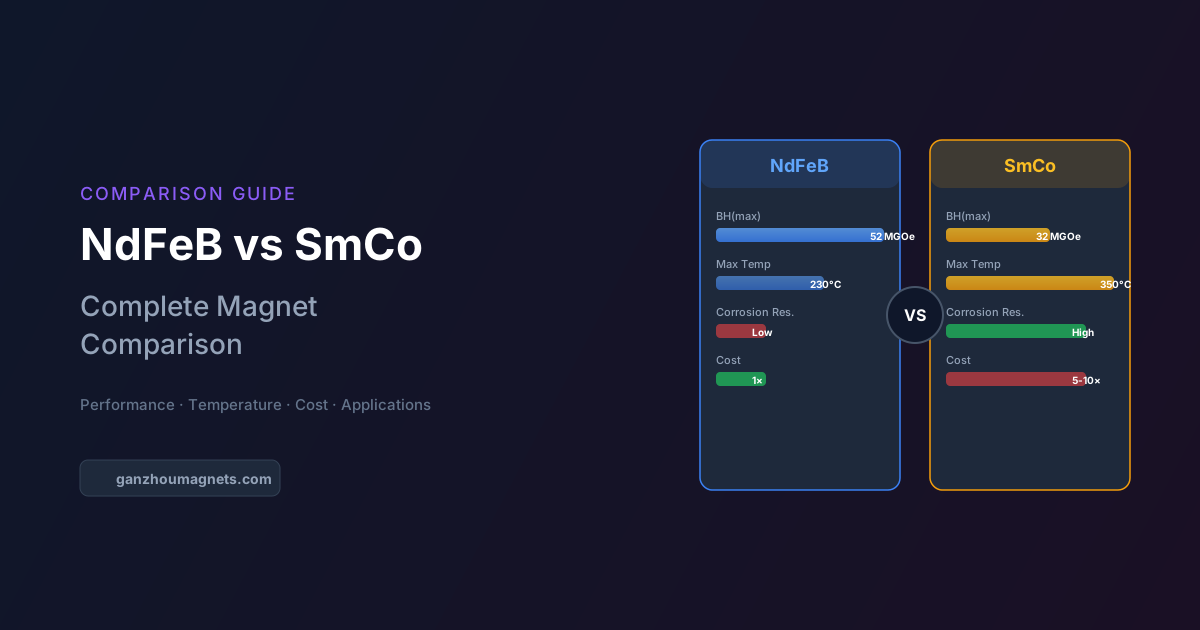
NdFeB vs SmCo: Guía completa de comparación de imanes para ingenieros
Comparación detallada de imanes de neodimio (NdFeB) y samario-cobalto (SmCo) que cubre rendimiento magnético, estabilidad térmica, resistencia a la corrosión, costo y recomendaciones por aplicación.
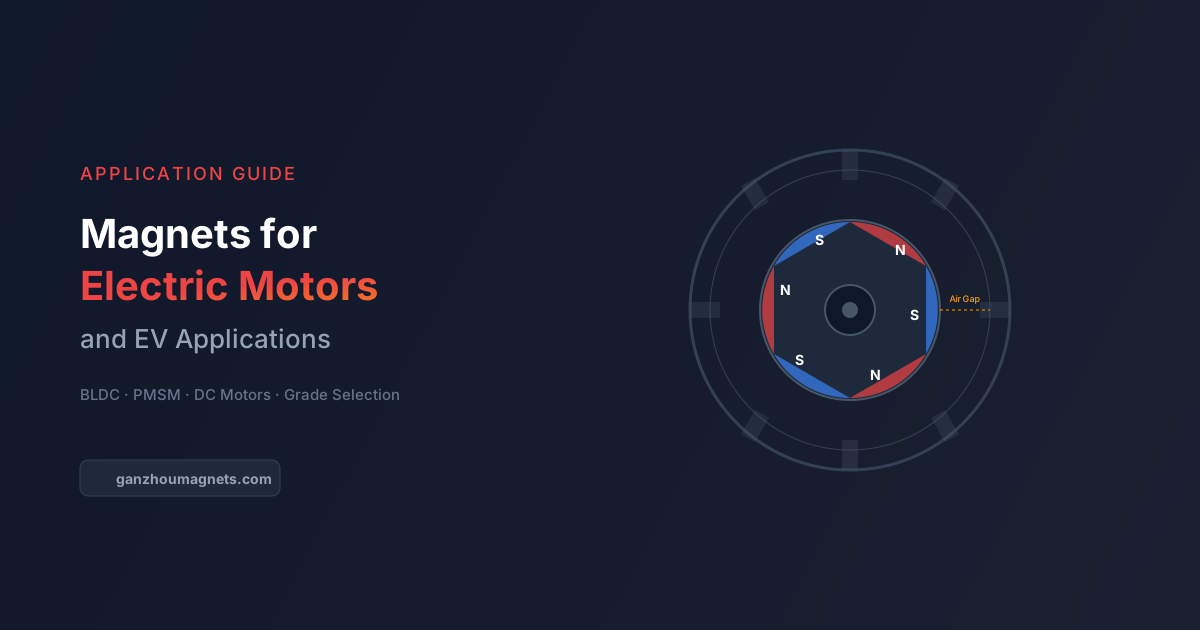
Imanes personalizados para motores eléctricos y aplicaciones EV: Guía de selección
Guía de ingeniería para la selección de imanes NdFeB y SmCo para motores BLDC, PMSM y DC. Cubre selección de grado, análisis de desmagnetización y abastecimiento desde prototipo hasta producción en volumen.