
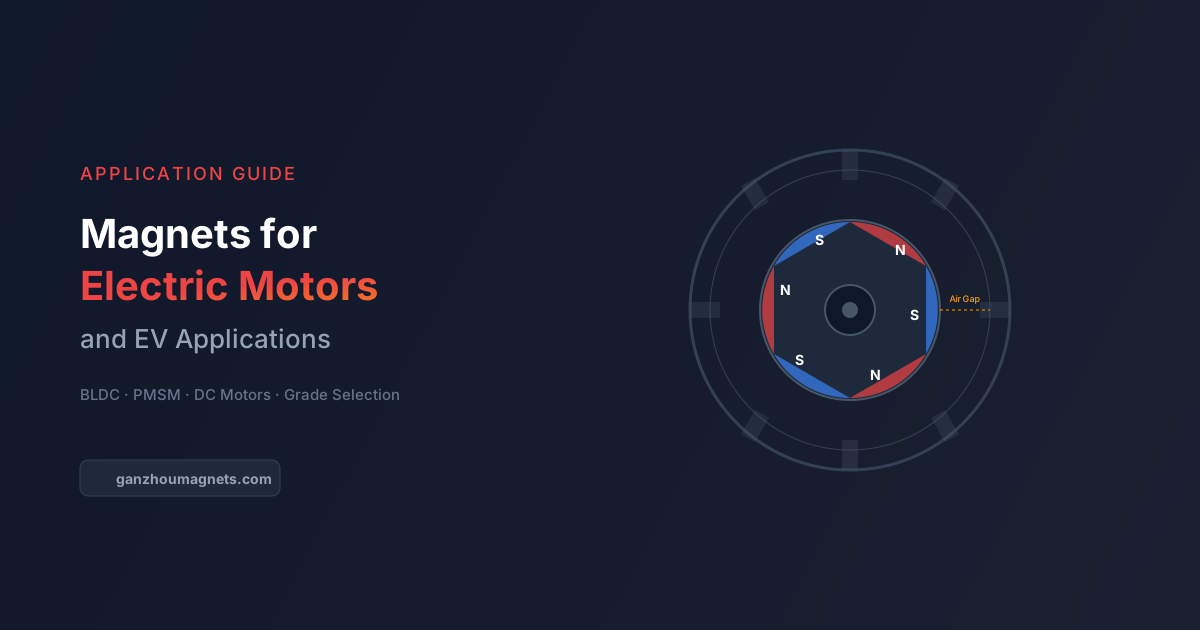
Custom Magnets for Electric Motors and EV Applications: Selection Guide
Engineering guide for selecting NdFeB and SmCo magnets for BLDC, PMSM, and DC motors. Covers grade selection, demagnetization analysis, thermal management, and sourcing from prototype to volume production.
Why Magnets Are Critical to Motor Performance
Permanent magnets define the core performance of brushless DC (BLDC), permanent magnet synchronous motors (PMSM), and brushed DC motors. The magnet selection directly determines:
- Torque density — stronger magnets produce more torque per unit volume
- Efficiency — higher energy product magnets reduce copper losses
- Operating temperature range — grade limits define thermal ceiling
- Cost — magnets are typically 15–30% of motor BOM cost
The global electric vehicle market consumed over 35,000 tonnes of NdFeB magnets in 2025, making EV motor applications the single largest demand driver for rare earth magnets.
Motor Types and Magnet Requirements
BLDC (Brushless DC) Motors
The most common motor type in EV drivetrains, drones, and industrial servo systems.
| Parameter | Typical requirement |
|---|---|
| Magnet shape | Arc segments, bread-loaf |
| Grade | N42SH to N48SH |
| Operating temp | 120–180°C (winding hotspot) |
| Magnetization | Radial (through thickness) |
| Key tolerance | Arc radius ±0.05 mm, parallelism ±0.03 mm |
PMSM (Permanent Magnet Synchronous Motors)
Used in high-efficiency industrial drives and EV traction motors.
| Parameter | Typical requirement |
|---|---|
| Magnet shape | Rectangular blocks (for IPM), arcs (for SPM) |
| Grade | N38UH to N45UH |
| Operating temp | 150–200°C |
| Magnetization | Through thickness |
| Key tolerance | Flatness ±0.02 mm for rotor slot insertion |
Brushed DC Motors
Simpler construction, used in automotive accessories, power tools, and small appliances.
| Parameter | Typical requirement |
|---|---|
| Magnet shape | Arc segments (curved tiles) |
| Grade | N35 to N42H |
| Operating temp | 80–120°C |
| Magnetization | Radial |
| Key tolerance | Arc geometry ±0.1 mm acceptable |
Grade Selection for Motor Applications
Temperature Is the Starting Point
The magnet operates at the winding hotspot temperature, not the ambient temperature. In most motors, the hotspot is 40–80°C above the cooling fluid temperature.
| Motor class | Insulation class | Winding hotspot | Recommended magnet grades |
|---|---|---|---|
| Low power (less than 1 kW) | Class B (130°C) | 80–100°C | N42, N45, N48 |
| Medium power (1–50 kW) | Class F (155°C) | 120–140°C | N42SH, N45SH, N48SH |
| EV traction (50–200 kW) | Class H (180°C) | 150–180°C | N38UH, N42UH, N45UH |
| Aerospace/high-perf | Class H+ | 180–220°C | N35EH, SmCo |
Demagnetization Risk Assessment
The most critical failure mode for motor magnets is irreversible demagnetization caused by:
- Thermal overload — exceeding the grade's maximum operating temperature
- Opposing field from stator — short-circuit or overload conditions create strong demagnetizing fields
- Combined thermal + field stress — the worst case: high temperature reduces coercivity while the stator applies strong opposing field
How to evaluate demagnetization risk:
- Obtain the demagnetization curve (B-H curve) at your operating temperature from the supplier
- Check the knee point of the curve — the magnetic operating point must stay above the knee at maximum temperature and maximum opposing field
- Add a safety margin of 10–20% above the knee point
Arc Segment Manufacturing Considerations
Arc magnets for motors require specialized manufacturing processes:
Pressing Methods
| Method | Tolerance | Best for |
|---|---|---|
| Die pressing | ±0.1 mm | High volume, standard arcs |
| Isostatic pressing + machining | ±0.03 mm | Precision, custom designs |
| Wire cutting from cylinder | ±0.05 mm | Small volumes, prototypes |
Key Dimensional Controls
For motor performance, these dimensions are critical:
- Arc radius (OD and ID): Determines air gap uniformity
- Span angle: Affects torque ripple and cogging
- Parallelism of pole faces: Affects vibration and noise
- Chamfers/radii on edges: Prevent chipping during assembly
Specify chamfers of 0.1–0.3 mm on all edges to prevent chipping. Unchamfered NdFeB edges are fragile and will chip during rotor assembly.
Coating for Motor Applications
| Application | Recommended coating | Why |
|---|---|---|
| IPM (interior mount) | NiCuNi or Epoxy | Protected inside rotor lamination |
| SPM (surface mount) | Epoxy or NiCuNi + Epoxy | Exposed to cooling fluid |
| Oil-cooled motors | Epoxy | Resistant to ATF and mineral oils |
| Hermetically sealed | NiCuNi | Minimal environmental exposure |
From Prototype to Volume: Motor Magnet Sourcing
Phase 1: Design Validation (5–20 pcs)
- Goal: Verify magnetic circuit design via FEM simulation vs. real performance
- Magnet source: Wire-cut from standard blocks/cylinders
- Tolerance: ±0.1 mm acceptable
- Timeline: 2–3 weeks
- Cost: Premium pricing (5–10× production)
Phase 2: Prototype Motors (50–200 pcs)
- Goal: Build and test prototype motors for performance validation
- Magnet source: Die-pressed or machined from near-net blanks
- Tolerance: ±0.05 mm
- Timeline: 3–4 weeks
- Cost: 2–3× production pricing
Phase 3: Pre-Production (500–2,000 pcs)
- Goal: Manufacturing process validation, assembly line trials
- Magnet source: Production tooling, production process
- Tolerance: Production spec (±0.03–0.05 mm)
- Timeline: 3–4 weeks
- Cost: Near-production pricing
Phase 4: Volume Production (5,000+ pcs/month)
- Goal: Sustained supply for motor production line
- Magnet source: Dedicated production line with blanket order
- Tolerance: Full production spec
- Timeline: 2–3 weeks per release
- Cost: Volume pricing with quarterly reviews
Frequently Asked Questions
How many magnets per motor?
Typically 4–8 for small motors (below 5 kW), 8–16 for medium motors, and 16–48 for large EV traction motors. Higher pole counts improve torque density but increase manufacturing complexity.
Can I use N52 for better performance?
N52 has the highest energy product but the lowest temperature resistance (80°C max). For motor applications, N42SH or N45SH typically provide the best balance of performance and thermal safety.
What is the cost impact of switching from ferrite to NdFeB?
NdFeB magnets cost 10–20× more per kg than ferrite, but you need 5–8× less volume for equivalent performance. Net cost increase is typically 2–4× for the magnet component, offset by 30–50% reduction in motor size and weight.
How do I prevent demagnetization during motor assembly?
Insert magnets into the rotor before final magnetization (magnetize-in-place), or use assembly fixtures that control the insertion sequence to avoid opposing field exposure.
Developing a motor application and need custom magnets? Share your motor specifications — we'll recommend grades, shapes, and provide samples within 2 weeks.
Author

Categories
More Posts
Rare Earth Permanent Magnets Market Update (2026-W16): Buyer Hold Points Before Q2 Disclosures
April 2026 buyer update on NdFeB and Sm: verified 30-day changes, unresolved risks, and sourcing actions for US, EU, and LATAM teams before Q2 disclosures.
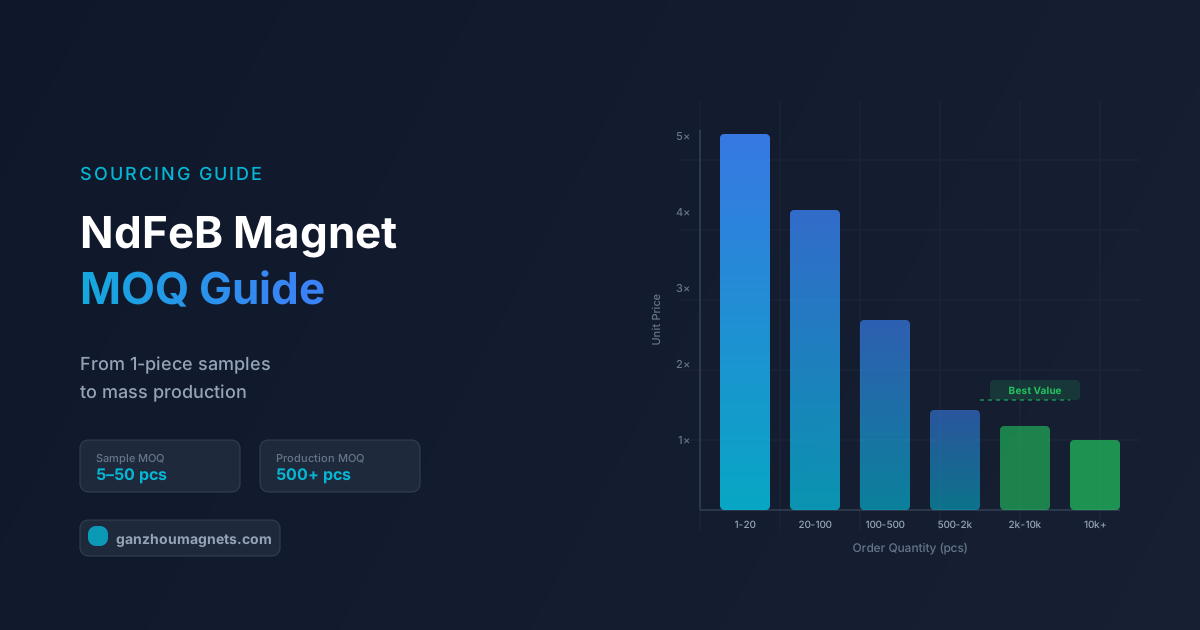
NdFeB Magnet MOQ Guide: From 1-Piece Samples to Mass Production
Understand minimum order quantities for custom neodymium magnets from Chinese suppliers. Covers sample orders, prototype runs, and volume pricing breakpoints.
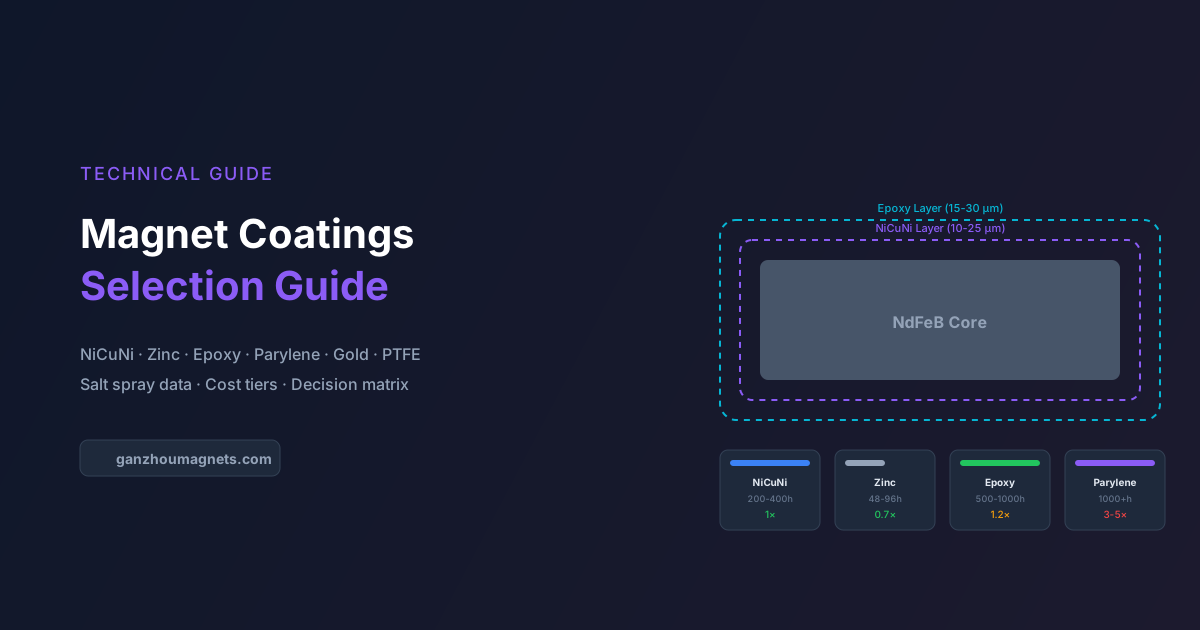
Magnet Coatings and Surface Treatments: Complete Selection Guide
In-depth comparison of NdFeB magnet coatings — NiCuNi, zinc, epoxy, parylene, gold, and PTFE. Includes salt spray data, cost tiers, thickness impact, and application-specific recommendations.