
Surface Gauss vs. Pull Force: How to Specify NdFeB Magnet Strength in RFQs
Use this RFQ checklist to specify NdFeB magnet strength with surface Gauss, pull force, BH(max), test conditions, supplier QA checks, and drawing notes.
The Most Common Sourcing Mistake in Magnet Procurement
If you send a Request for Quotation (RFQ) to a Chinese magnet factory stating, "I need a custom neodymium magnet with 5,000 Gauss," you are setting your supply chain up for failure.
To a procurement team, "5,000 Gauss" sounds like a precise technical specification. To a magnet manufacturer in Ganzhou, it is an incomplete metric that is completely dependent on how and where it is measured. Will the magnet be 10mm thick or 2mm thick? Are you measuring at the center of the pole or at the edge? Are you measuring the bare magnet or the magnet inside a steel assembly?
Misunderstanding how to specify magnetic strength is the number one cause of disputes between Western buyers and Chinese permanent magnet suppliers. It leads to rejected shipments, underperforming products, and project delays.
In this comprehensive guide, we will break down the engineering reality of Maximum Energy Product (Grade), Surface Gauss, and Pull Force. We will explain how factories actually test these metrics on the production floor, and provide a definitive checklist for specifying magnet strength in your RFQs so you get exactly what you need, every time.
Snapshot date: July 19, 2026. Scope: this guide covers RFQ and incoming-inspection wording for sintered NdFeB magnets and simple magnet assemblies. It does not replace magnetic circuit simulation, safety certification, or supplier-specific acceptance testing.
If you already have a drawing, share the magnet grade, dimensions, magnetization direction, coating, operating temperature, and target test method with Ganzhou Magnets engineering support before comparing quotes.
1. Why "Gauss" is a Dangerous Metric in Isolation
Gauss (or Tesla, where 1 Tesla = 10,000 Gauss) is the unit of magnetic flux density. It represents the number of magnetic field lines passing through a given area.
When buyers ask for a specific "Gauss," they are usually referring to Surface Gauss — the magnetic field strength measured on the physical surface of the magnet using a Gaussmeter.
However, Surface Gauss is highly localized and geometrically dependent.
The Geometry Problem
A tiny N52 magnet (e.g., 5mm x 5mm x 1mm) and a massive N52 magnet (e.g., 50mm x 50mm x 25mm) are made of the exact same material with the same intrinsic magnetic capability. However, their Surface Gauss readings will be vastly different. The massive block will have a much higher Surface Gauss simply because there is more magnetic mass driving the field lines outward.
The Probe Placement Problem
Even on the exact same magnet, moving the Gaussmeter probe a few millimeters will change the reading drastically. On a standard axially magnetized disc, the Surface Gauss is highest at the edges of the pole face and lowest at the exact center. If your QA team measures at the center, and the factory measures at the edge, the readings will mismatch, leading to unnecessary rejection reports.
2. The Three Key Metrics of Magnet Strength
To source magnets successfully, you must understand the distinction between the material's grade, the measurable surface field, and the functional holding power.
A. Material Grade: Maximum Energy Product (BHmax)
The "Grade" of a neodymium magnet (e.g., N35, N42SH, N52) is defined by its Maximum Energy Product, denoted as BH(max) and measured in MegaGauss-Oersteds (MGOe).
- What it is: The theoretical maximum magnetic energy stored in the material itself, regardless of its shape or size.
- How it's tested: Factories test raw blocks of NdFeB using a Hysteresis Graph (Permeameter) before slicing them into custom shapes.
- When to use it: Always. This is the foundational specification. You must specify the grade (e.g., N42) and the temperature rating (e.g., SH for 150°C).
B. Surface Gauss (Magnetic Flux Density)
- What it is: The density of the magnetic field at a specific point in space, usually right on the magnet's surface.
- How it's tested: Using a Gaussmeter equipped with a Hall Effect probe.
- When to use it: When your application involves a sensor (like a Hall Effect sensor) that needs to trigger at a specific Gauss threshold at a specific distance.
C. Pull Force
- What it is: The physical force (measured in pounds, kilograms, or Newtons) required to pull the magnet straight off a flat steel surface.
- How it's tested: Using a digital force gauge or tensile testing machine.
- When to use it: When the magnet's primary function is holding, lifting, or mounting.
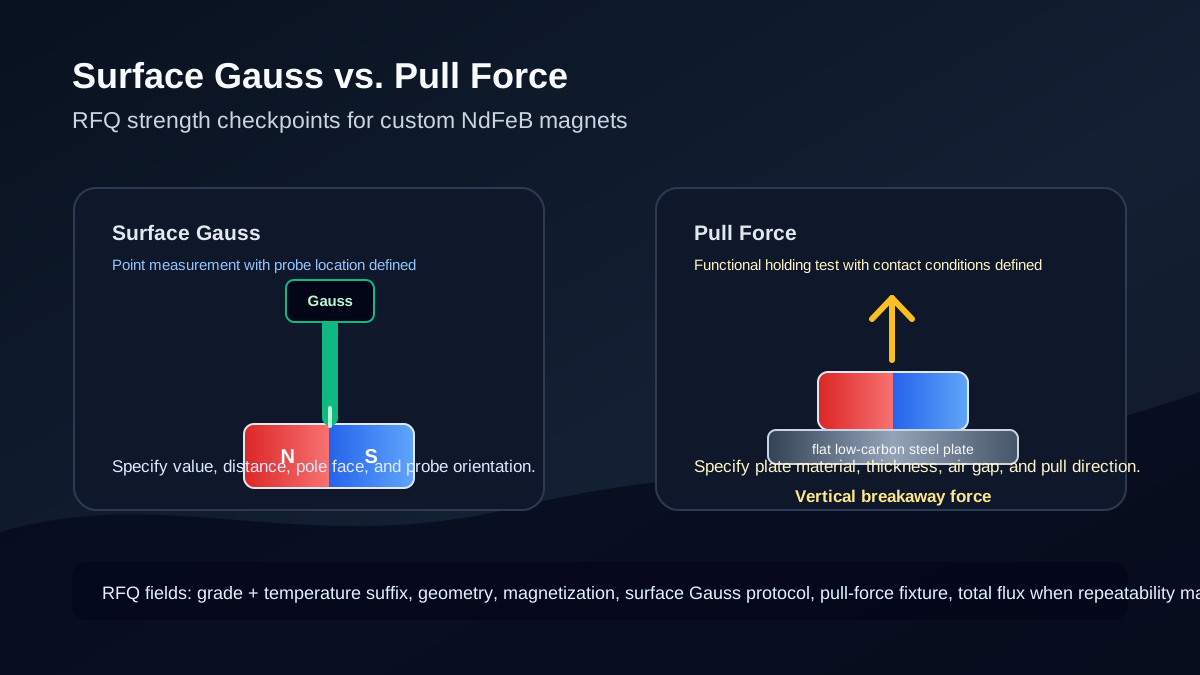
3. Visualizing the Measurement Difference
The following diagram illustrates why specifying the testing method is as important as the value itself.
4. Deep Dive: How Factories Test Quality (and Where It Goes Wrong)
Understanding how your supplier tests your magnets is crucial for aligning your RFQ with their QA capabilities.
The Problem with Gaussmeters
Chinese factories use standard Gaussmeters (usually Chinese brands like Lake Shore equivalents) for quick spot-checks. However, the Hall Effect probe inside the meter is incredibly sensitive to orientation and distance. A difference of 0.5mm in the probe's protective casing thickness can change the reading by 5% to 10%. If your incoming inspection uses a probe with a different active area size than the factory's probe, your readings will never match perfectly.
The Helmholtz Coil (The Gold Standard)
For critical engineering applications, professional factories in Ganzhou rely on a Helmholtz Coil connected to a Fluxmeter. Instead of measuring the field at a single point, a Helmholtz Coil measures the total magnetic flux of the entire magnet.
- Advantage: It is highly repeatable. It doesn't matter exactly where the magnet is placed inside the coil, making it immune to operator error.
- The Catch: It outputs Flux (in Webers or Maxwells), not Surface Gauss. If you need ultimate consistency across millions of parts (like in EV motors), specify a Flux value, not a Gauss value.
The Hidden Variables in Pull Force
If you specify "Must hold 10 lbs," you are leaving critical variables undefined. Pull force is highly dependent on the test environment. In controlled breakaway testing:
- Steel Thickness: The steel test plate must be thick enough to absorb all magnetic flux without saturating. A thick magnet tested on a thin sheet metal plate will show a falsely low pull force.
- Air Gaps: Even a layer of paint, a coating of oil, or a 0.1mm air gap will drastically reduce pull force.
- Pull Direction: Magnets have high resistance to direct vertical pull, but they slide easily under shear force (sliding parallel to the steel). If your application relies on shear force, specify a shear test, not a standard vertical pull test.
For more detail on force loss from gaps and contact conditions, see our pull-force calculation and air-gap guide. If your issue is material grade selection rather than a test fixture, start with the NdFeB grade selection matrix.
5. Comparison: Gauss vs. Pull Force vs. Flux
Use this table to determine which metric belongs on your engineering drawings and RFQs.
| Metric | Measured Unit | Testing Tool | Operator Dependency | Best Application Scenario |
|---|---|---|---|---|
| Magnetic Grade | BH(max) / MGOe | Hysteresis Graph | Low | All raw material specifications |
| Surface Field | Gauss / Tesla | Gaussmeter (Hall Probe) | High (Probe position matters) | Hall Effect sensors, reed switches |
| Pull Force | Lbs / Kg / Newtons | Tensile Tester | Medium (Depends on steel plate) | Magnetic latches, holding assemblies, separators |
| Total Flux | Webers / Maxwells | Helmholtz Coil | Very Low (Highly repeatable) | Precision EV motors, aerospace actuators |
| Intrinsic Coercivity | kOe / kA/m | Permeameter | Low | High-temperature motor environments |
| Remanence | kG / Tesla | Permeameter | Low | Theoretical baseline for flux density |
6. The RFQ Magnet Specification Checklist
Before sending your next RFQ to a supplier in Ganzhou, ensure your technical drawing or specification sheet covers these essential points. This will filter out bad suppliers and prevent costly disputes.
- Specify the Exact Material Grade: e.g., "Sintered NdFeB, Grade N45SH". Do not just say "N45" if your application runs hot.
- Specify Tolerances clearly: e.g., "±0.05mm". Tighter tolerances cost more.
- Define the Magnetization Direction: e.g., "Magnetized through the thickness (Z-axis)."
- If specifying Surface Gauss, define the test point: e.g., "Minimum 3,500 Gauss measured at the geometric center of the North pole face."
- If specifying Pull Force, define the test conditions: e.g., "Minimum 15 lbs vertical pull force against a 10mm thick low-carbon steel plate with no air gap."
- State the Coating/Plating: e.g., "NiCuNi plating, minimum 12 microns."
- Define Operating Temperature: e.g., "Must withstand 120°C for 2 hours with less than 3% irreversible flux loss."
7. Case Study: The Motor vs. Sensor Breakdown
In early 2025, a European automotive tier-2 supplier ordered 100,000 custom arc magnets from a mid-sized Ganzhou factory. The buyer's drawing specified: N42SH, 4500 Gauss.
The factory produced the magnets. Their internal QA tested the magnets using a Gaussmeter at the edge of the arc, reading 4600 Gauss, and shipped them.
The buyer's incoming inspection tested the magnets using a Gaussmeter at the exact center of the arc, reading only 3900 Gauss. The entire shipment was rejected.
The Root Cause: The buyer was using the magnets for a high-speed rotor, but specified a sensor-centric metric (Surface Gauss) without defining the measurement protocol. The Solution: The buyer updated their drawings to specify Total Magnetic Flux via Helmholtz Coil. The factory re-tested the retained samples in a coil, confirmed they met the required total magnetic moment for an N42SH block of that volume, and the dispute was resolved.
If the buyer had understood the boundaries of testing, they would have avoided a 3-week production halt.
8. Limitations and Boundaries
While specifying metrics properly is crucial, buyers must also recognize the physical limitations of NdFeB magnets.
- You cannot arbitrarily combine specs: You cannot demand a 2mm thick N35 disc to have a pull force of 50 lbs. The physical volume dictates the maximum possible strength. If you need more force in a limited space, you must redesign the magnetic circuit (e.g., using a steel pot magnet to redirect flux) rather than simply asking for a "stronger magnet."
- Skin effect on coatings: Thick coatings (like heavy Epoxy or Parylene) create a microscopic air gap. A magnet tested bare will show a higher surface Gauss and Pull Force than the exact same magnet tested after a 25-micron coating.
9. Frequently Asked Questions (FAQ)
Q1: Is a Gauss rating the same as a Pull Force rating?
No. Gauss measures the density of the magnetic field in the air. Pull force measures the physical interaction between the magnet and a ferrous object. A magnet with a very high Gauss reading concentrated in a tiny area might have a very weak overall pull force because it lacks the total mass to hold onto a large steel plate.
Q2: Why does my N52 magnet feel weaker than my N42 magnet?
If the N42 magnet is physically much larger, it will have a higher pull force and higher total flux than a tiny N52 magnet. Grade (N52) is the energy per unit volume, not the total absolute strength of the finished product.
Q3: My factory says they test using AQL 0.65. What does that mean for magnetic strength?
AQL (Acceptable Quality Limit) 0.65 is a statistical sampling method. It means they do not test every single magnet for Gauss or Pull Force. For critical strength parameters, you should ask if the factory performs 100% automated magnetic testing or relies solely on batch sampling.
Q4: Should I buy a Gaussmeter for my warehouse receiving team?
Yes, but use it for consistency checks, not absolute pass/fail unless you have perfectly matched your probe and protocol with the factory in China. A better investment for incoming inspection is often a custom pull-force jig or a Helmholtz coil.
Q5: How do temperature ratings (M, H, SH, UH) affect magnetic strength?
High-temperature grades (like SH and UH) have higher Intrinsic Coercivity (Hcj), meaning they resist demagnetization at heat. However, their Remanence (Br) — which dictates surface Gauss and pull force at room temperature — is often slightly lower than standard grades. An N42SH will generally have a slightly lower room-temperature pull force than a standard N42.
10. Summary and Next Steps
Specifying custom magnets requires more than just picking a grade from a chart. By understanding the profound differences between material grade, localized surface field (Gauss), and functional holding power (Pull Force), you protect your supply chain from costly miscommunications.
When you engage with a Chinese factory, providing a precise, unambiguous test protocol on your RFQ immediately signals that you are a professional buyer, reducing the likelihood of receiving substandard parts.
Struggling to define the right magnetic specifications for your application? Contact our engineering team at Ganzhou Magnets. We can review your 2D/3D drawings, optimize your tolerances, and help you establish a bulletproof QA protocol for your next production run.
Sources & References:
Author

Categories
More Posts

Custom Magnets for Electric Motors and EV Applications: Selection Guide
Engineering guide for selecting NdFeB and SmCo magnets for BLDC, PMSM, and DC motors. Covers grade selection, demagnetization analysis, thermal management, and sourcing from prototype to volume production.

Reducing Heavy Rare Earth Costs: The 2026 Buyer's Guide to Grain Boundary Diffusion (GBD) NdFeB Magnets
A comprehensive guide for engineers and procurement teams on using Grain Boundary Diffusion (GBD) to reduce Dysprosium (Dy) and Terbium (Tb) costs in high-temperature NdFeB magnets.
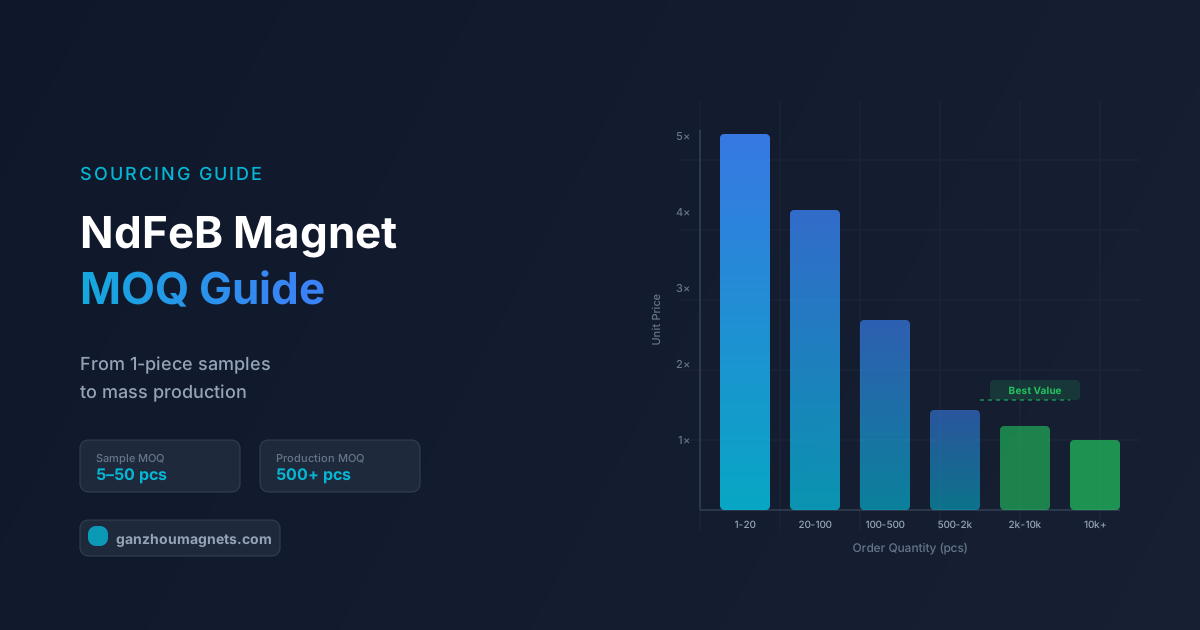
NdFeB Magnet MOQ Guide: From 1-Piece Samples to Mass Production
Understand minimum order quantities for custom neodymium magnets from Chinese suppliers. Covers sample orders, prototype runs, and volume pricing breakpoints.