
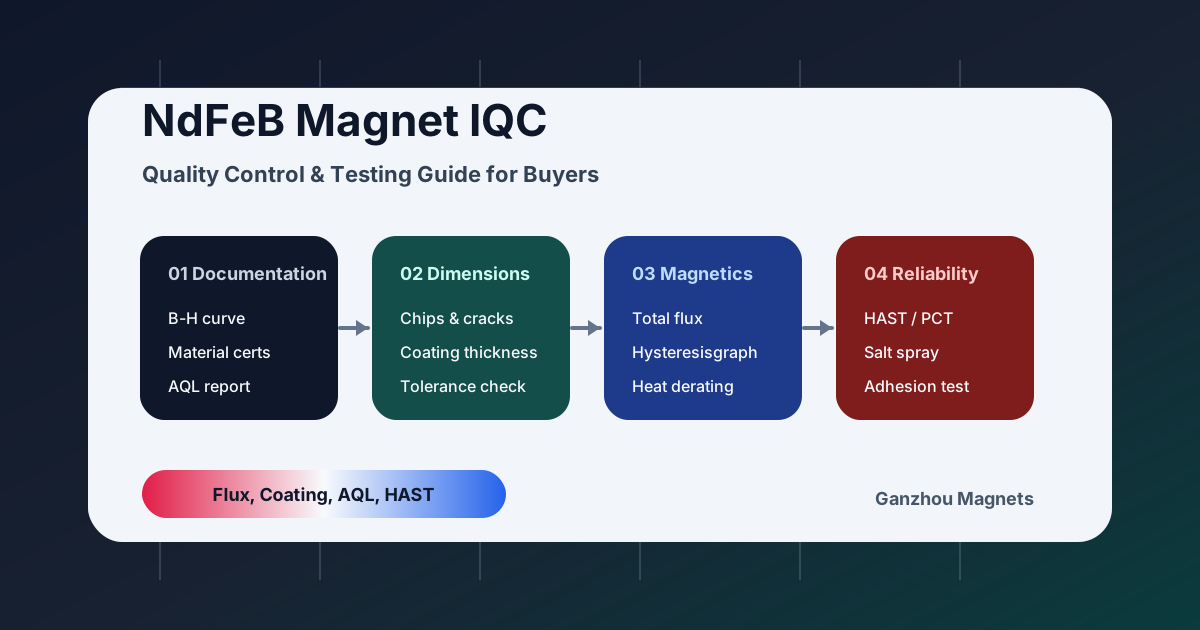
Neodymium Magnet Quality Control & Testing: The Complete IQC Guide for Buyers
A comprehensive guide to Incoming Quality Control (IQC) for NdFeB magnets. Learn how to test magnetic flux, verify coatings with HAST/SST, and audit Chinese suppliers.
Snapshot date: July 21, 2026. Sourcing sintered neodymium (NdFeB) magnets from overseas can be fraught with hidden risks. A magnet might look perfect upon delivery, pass a basic dimensional check, and magnetically snap together. Yet, six months into field deployment within an electric motor or a sensor assembly, the protective coating fails, the magnet oxidizes into a crumbling powder, and the entire unit suffers a catastrophic failure. This guide details exactly how procurement teams, QA managers, and mechanical engineers should establish their Incoming Quality Control (IQC) and evaluate supplier testing protocols to prevent million-dollar assembly line disasters.
Scope: This is a deep-dive B2B guide for buyers and engineers. We will cover magnetic property verification, dimensional and cosmetic Acceptable Quality Limits (AQL), accelerated environmental testing (HAST/SST), and coating adhesion standards.
When you purchase custom magnets, you are not just buying a block of metal; you are buying a guaranteed magnetic field that must survive over a defined lifespan. Relying simply on a supplier's "ISO 9001" badge is insufficient. You need a verifiable, data-backed IQC process.
The Foundation of Magnet Quality: International Standards
Before establishing an IQC protocol, procurement teams must understand the baseline international standards that govern NdFeB manufacturing and testing. By citing these standards in your Request for Quotation (RFQ) and Purchase Orders (POs), you establish a legal and technical baseline for quality disputes.
- ASTM A1101: The Standard Specification for Sintered and Fully Dense NdFeB Permanent Magnets. This American standard defines the grades, minimum magnetic properties, and physical characteristics expected of commercial neodymium magnets.
- IEC 60404-8-1: The International Electrotechnical Commission's standard specifying the minimum values for principal magnetic properties, such as remanence (Br), coercivity (Hcb, Hcj), and maximum energy product ((BH)max).
- ASTM A1017 / IEC 60068: Standards covering environmental testing, specifically hygrothermal corrosion resistance, which is critical for rare-earth materials.
When you audit a supplier, ask for their internal testing procedures. If their documentation does not reference these or equivalent national standards (like China's GB/T 13560), their quality control may be entirely ad-hoc.
Phase 1: Magnetic Property Validation
The most fundamental requirement of a magnet is its magnetic performance. However, there is a massive disconnect between how buyers test magnets and how factories test magnets.
The Problem with Surface Gauss
Many buyers purchase a $300 handheld Gaussmeter, measure the surface of the magnet, and reject the batch if the number is lower than they expected. Surface Gauss is a highly unreliable metric for acceptance. The reading depends entirely on the exact location of the Hall-effect probe, the size of the probe tip, the ambient temperature, and the distance from the edge of the magnet. Even a 0.5mm misalignment by the operator can change the reading by 10%.
Total Magnetic Flux (Helmholtz Coil)
For accurate IQC, QA departments must use a Fluxmeter combined with a Helmholtz Coil. A Helmholtz Coil measures the total magnetic moment of the entire magnet, not just a single point on the surface. It is highly repeatable and independent of operator error. When sourcing magnets, your specification should define the acceptable Total Flux (in Maxwells or Webers) rather than a Surface Gauss value.
The B-H Curve (Hysteresisgraph)
You cannot test the true grade of a magnet (e.g., N52 vs N42) with a Gaussmeter or a Fluxmeter alone. To verify the intrinsic coercivity (Hcj) and the exact Maximum Energy Product ((BH)max), the factory must test a raw, unmagnetized sample block in a closed-circuit Hysteresisgraph. Buyer Action: Always demand the B-H curve report for your specific batch of material from the supplier before shipment. This proves they actually melted and pressed the grade you paid for.
Phase 2: Dimensional and Cosmetic Inspection (AQL)
Because sintered NdFeB is a brittle ceramic, achieving zero physical defects on millions of pieces is practically impossible and economically prohibitive. This is why the industry uses Acceptable Quality Limits (AQL).
When establishing your IQC for dimensions and appearance, you must agree with the supplier on what constitutes a "defect" and what sample size will be checked.
Standard Cosmetic AQL Matrix for NdFeB
The following table shows standard defect classifications for commercial motor and sensor magnets. Without this agreed-upon matrix, a supplier might argue that a 1mm chip is "normal," while your assembly line rejects it as "broken."
| Defect Type | Criticality | Typical Acceptance Criteria (Commercial Standard) | IQC Inspection Method |
|---|---|---|---|
| Missing Corner / Chipping | Major | ≤ 0.5mm length on non-mating edges. No exposure of raw NdFeB allowed. | Visual inspection under 10x magnification |
| Surface Cracks | Critical | Zero tolerance. Any visible crack risks structural failure during motor rotation. | Visual / Dye penetrant |
| Coating Blistering / Peeling | Critical | Zero tolerance. Leads to rapid internal corrosion. | Visual / Tape adhesion test |
| Scratches | Minor | Acceptable if the scratch does not penetrate the plating layers to the substrate. | Visual |
| Dimensional Tolerance | Major | Must meet drawing spec (typically ±0.05mm). | Micrometer, Optical Comparator |
| Plating/Coating Thickness | Major | Must meet minimum thickness (e.g., Ni-Cu-Ni 15-25µm) across all surfaces. | XRF (X-ray fluorescence) |
Note: For aerospace or medical applications, the criteria are drastically tightened, and 100% visual inspection is often required, which multiplies the unit cost.
Phase 3: Environmental and Reliability Testing (HAST / SST)
Neodymium contains iron, which rusts, and neodymium itself is highly reactive. The magnet is only as good as its protective coating (typically Ni-Cu-Ni or Epoxy). To ensure a magnet will survive 10 years inside a humid environment, QA labs use accelerated aging tests.
Highly Accelerated Stress Test (HAST) / Pressure Cooker Test (PCT)
This is the ultimate test of a magnet's internal stability and coating integrity. It simulates years of aging in just a few days.
- The Process: Magnets are placed inside a pressurized chamber (an industrial pressure cooker).
- Typical Conditions: 120°C to 130°C, 100% Relative Humidity, 2.0 to 2.6 Atmospheres of pressure.
- Duration: 48, 96, or 120 hours depending on the application.
- Pass Criteria: The magnets are removed and inspected. There must be no weight loss (indicating crumbling), no severe rust spots, and no loss of magnetic properties beyond a defined threshold (typically < 3-5%).
Buyer Action: If your application involves high humidity (e.g., outdoor sensors, automotive motors, wind turbines), you must demand HAST data from your supplier. A cheap magnet with a poorly applied coating will disintegrate into powder during a 96-hour HAST.
Salt Spray Test (SST)
While HAST tests the total package under pressure, the Salt Spray Test evaluates the surface coating's resistance to galvanic corrosion.
- The Process: Magnets are placed in a chamber and continuously sprayed with a 5% NaCl (salt) solution at 35°C.
- Duration Expectations:
- Standard Ni-Cu-Ni plating: 24 to 48 hours.
- High-grade Epoxy coating: 48 to 96+ hours.
- specialized Zinc: 12 to 24 hours.
- Pass Criteria: No visible red rust. (White rust on zinc is sometimes acceptable, depending on the spec).
Phase 4: Coating Adhesion Testing
A coating that survives a salt spray test is useless if it flakes off when you try to glue the magnet into your assembly.
- Cross-Cut Adhesion Test (ASTM D3359): A technician uses a sharp blade to cut a grid pattern (e.g., 1mm x 1mm squares) through the coating down to the raw magnet. A specialized, high-tack tape is applied firmly over the grid and rapidly ripped off. If the coating flakes away with the tape, the adhesion has failed. This usually indicates poor cleaning (oil or dust left on the magnet) before electroplating.
- Thermal Shock Testing: The magnet is cycled rapidly between extreme cold (e.g., -40°C) and extreme heat (e.g., +150°C). Because the NdFeB material and the Nickel/Epoxy coatings have different coefficients of thermal expansion, poor coatings will blister, crack, or delaminate under thermal shock.
The 6-Point IQC Setup Checklist for Procurement
To stop failures before they reach your assembly line, implement this checklist with your QA team and your Chinese supplier:
- Define the B-H Curve Requirement: Require the factory to provide a B-H demagnetization curve report for the specific block of material used for your batch.
- Shift to Flux Testing: Stop rejecting parts based on a handheld Gaussmeter. Buy a Helmholtz coil and Fluxmeter for your receiving department, and establish a baseline Flux tolerance with the supplier.
- Codify the AQL Standard: Attach a visual defect matrix to your purchase order. Define exactly how big a corner chip is allowed to be. Specify ISO 2859-1 (or similar) sampling plans (e.g., General Inspection Level II, AQL 1.0 for Major defects).
- Require Plating Thickness Data: Require the supplier to provide X-Ray Fluorescence (XRF) measurement data showing the plating thickness (e.g., Nickel 15µm, Copper 5µm, Nickel 10µm).
- Mandate Environmental Data for New Suppliers: Before qualifying a new vendor, require them to submit a 96-hour HAST report and a 48-hour SST report for their standard Ni-Cu-Ni coating.
- Validate the Glue Joint: Perform cross-cut tape adhesion testing on a sample from every incoming batch before sending them to the motor assembly line.
Auditing Your Supplier's QC Lab
If you visit a magnet factory in China, the quality of their laboratory tells you everything you need to know about their capabilities. A top-tier manufacturer will have an in-house lab equipped with:
- A NIM-2000 or similar Hysteresisgraph for B-H curve plotting.
- ICP-OES (Inductively Coupled Plasma) or XRF for chemical composition and heavy rare earth (Dysprosium/Terbium) verification.
- Multiple Salt Spray Chambers and HAST pressure cookers.
- Optical Projectors (Profile Projectors) or automated CCD visual inspection machines for dimensional validation.
- Laser Particle Size Analyzers for controlling the raw powder before pressing.
If a factory is outsourcing all of these tests, they do not have real-time control over their own manufacturing process.
Frequently Asked Questions (FAQ)
Can I test a magnet's grade (e.g., N52) after it has been fully machined and plated?
Not easily or accurately. The true grade is measured on a standardized, unmagnetized block using a closed-circuit Hysteresisgraph. Once cut into a small complex shape and magnetized, you can only infer the grade by measuring the total flux and comparing it to a known gold-standard sample, or by sending it to a third-party lab to be demagnetized and tested in a Vibrating Sample Magnetometer (VSM), which is highly expensive.
Why did our magnets pass IQC but lose strength when installed in the motor?
This is typically caused by the "Operating Load Line" (Permeance Coefficient) of your specific motor design combined with elevated operating temperatures. Even if a magnet passes IQC at room temperature, it may suffer irreversible demagnetization if subjected to a reverse magnetic field at 120°C. You must test magnets at their actual operating temperature, and ensure you specified a high-temperature grade (like SH, UH, or EH) rather than standard N-grade.
Is a 0.5mm chip on the edge of a magnet going to affect its magnetic strength?
No. A small chip on the edge removes less than 0.1% of the total magnetic volume, so the flux loss is undetectable. The real danger of a chip is that it compromises the protective Ni-Cu-Ni or Epoxy coating, creating an entry point for moisture. If the chip exposes raw NdFeB, it will rust rapidly.
How many pieces should I test in an incoming batch of 10,000 magnets?
Most companies use the ISO 2859-1 (ANSI/ASQ Z1.4) standard. For a batch of 10,000 pieces under General Inspection Level II, the sample size is typically 200 pieces. If you set an AQL of 1.0 for major defects (like dimensional failure), you would accept the batch if you find 5 or fewer defects, and reject the whole batch if you find 6 or more.
Sources and References
This guide synthesizes testing parameters from international standards and commercial QA practices. The following standards and industry resources were referenced during the compilation of this guide on July 21, 2026:
| Source Standard / Resource | Relevance to NdFeB Quality Control | Reference URL |
|---|---|---|
| ASTM A1101 | Standard Specification for Sintered NdFeB Permanent Magnets. Defines minimum properties and grade classifications for US procurement. | astm.org/a1101 |
| IEC 60404-8-1 | Magnetic materials - Specifications for individual materials. The global baseline for classifying hard magnetic materials and testing procedures. | webstore.iec.ch |
| ISO 2859-1 | Sampling procedures for inspection by attributes. Defines the AQL sampling plans and general inspection levels for quality control. | iso.org/standard/1141 |
| ASTM D3359 | Standard Test Methods for Rating Adhesion by Tape Test. Essential for verifying the integrity of Ni-Cu-Ni and Epoxy coatings on magnets. | astm.org/d3359 |
Don't let a generic "QC Passed" sticker ruin your assembly line. Contact Ganzhou Magnets to request a quote. We provide comprehensive B-H curves, HAST data, and transparent AQL reports with every custom order, ensuring your magnets perform exactly as specified for years to come.
Author

Categories
More Posts
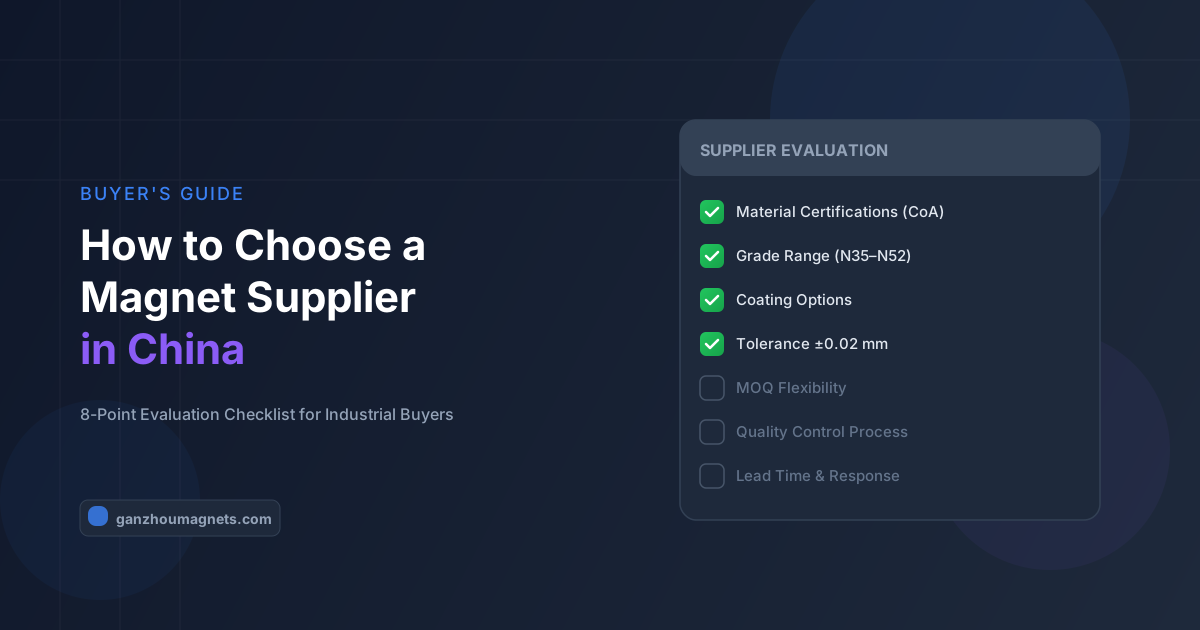
Cómo elegir un proveedor de imanes personalizados en China: Lista de verificación para compradores
Guía práctica para compradores industriales que evalúan proveedores de imanes chinos. Incluye fábrica vs. empresa comercial, certificaciones, MOQ y señales de alerta.
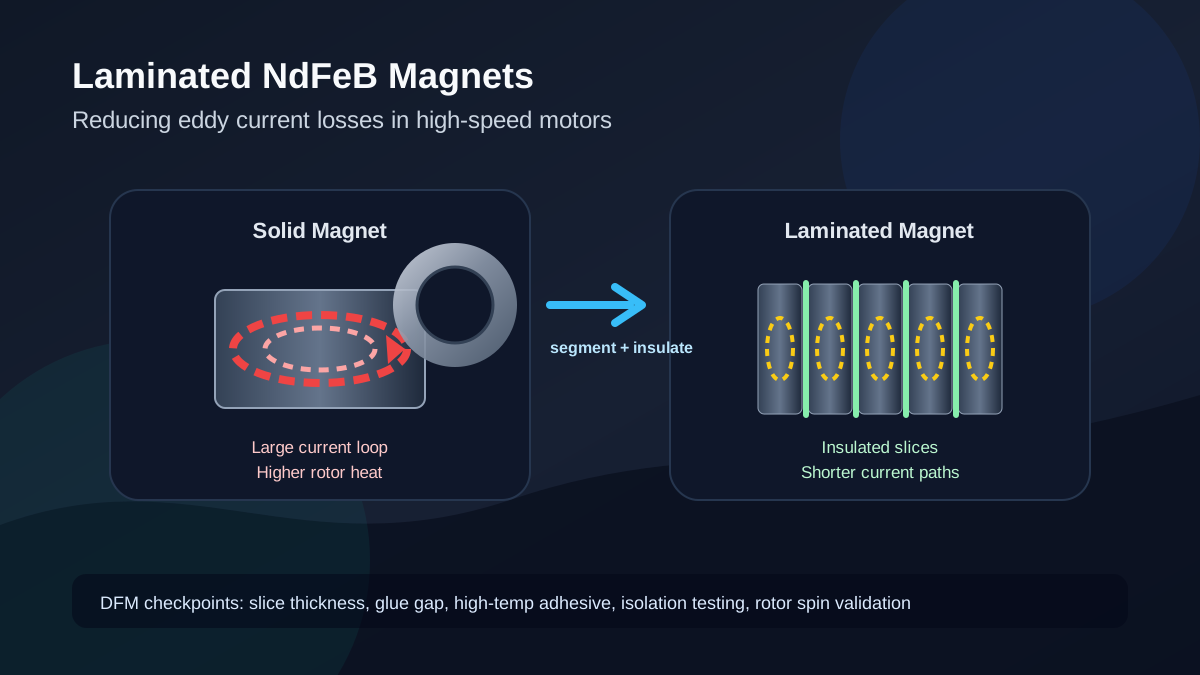
Laminated NdFeB Magnets for High-Speed Motors
Laminated NdFeB magnets guide for high-speed motors: compare eddy current loss, slice thickness, QA tests, cost trade-offs, and RFQ specs. Contact us.
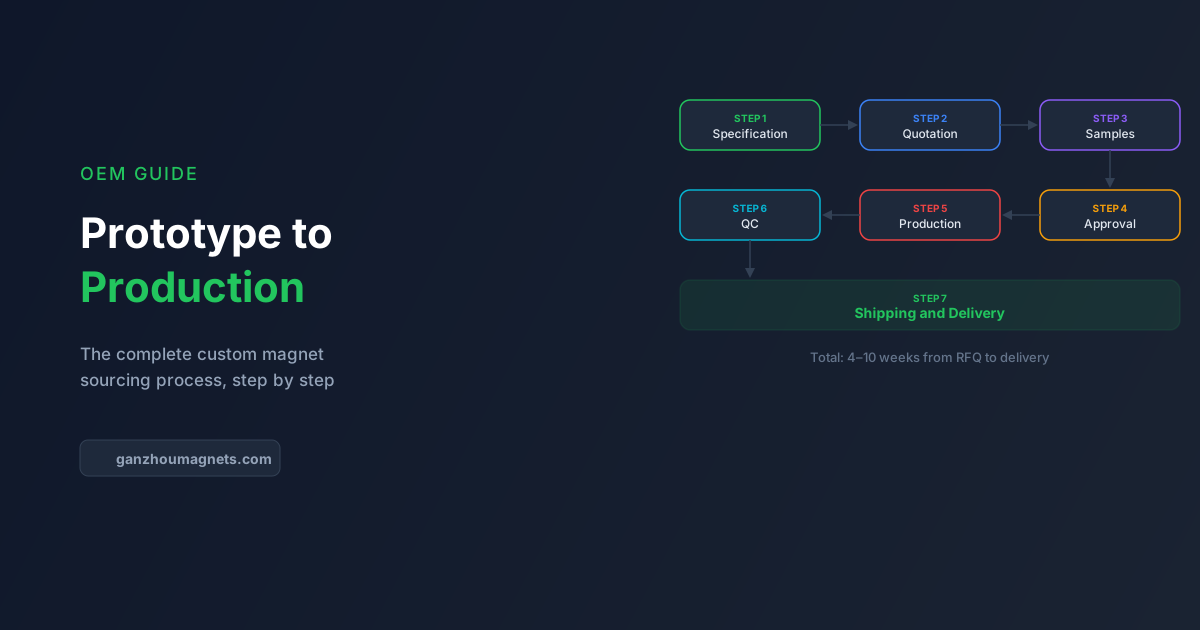
De prototipo a producción en masa: Guía de imanes personalizados OEM
Guía paso a paso para compradores que obtienen imanes personalizados de China por primera vez. Cubre el proceso de 7 pasos desde la especificación hasta la producción en masa.