
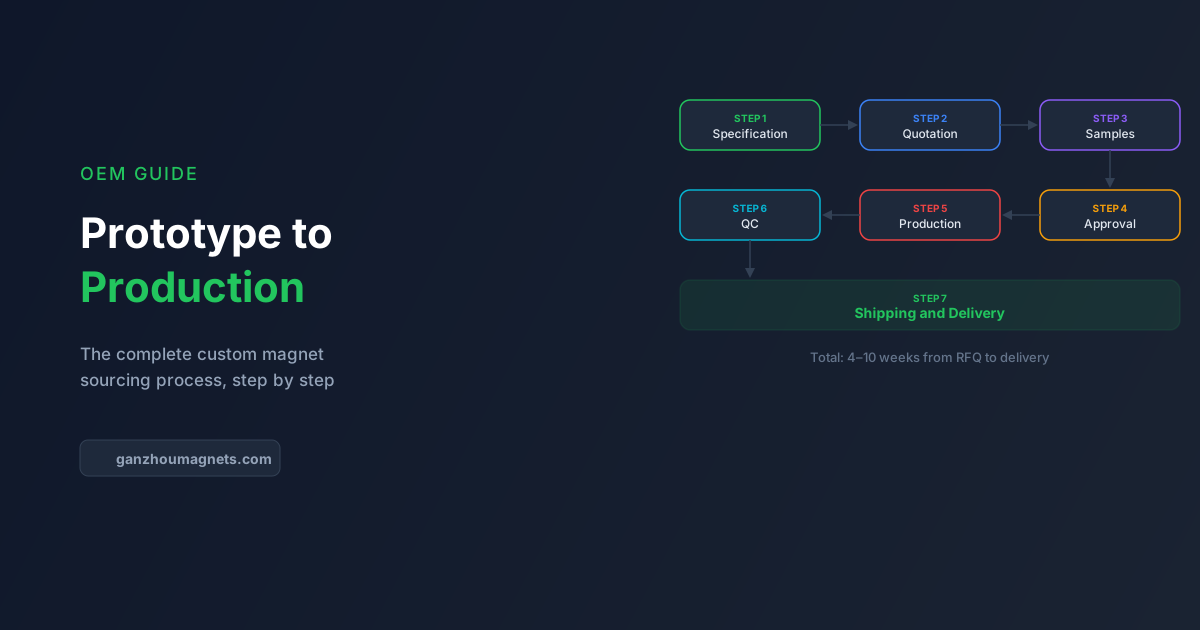
From Prototype to Mass Production: The OEM Custom Magnet Guide
Step-by-step guide for first-time buyers sourcing custom magnets from China. Covers the 7-step process from specification to mass production, including MOQ, testing, certifications, and logistics.
Why This Guide Exists
If you're sourcing custom magnets from China for the first time, the process can feel opaque. Questions like "How do I start?", "What documents do I need?", and "How long until I get production parts?" are common — but rarely answered in a structured way.
This guide walks through the complete OEM magnet sourcing process, from initial specification to mass production delivery, based on real projects we've coordinated through Ganzhou suppliers.
The 7-Step Custom Magnet Process
Step 1: Specification and Requirements (Week 0)
Before contacting any supplier, prepare your specification package:
Minimum required information:
- Material: NdFeB or SmCo (if unsure, describe the application)
- Dimensions: With tolerances on critical features
- Grade: Target BH(max) or specify operating temperature
- Coating: Surface treatment requirements
- Magnetization direction: Axial, diametral, radial, or multi-pole
- Quantity: Sample qty + projected annual volume
- Application: What the magnet does in your product
Helpful but optional:
- CAD drawing (STEP or DXF format)
- Target pull force or flux density
- Environmental conditions (temperature range, humidity, chemical exposure)
- Compliance requirements (RoHS, REACH, UL, etc.)
Step 2: Supplier Quotation (Week 0–1)
Once you submit your RFQ, a professional supplier should respond with:
| Quote element | What to look for |
|---|---|
| Unit price | Tiered by quantity (sample / 500 / 1k / 5k) |
| Tooling cost | One-time charge for custom shapes ($0–$500) |
| Lead time | Separate for samples vs. production |
| Grade confirmation | Supplier may suggest alternative grades |
| Coating recommendation | Based on your operating environment |
| MOQ | Minimum for production (typically 500+ pcs) |
Red flag: If a supplier quotes without asking any technical questions, they may not have the engineering capability to deliver consistently.
Step 3: Sample Order (Week 1–3)
Sample orders are critical — never skip this step.
Typical sample parameters:
- Quantity: 10–50 pieces
- Price: 2–5× production unit price
- Lead time: 7–14 days
- Purpose: Dimensional fit, magnetic performance validation, coating quality
What to test on received samples:
- Dimensions: Measure all critical features with calipers or CMM
- Magnetic properties: Use a Gaussmeter to verify surface flux
- Coating adhesion: Cross-hatch tape test (ASTM D3359)
- Fit test: Install in your assembly to verify mechanical fit
- Functional test: Run your product with the sample magnets under operating conditions
Step 4: Sample Approval and Feedback (Week 3–4)
After testing samples, you'll typically be in one of three scenarios:
| Scenario | Action | Timeline impact |
|---|---|---|
| Full approval | Proceed to production order | No delay |
| Minor revision | Adjust tolerance or spec, new samples | +1–2 weeks |
| Major revision | Redesign needed, restart at Step 1 | +3–4 weeks |
Pro tip: Provide detailed feedback on what worked and what didn't. The more specific your feedback, the faster the iteration. "Magnets are too weak" is unhelpful — "Surface flux measured 2,800 Gauss, target is 3,200 Gauss" gives the factory actionable data.
Step 5: Production Order (Week 4–7)
Once samples are approved, place the production order:
Production order checklist:
- Reference approved sample batch number
- Confirm final spec sheet with all parameters
- Agree on inspection criteria (AQL level, critical dimensions)
- Confirm packing specification (bulk, row-packed, individually wrapped)
- Set delivery schedule (single shipment or phased releases)
- Agree on payment terms (typically 30% deposit, 70% before shipment)
Typical production lead times:
- Standard shapes and grades: 2–3 weeks
- Custom shapes: 3–4 weeks
- Magnetic assemblies: 4–6 weeks
Step 6: Quality Control and Inspection (During Production)
A reliable supplier should provide documentation per shipment:
Standard QC documents:
- Certificate of Analysis (CoA): Br, Hcj, BH(max) values per batch
- Dimensional inspection report: Critical dimensions measured
- Coating test report: Salt spray hours, adhesion test results
- Photos: Production line photos and packed goods
Optional (for higher-tier requirements):
- 100% Gaussmeter testing data
- CMM reports for precision parts
- RoHS/REACH test certificates from third-party lab
- Full material traceability to alloy batch
Step 7: Shipping and Logistics (Week 7–9)
Magnets are classified as magnetized material for shipping, which requires special handling:
Air freight:
- Must comply with IATA DGR (Dangerous Goods Regulations)
- Requires magnetic field measurement at 2.1m from package surface
- Must be below 0.00525 Gauss at aircraft distance
- Proper shielding with steel plates in packaging
- UN3005 classification for some types
Sea freight:
- Fewer restrictions, but proper packaging still required
- IMO Declaration for magnetized materials
- Recommended for large volumes (cost-effective)
Typical transit times:
| Mode | China to US | China to EU | China to AU |
|---|---|---|---|
| Air express | 3–5 days | 4–6 days | 4–6 days |
| Air freight | 5–7 days | 5–8 days | 5–7 days |
| Sea freight | 18–25 days | 25–35 days | 15–20 days |
Common Certifications
| Certification | What it covers | Typical cost | Timeline |
|---|---|---|---|
| RoHS | Restricted substances | $200–$500 per test | 5–7 business days |
| REACH | EU chemical registration | $300–$800 per test | 7–10 business days |
| ISO 9001 | Factory quality management | Factory bears cost | Verify at quoting |
| UL recognition | Component safety (for assemblies) | $1,000+ | 4–8 weeks |
| IATF 16949 | Automotive quality standard | Factory bears cost | Verify at quoting |
Cost Breakdown: What You're Really Paying For
Understanding the cost structure helps you negotiate effectively:
| Cost component | Percentage of total | Notes |
|---|---|---|
| Raw material (rare earth alloy) | 40–60% | Fluctuates with Nd/Pr prices |
| Processing (sintering, machining) | 20–30% | Higher for complex shapes |
| Coating | 5–10% | Higher for parylene/gold |
| QC and testing | 3–5% | Higher for 100% inspection |
| Tooling (amortized) | 0–5% | One-time for custom shapes |
| Packaging and shipping | 5–10% | Higher for air freight |
Timeline Summary
| Phase | Duration | Key deliverable |
|---|---|---|
| Specification | 1–3 days | Complete RFQ package |
| Quotation | 1–3 days | Detailed quote with alternatives |
| Sample production | 7–14 days | 10–50 sample pieces |
| Sample testing | 3–7 days | Test report with pass/fail |
| Production | 14–28 days | Full run with QC docs |
| Shipping | 3–35 days | Delivered to your facility |
| Total | 4–10 weeks | From RFQ to delivery |
Ready to start your custom magnet project? Submit your specification and we'll provide a detailed quote with timeline within 48 hours.
Author

Categories
More Posts

Reducing Heavy Rare Earth Costs: The 2026 Buyer's Guide to Grain Boundary Diffusion (GBD) NdFeB Magnets
A comprehensive guide for engineers and procurement teams on using Grain Boundary Diffusion (GBD) to reduce Dysprosium (Dy) and Terbium (Tb) costs in high-temperature NdFeB magnets.
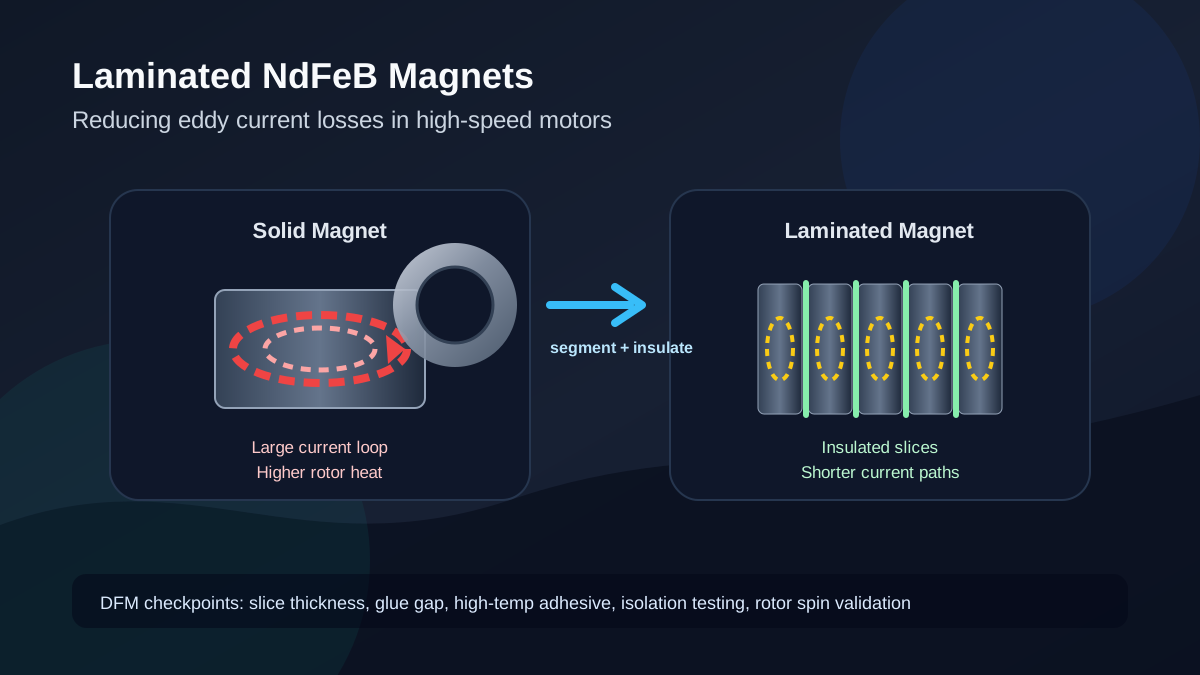
Laminated NdFeB Magnets for High-Speed Motors
Laminated NdFeB magnets guide for high-speed motors: compare eddy current loss, slice thickness, QA tests, cost trade-offs, and RFQ specs. Contact us.
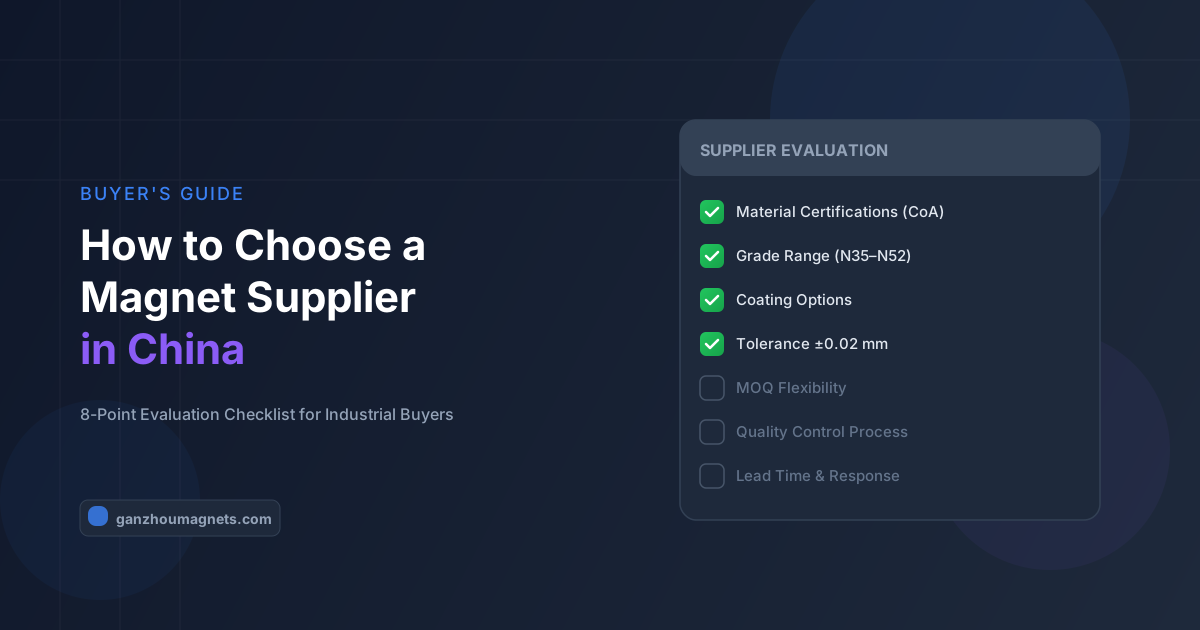
How to Choose a Custom Magnet Supplier in China: A Buyer's Checklist
A practical guide for industrial buyers evaluating Chinese magnet suppliers. Covers factory vs. trading company, quality certifications, MOQ expectations, and red flags to avoid.