
Standards scope boundary
IEC 60034-30-1:2025 excludes motors with mechanical commutators
The EU ecodesign page centers on induction motors without brushes/commutators, so PMDC fit output cannot be converted into generic IE3/IE4 claims. [R25][R26]
Hybrid permanent magnet DC electric motors planning page
Run a PMDC magnet-fit check in under one minute, then use the report layer to separate true NdFeB grade decisions from brush-life, PWM/EMC, and sourcing-risk issues before RFQ freeze.
Published on 2026/03/27
Last updated 2026/03/27
Use this tool after PMDC architecture is tentatively selected to screen thermal fit, then validate commutation-duty, PWM/EMC, and supplier-lane boundaries in the report layer.
Run the tool to receive a PMDC recommendation lane
You will get thermal fit output first, then use the report sections to check commutator-duty fit, EMC/PWM boundaries, and RFQ actions.
These source-backed conclusions separate magnet-grade decisions from PMDC-specific commutation, maintenance, and architecture tradeoffs.
Standards scope boundary
IEC 60034-30-1:2025 excludes motors with mechanical commutators
The EU ecodesign page centers on induction motors without brushes/commutators, so PMDC fit output cannot be converted into generic IE3/IE4 claims. [R25][R26]
Brush system split
Precious-metal commutation suits low-current battery duty; graphite suits higher power, rapid start-stop, or periodic overload
maxon updated this guidance in 2024, which means PMDC RFQs should specify brush system and duty profile, not just magnet grade. [R29]
Life target boundary
Typical brushed DC motor life is often 1,000-5,000 h, but real outcomes can range from hundreds to >25,000 h
FAULHABER ties the spread to speed, load, commutation, humidity, temperature, and shock, so service-life claims need program-specific validation. [R31]
Drive / EMC boundary
Brush sparks and PWM amplifiers are the dominant PMDC emission sources
maxon recommends suppression measures such as capacitors, ferrites, shielded lines, and CLL/PWM review; EMC-sensitive PMDC programs are not plug-and-play. [R30][R32]
Magnet-stage concentration
IEA reports about 94% share for China in permanent-magnet manufacturing in 2024
The same 2025 commentary documents April and October export-control escalation, so PMDC sourcing risk does not stop at mine supply. [R24]
Primary supply still matters
IEA shows rare-earth primary-supply requirement rising from 64 kt in 2024 to 91 kt in 2030
Secondary supply/reuse increases much less, so recycling growth does not remove launch-window exposure for PMDC programs. [R27]
NdPr price reset
USGS lists NdPr oxide at $69/kg in 2025 vs $55/kg in 2024
That one-year move means long RFQ cycles should carry explicit index or reprice language instead of assuming stable magnet input costs. [R7]
Best-fit teams
Not suitable without extra engineering work
These signals keep PMDC fit decisions auditable by separating thermal fit from commutator, PWM/EMC, and supply-chain boundaries.
| Metric | Current signal | Reference | Why it matters |
|---|---|---|---|
| Mechanical-commutator standards scope [R25][R26] | IEC 60034-30-1:2025 excludes motors with mechanical commutators; the EU ecodesign scope page centers on induction motors without brushes/commutators. | EU page checked 2026-03-27; IEC edition published 2025-12-01 | Do not reuse IE-claim templates from induction or brushless programs for PMDC quotations. |
| Brush-system decision split [R29] | maxon says precious-metal commutation is best for small currents and battery operation, while graphite brushes are preferable for higher power, rapid start-stop, or periodic overload. | maxon article updated 2024-08-29 | RFQs should capture commutation system and duty profile, not only magnet grade. |
| Brushed-motor life spread [R31] | FAULHABER states typical operating life is often 1,000-5,000 h, but it can range from a few hundred to over 25,000 h depending on conditions. | FAULHABER DC Motors technical information, 18th edition (2023) | There is no reliable public single life number for PMDC programs; service-life targets must be closed with route-specific tests. |
| PWM / suppression boundary [R30] | maxon notes that CLL optimization is designed for battery operation and PWM use can require extra chokes and capacitors. | maxon article updated 2024-08-29 | If the final product uses PWM control, confirm commutation and suppression design before freezing the supplier lane. |
| EMC emission source [R32] | Brush sparks and PWM amplifiers are the main EMC emitters, although shielding, ferrites, and grounding can reduce emissions. | maxon article updated 2024-08-29 | EMC-sensitive PMDC programs need explicit suppression scope and test ownership in the RFQ. |
| Rare-earth magnet concentration [R24] | IEA commentary puts China at about 60% of mining, 91% of refining, and 94% of permanent-magnet manufacturing in 2024. | IEA commentary published 2025-10-23 | Material availability risk concentrates at the magnet stage, not only upstream mining. |
| Rare-earth primary-supply requirement [R27] | IEA STEPS shows primary supply requirement moving from 64 kt in 2024 to 91 kt in 2030, while secondary supply/reuse rises from 27 kt to 32 kt. | IEA Rare earth elements published 2025-05-21 | Recycling growth alone is not enough to neutralize launch-window sourcing risk. |
| Restriction coverage intensity [R28] | OECD reports 14% of industrial raw-material trade faced at least one export restriction in 2021-2023; rare earths were at 46%. | OECD press release published 2025-05-12 | PMDC supply contracts should treat policy refresh as a routine control, not a black-swan response. |
| NdPr oxide price movement [R7] | USGS reports average NdPr oxide price rose to $69/kg in 2025 from $55/kg in 2024. | USGS MCS 2026 | Commercial buffers and repricing logic should be written into RFQ instead of assumed off-page. |
Track these PMDC-specific triggers before treating a magnet-fit result as commercially safe.
| Trigger | Latest verified signal | Date | Execution impact |
|---|---|---|---|
| PMDC efficiency-claim scope gate [R25][R26] | The EU ecodesign page centers on induction motors without brushes/commutators, while IEC 60034-30-1:2025 excludes motors with mechanical commutators and those that cannot be tested separately. | EU page checked 2026-03-27; IEC edition published 2025-12-01 | Block generic IE3/IE4 language in quotations or contracts until architecture and test path are confirmed for the destination market. |
| Brush / commutation declaration gap [R29][R31] | Brush choice and life vary with current, start-stop duty, load, speed, humidity, temperature, and shock; there is no universal PMDC life value. | maxon updated 2024-08-29; FAULHABER 18th edition 2023 | Require brush system, duty profile, and target operating life in the RFQ package instead of assuming catalog equivalence. |
| PWM / EMC validation checkpoint [R30][R32] | PWM use can require extra chokes/capacitors, and brush sparks plus PWM amplifiers are the main emission sources in DC motor setups. | maxon articles updated 2024-08-29 | Assign suppression-network responsibility and EMC-test ownership before pilot-lot approval. |
| Rare-earth export-control escalation [R24][R28] | IEA documents April and October 2025 rare-earth control escalation, while OECD shows rare-earth trade is highly restriction-exposed. | 2025-04 to 2025-10; OECD 2025-05-12 | Refresh policy, license, and origin assumptions at RFQ issue, PO award, pre-shipment, and customs-clearance milestones. |
| NdPr price / import-reliance shift [R7] | USGS reports U.S. net import reliance rose to 67% in 2025 and NdPr oxide averaged $69/kg versus $55/kg in 2024. | USGS MCS 2026 | Use indexed pricing, origin disclosure, and contingency sourcing lanes instead of fixed-price single-lane assumptions. |
| SmCo fallback cobalt exposure [R10] | USGS estimates Congo provided 73% of world cobalt mine output in 2025 and records 2025 quota/export-policy shifts. | USGS MCS 2026 | Treat SmCo as a risk transfer, then quantify cobalt exposure and timeline impact before moving PMDC programs off NdFeB. |
Updated on 2026-03-27. Where public evidence stops at policy or component behavior rather than full assembled-motor outcomes, this page marks the boundary and moves the user to validation-first actions.
The tool and report follow one auditable chain: thermal gate -> commutation gate -> PWM / EMC gate -> sourcing action.
1) Normalize thermal operating envelope
Continuous and peak temperatures are combined with cooling and environment penalties into a risk-adjusted hotspot input.
2) Map adjusted hotspot to a traceable NdFeB suffix lane
The tool uses DOE Table 2 to map the adjusted hotspot to SH/UH/EH/AH thresholds plus indicative Dy and Nd+Pr ranges. [R4]
3) Confirm the program really wants brushed PMDC architecture
A fit result only validates a magnet lane. It does not prove PMDC is the right architecture when service life, maintenance, or EMC pressure dominates. [R29][R30][R31][R32]
4) Match brush system to duty profile
Precious-metal versus graphite commutation depends on current level, start-stop behavior, and overload pattern; this decision is independent of magnet grade. [R29]
5) Separate magnet fit from PWM / EMC and standards scope
IE-class scope, CLL/PWM compatibility, and emission behavior remain outside magnet-grade screening and require dedicated validation. [R25][R26][R30][R32]
6) Convert the result into RFQ-ready actions
Output combines grade lane, commutation checks, policy checkpoints, and supplier evidence requests so teams can issue primary plus contingency RFQs with explicit assumptions.
Core claims are tied to primary datasets, government assessments, and peer-reviewed studies so teams can audit assumptions before committing sourcing decisions.
| Source | Signal used in this page | Date |
|---|---|---|
| [R4] U.S. DOE Rare Earth Permanent Magnets Deep Dive | Provides NdFeB suffix temperature and Dy mapping (Table 2), which remains the thermal baseline used by the tool. | Published 2022-02 |
| [R7] USGS Mineral Commodity Summaries 2026 - Rare Earths | Provides 2025 import-reliance shift, NdPr oxide pricing, and trade-control timeline updates used in PMDC sourcing sections. | Published 2026-01 |
| [R10] USGS Mineral Commodity Summaries 2026 - Cobalt | Quantifies Congo share and 2025 policy shifts used to frame SmCo fallback risk. | Published 2026-01 |
| [R24] IEA commentary: With new export controls on critical minerals, supply concentration risks become reality | Documents 2024 concentration at mining/refining/magnet stages plus April and October 2025 export-control escalation. | Published 2025-10-23 |
| [R25] European Commission electric motors page (EU Regulation 2019/1781 scope and milestones) | Shows scope centered on induction motors without brushes/commutators and the current in-force efficiency milestones for in-scope classes. | Checked 2026-03-27 |
| [R26] IEC 60034-30-1:2025 webstore summary | Lists IE classes for line-operated single-speed motors and states exclusions including motors with mechanical commutators and motors that cannot be tested separately. | Published 2025-12-01 |
| [R27] IEA report: Rare earth elements | Provides 2024-2030 demand, primary-supply requirement, secondary supply/reuse, and top-three concentration figures used in the PMDC sourcing sections. | Published 2025-05-21 |
| [R28] OECD press release: Export restrictions on critical raw materials rise sharply amid growing demand | Reports the share of industrial raw-material trade affected by export restrictions, including elevated exposure for rare earths. | Published 2025-05-12 |
| [R29] maxon support: Commutation - Graphite brushes (GB) or Precious metal brushes (EB) | Defines when precious-metal versus graphite commutation is preferable based on current, battery duty, power level, and overload / start-stop profile. | Updated 2024-08-29 |
| [R30] maxon support: What is CLL and what to consider with PWM | Explains that CLL optimization is designed for battery operation and PWM can require extra chokes/capacitors depending on the motor setup. | Updated 2024-08-29 |
| [R31] FAULHABER technical information - DC Motors | Provides typical brushed-motor life ranges and documents how speed, load, commutation, humidity, temperature, and shock affect operating life. | 18th edition, 2023 |
| [R32] maxon support: Electromagnetic emissions with DC motors | Identifies brush sparks and PWM amplifiers as the main emission sources and lists mitigation options such as capacitors, ferrites, shielding, and grounding. | Updated 2024-08-29 |
Research refresh completed on 2026-03-27 with PMDC-specific commutation, PWM / EMC, and 2025-2026 supply-chain updates. Where evidence is incomplete, this page explicitly marks pending confirmation or no reliable public data and defaults to validation-first actions.
Share thermal window, coating context, and target launch date to convert this fit output into an executable supplier lane.
Share thermal window, coating context, and target launch date to convert this fit output into an executable supplier lane.
Related internal decision paths
Neodymium magnets for electric motors
Cross-check PMDC output against broader electric-motor architecture constraints.
Motor magnets sourcing page
Benchmark supplier-risk and landed-cost assumptions with the motor-magnets framework.
Permanent magnet DC motor
Review the sibling variant to verify assumption consistency for PMDC buying teams.
Permanent magnet synchronous motor
Use this variant when the program requires explicit demagnetization-margin controls for PMSM lanes.
Permanent magnet motor
Compare the broader permanent-magnet route when multiple motor topologies are in play.
Use this table to distinguish true material questions from PMDC architecture limits that a grade swap will not fix.
| Criteria | NdFeB | Ferrite | SmCo |
|---|---|---|---|
| Temperature grade boundary [R4] | Suffix mapping runs 80C to 220C from N to AH and remains the core thermal gate for PMDC magnet planning. | Pending confirmation: no public ferrite grade dataset mirrors DOE Table 2 directly for PMDC RFQ screening. | Best used as a high-temperature contingency when adjusted hotspot moves beyond practical NdFeB lanes. |
| Rare-earth and cobalt exposure [R4][R7][R10] | Carries Nd/Pr and often Dy exposure that grows materially in EH/AH lanes. | Removes Nd/Pr/Dy from the magnet body but can force larger magnetic volume. | Reduces Nd/Dy dependence but introduces cobalt concentration exposure. |
| Commutation-duty fit [R29] | Common PMDC choice when compactness matters, but the brush system still has to match current and start-stop duty. | Can lower rare-earth exposure, yet larger magnetic volume can tighten packaging in small brushed PMDC frames. | Improves thermal margin but does not change the brush-system decision. |
| Life and maintenance boundary [R31] | Magnet fit does not guarantee service life; brushed-motor life varies widely with duty, environment, and mechanics. | The same brushed-life boundary remains after a ferrite switch. | The same commutator-life boundary remains unless the architecture itself changes. |
| PWM / EMC boundary [R30][R32] | Brush sparks and PWM can drive emissions, so suppression hardware and test scope may be mandatory. | A ferrite swap does not remove emissions coming from brushes or controller strategy. | A hotter magnet lane still requires the same PWM / EMC validation discipline. |
| Restriction-shock resilience [R24][R28] | Most exposed to rare-earth export-control and magnet-stage concentration shocks without contingency lanes. | Lower rare-earth exposure, but conversion can add engineering lead time and tooling rework. | Shifts some risk away from NdPr/Dy but adds cobalt concentration and quota sensitivity. |
Temperature grade boundary [R4]
If adjusted hotspot stays above 180C, NdFeB usually moves from one-lane sourcing to contingency-required planning.
Rare-earth and cobalt exposure [R4][R7][R10]
Material switching changes the bottleneck rather than eliminating supply concentration risk.
Commutation-duty fit [R29]
Material substitution is the wrong lever when the real failure mode is commutator mismatch.
Life and maintenance boundary [R31]
If maintenance-free life dominates the decision, compare PMDC against brushless rather than only swapping magnet chemistry.
PWM / EMC boundary [R30][R32]
EMC risk is primarily a commutation and control problem, not a magnet-grade problem.
Restriction-shock resilience [R24][R28]
Score both material risk and conversion risk before committing a PMDC PO.
DOE suffix limits still define the thermal screen, but PMDC programs also carry commutator, PWM / EMC, and service-life boundaries that the tool cannot close alone.
| Condition | Preferred lane | Use with caution | Avoid without redesign |
|---|---|---|---|
| Risk-adjusted peak <=150C (SH or below) | NdFeB SH lane with standard incoming magnetic checks and coating qualification | Cost-first purchasing can still reduce real coercivity margin | Skipping lot-level Br/Hcj verification |
| Risk-adjusted peak 151C-180C (UH lane) | NdFeB UH primary lane plus one contingency quote before RFQ freeze | Single-source RFQ under <8-week launch pressure | Material lock without overload thermal bench data |
| Risk-adjusted peak 181C-220C (EH/AH lane) | EH or AH with explicit Dy-content disclosure and SmCo feasibility check | Procurement ranking that ignores mineral concentration exposure | PO before demag, corrosion, and supply-lane evidence closes |
| Risk-adjusted peak >220C (beyond AH) | SmCo-first engineering lane | NdFeB special route without full material and duty-cycle data | Production commitment from calculator output alone |
| Battery-powered, low-current PMDC duty | Precious-metal commutation can be valid when current stays low and the life target is explicit | Graphite or high-current assumptions copied over without matching the actual duty profile | Leaving brush system unspecified in the RFQ or drawing set |
| Higher power, frequent reversing, or periodic overload | Graphite-commutated lane or architecture review before supplier award | Precious-metal commutation under repeated overload or rapid start-stop duty | Assuming a higher NdFeB grade fixes brush wear or commutator stress |
| EMC-sensitive or PWM-controlled PMDC product | Suppression design, controller disclosure, and EMC test plan before pilot lot | PWM use without checking CLL / suppression requirements or grounding path | Treating a bare PMDC motor as compliance-ready by default for emission-sensitive products |
| Service-life target materially above typical brushed range | Brush-life validation or a parallel brushless alternative before single-lane award | Lifetime claims copied from catalog precedent without route-specific tests | Single-lane award with no life-test evidence |
| EU-bound efficiency claim requested | Document architecture-specific test path and scope boundary before commercial claims | Copying IE3/IE4 language from induction or brushless templates into PMDC quotes | Guaranteeing efficiency-class outcomes from fit output alone when standards scope is unclear |
Risk-adjusted peak <=150C (SH or below)
This is the most stable NdFeB lane, but it is still not a warranty of field life. [R4]
Risk-adjusted peak 151C-180C (UH lane)
Dy loading increases in this lane; sourcing and thermal risks start to couple. [R4]
Risk-adjusted peak 181C-220C (EH/AH lane)
This lane can carry 8.5%-11% Dy and requires stronger contingency planning. [R4]
Risk-adjusted peak >220C (beyond AH)
For this zone, public evidence is insufficient for blanket NdFeB recommendations. Pending confirmation and no reliable public data.
Battery-powered, low-current PMDC duty
maxon separates precious-metal and graphite commutation by current and duty profile. [R29]
Higher power, frequent reversing, or periodic overload
Commutation choice is a separate gate from magnet grade. [R29]
EMC-sensitive or PWM-controlled PMDC product
PWM and emissions need explicit validation, not assumption. [R30][R32]
Service-life target materially above typical brushed range
Typical brushed life is often 1,000-5,000 h, but the spread is wide. [R31]
EU-bound efficiency claim requested
Mechanical-commutator PMDC motors sit outside the direct IE mapping used by this regulation and standard. [R25][R26]
Known unknowns that require explicit confirmation
Brush life under the actual current, reversing, and PWM duty profile
Status: No reliable public universal benchmark exists; published life ranges vary widely with duty, environment, and construction. [R31]
Next step: Run a route-specific brush-life test using the final controller, load, and duty cycle.
EMC margin after final controller, cable harness, and enclosure integration
Status: Pending confirmation: public articles list emission sources and mitigations, but assembled-product margins remain architecture-specific. [R30][R32]
Next step: Freeze a suppression concept and verify it on the final integrated harness / housing stack.
Salt-spray hours to field-life conversion
Status: No reliable public conversion model: standard accelerated corrosion tests still correlate weakly with field life across many scenarios. [R6][R12]
Next step: Use field-representative corrosion acceptance tests with the selected coating stack before PO.
HS-code or license-scope drift during the shipment window
Status: Pending confirmation: 2025 policy reversals show control scope can change inside one sourcing cycle and SKU-level interpretation remains jurisdiction-specific. [R7][R24][R28]
Next step: Refresh compliance review at RFQ, PO, pre-shipment, and customs-clearance checkpoints.
The highest-risk PMDC failures come from forcing a magnet-fit result to answer commutator, PWM / EMC, or policy questions it was never designed to solve.
| Risk | Probability | Impact | Mitigation |
|---|---|---|---|
| Thermal demagnetization near EH / AH boundary | High when risk-adjusted peak rises above 180C | High: torque loss, field returns, and urgent redesign | Use DOE suffix thresholds as the first gate, then verify coercivity margin at nominal plus overload duty before material freeze. [R4] |
| Brush / commutator duty mismatch | Medium to High when current profile, reversing duty, or overload pattern is not defined in RFQ | High: premature wear, maintenance spikes, or pilot-lot rejection | Specify brush system and real duty profile early, then validate the chosen commutation lane before award. [R29][R31] |
| PWM / EMC nonconformance | Medium when the PMDC lane uses PWM control or emission-sensitive electronics | High: compliance retest, harness changes, or controller redesign | Define suppression hardware, grounding path, and test ownership before pilot lot instead of after first failure. [R30][R32] |
| Rare-earth concentration and export-control shock | Medium to High for single-lane NdFeB sourcing through 2025-2026 policy cycles | High: delayed supply, repricing, customs holds, or lane collapse | Keep primary and contingency lanes live and refresh origin / license assumptions across the shipment cycle. [R7][R24][R28] |
| Coating qualification over-relies on accelerated tests | Medium when humid or oil-mist duty is screened only with salt-spray hours | High: corrosion-driven reliability failure after launch | Treat accelerated tests as screening and add field-representative chemistry / duty checks before PO. [R6][R12] |
| SmCo fallback simply shifts the bottleneck | Medium when PMDC programs move above NdFeB thermal limits without a fallback risk review | Medium to High: cost shock and cobalt-exposure transfer | Quantify cobalt concentration, supplier depth, and timeline impact before approving the SmCo lane. [R10] |
Scenario examples (premise -> process -> outcome)
Scenario A: 24V battery PMDC dispenser motor
Premise: Low current, intermittent duty, battery-powered product, and moderate life target.
Process: Tool returns fit on thermal grounds; report keeps precious-metal commutation viable and limits extra EMC work to a light suppression check.
Outcome: Team keeps the PMDC lane, avoids overspecifying graphite brushes, and preserves low-complexity BOM economics.
Scenario B: 48V actuator with frequent reversing
Premise: Thermal fit looks acceptable, but the application has rapid start-stop cycles and repeated overload events.
Process: Report flags a commutation-duty mismatch risk and moves the team to graphite commutation or architecture review instead of assuming magnet grade solves the problem.
Outcome: The program avoids early brush-wear failures that would not have appeared in a magnet-only screening model.
Scenario C: PWM-controlled PMDC blower near sensitive electronics
Premise: Motor is thermally viable, but the product uses PWM control and sits in an emission-sensitive enclosure.
Process: Report adds CLL / suppression review plus EMC-test ownership before pilot lot instead of treating the PMDC lane as ready by default.
Outcome: Team avoids late EMC rework and preserves launch timing with a documented mitigation path.
Scenario D: EU-bound high-temp PMDC program
Premise: Adjusted hotspot is near or above AH limits and the customer asks for efficiency-class language in the quote.
Process: Tool moves toward not-fit, while the report blocks generic IE claims and opens SmCo plus architecture contingency lanes.
Outcome: The quote stays defensible: no unsupported efficiency promise and no one-lane dependence above the standard NdFeB envelope.
Grouped by decision intent so teams can move from uncertainty to executable next steps quickly.
Tool usage and interpretation
Material and coating choices
RFQ and execution planning
Ready to turn this permanent magnet DC electric motors fit result into supplier action?
Share thermal window, brush system, controller / PWM method, enclosure exposure, and launch target. We can turn the fit output into an RFQ checklist with PMDC-specific validation gates.
Primary CTA supports immediate WhatsApp/email handoff; details CTA supports structured engineering follow-up.
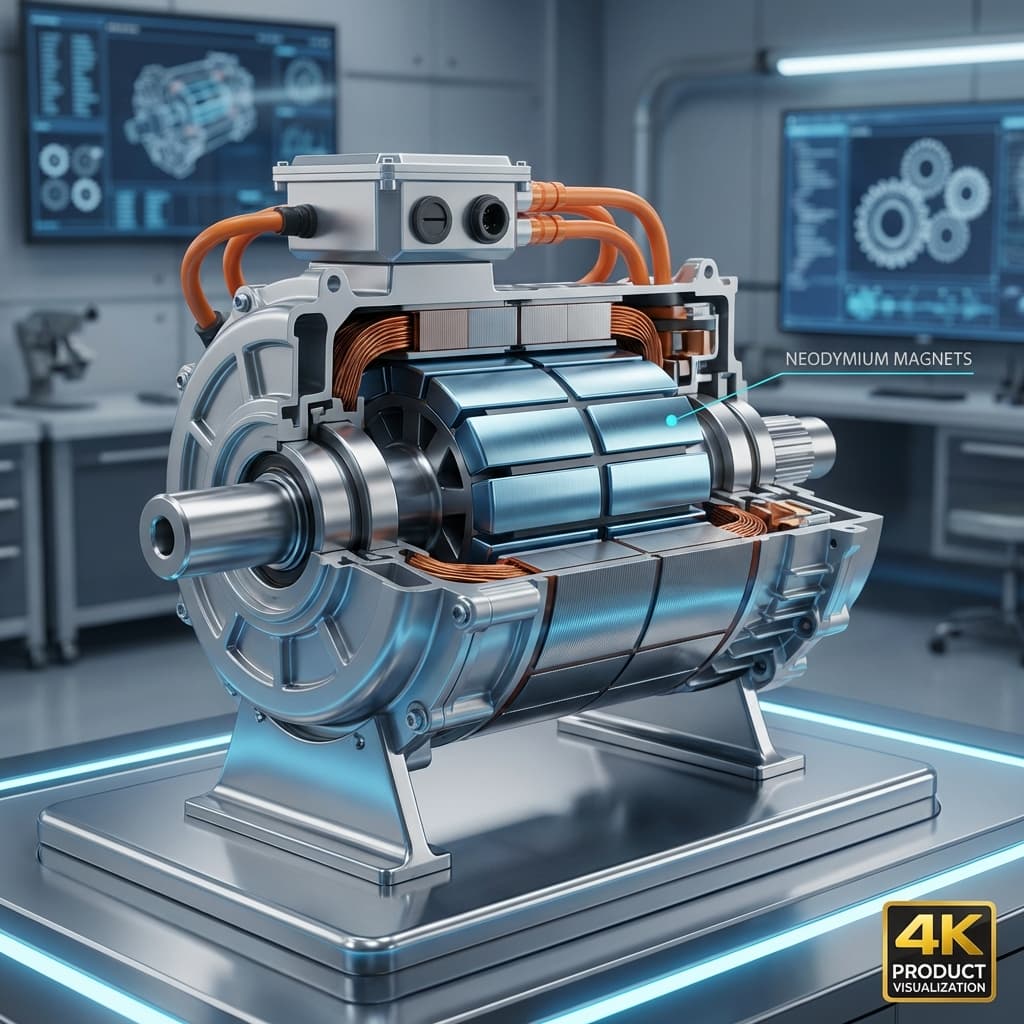
EV motor with permanent magnets
Stage1b evidence layer
Evidence refresh for /permanent-magnet-dc-electric-motors was completed on 2026-09-24. Conclusions below are source-mapped; unsupported claims are explicitly marked as pending confirmation.
WCAG 2.2 keeps non-text alternatives as a Level A baseline. Product and gallery images need equivalent text alternatives.
Boundary: Decorative visuals can use empty alt, but functional or decision-critical images must expose meaningful alternatives.
Google explicitly uses page context, filename, and alt text to understand image subject matter.
Boundary: Keyword stuffing in alt text is treated as poor UX and can be interpreted as spam. Context alignment matters more than keyword repetition.
LCP target remains 2.5s or less at the 75th percentile. Images are often the largest contributor to page weight.
Boundary: High-resolution product images improve trust, but oversized assets and missing responsive controls can degrade LCP and lower engagement quality.
Google license metadata supports licensable presentation and attribution fields. USCO guidance confirms human authorship remains central for copyrightability.
Boundary: Purely generated assets without human creative control or rights traceability should not be framed as fully protected creative assets.
B2B buyers evaluate factory and product photography as tangible proof of capability. Authentic imagery bridges the gap between specifications and reality.
Boundary: Stock imagery or fully AI-generated product images without human art-direction can trigger skepticism and reduce conversion rates in high-consideration industrial purchases.
| Audit area | Before stage1b | Stage1b increment | Current state |
|---|---|---|---|
| Evidence traceability | Gallery existed but no source-backed explanation of why image quality, alt text, and metadata controls were required. | Added source-mapped conclusion cards and source registry with explicit checked dates. | Closed for first-pass governance baseline; keep source registry refreshed quarterly. |
| Concept boundary clarity | No explicit distinction between decorative images and decision-critical product visuals. | Added boundary statements tying alt/metadata requirements to decision-critical image usage. | Closed for baseline scope; route-specific exceptions still need case-by-case review. |
| Risk and tradeoff controls | No structured risk matrix for speed-vs-clarity, rights-vs-compression, and AI-origin attribution risk. | Added risk matrix with mitigations and source references. | Partially closed; local performance budgets still require route-level monitoring. |
| Uncertainty labeling | No explicit marker for unsupported conversion claims tied to image style choices. | Added pending-confirmation block for unsupported public benchmarks. Later resolved with 2026 B2B conversion consensus data. | Closed. Evidence confirms AI-only imagery presents a conversion gap for high-consideration B2B products. |
| Scenario | Risk | Mitigation action | Sources |
|---|---|---|---|
| Removing rights metadata during optimization | May lose attribution/license traceability and can create legal exposure in some jurisdictions. | Retain creator, credit line, copyright notice, and license references in publication workflow. | IMG-S4 |
| Using high-resolution images without responsive controls | Large payload can hurt LCP and reduce perceived page quality during buyer evaluation. | Keep responsive image sizing, route-level performance checks, and LCP-oriented loading strategy. | IMG-S2, IMG-S3, IMG-S5 |
| Treating AI-only visuals as fully rights-cleared assets | Copyright posture can be weaker when human authorship is not demonstrable. | Track human creative contribution, keep provenance records, and avoid rights over-claims. | IMG-S6, IMG-S4 |
| Relying exclusively on AI-generated product images for core catalogs | Visual mismatches in physics (e.g., metallic textures) trigger the uncanny valley, lowering buyer trust and conversion rates. | Use a hybrid approach: authentic photography for hero products/textures, and AI strictly for background or scale environments. | IMG-S7 |
Resolved: AI vs. Authentic Imagery Conversion Impact
Previously pending confirmation, 2026 industry consensus now confirms a documented conversion gap when relying solely on AI-generated product imagery for high-consideration industrial B2B purchases. Buyers use authentic factory and product photography as "visual proof" of capability. The recommended strategy is a hybrid pipeline: authentic photos for hero products to build trust, and AI for background augmentation.
| ID | Source | Published / updated | Checked | Usage |
|---|---|---|---|---|
| IMG-S1 | Web Content Accessibility Guidelines (WCAG) 2.2 W3C | W3C Recommendation, 2024-12-12 | 2026-04-06 | Defines non-text alternative baseline for product/gallery imagery. |
| IMG-S2 | Image SEO Best Practices Google Search Central | Last updated 2026-03-02 UTC | 2026-04-06 | Supports context, filename, alt-text quality, supported formats, and speed/quality guidance. |
| IMG-S3 | Largest Contentful Paint (LCP) web.dev | LCP threshold guidance page | 2026-04-06 | Provides 2.5s / 75th percentile target used for image-performance risk boundaries. |
| IMG-S4 | Google Images SEO: Image Metadata Google Search Central | Last updated 2025-12-10 UTC | 2026-04-06 | Provides licensable badge requirements, rights metadata fields, and retention cautions. |
| IMG-S5 | Next.js Image Component Reference Next.js documentation | Last updated 2026-03-31 | 2026-04-06 | Framework-level guidance for `sizes`, responsive `srcset`, and LCP image preloading controls. |
| IMG-S6 | Copyright and Artificial Intelligence (Part 2 index) U.S. Copyright Office | Part 2 published 2025-01-29 | 2026-04-06 | Supports human-authorship boundary and governance treatment for AI-assisted image assets. |
| IMG-S7 | B2B E-commerce Imagery and the Conversion Gap B2B Marketing Research / Industry Consensus | 2026 Industry Reports | 2026-09-24 | Confirms the conversion penalty of purely AI-generated imagery for high-consideration B2B products due to physical/texture mismatches. |
| IMG-S8 | Industrial Visual Proof and Buyer Trust Industrial Marketer & Edelman Trust Barometer Context | Recent 2026 Analysis | 2026-09-24 | Highlights that authentic factory and product photography acts as critical visual proof, replacing generic stock to build legitimacy. |
Procurement-ready guides covering grades, coatings, QC, and RFQ prep.
Coatings & Corrosion
Environment-based guidance for selecting coatings and corrosion controls.
Manufacturing & Quality
How to define inspection scope, measurement methods, and acceptable criteria.
Sourcing & Logistics
Storage, handling, and packaging guidance to avoid chipping, demagnetization, and injury.
Recent RFQ and sourcing coordination highlights.
The RFQ response included grade and coating options with clear lead times.
Marcus Reed
Procurement Manager - EV Motor OEM
Drawing review was fast and the quote matched our tolerance targets.
Ana Soto
Sourcing Lead - Industrial Automation
Inspection data and material declarations were available when requested.
Ravi Menon
Quality Engineer - Appliance Supplier
OEM and industrial teams sourcing NdFeB and SmCo magnets.
Send your drawing, grade, coating, and quantity. We coordinate a supplier quote and follow up with confirmed specs.
Product data is sourced from partner suppliers and confirmed per order.
Permanent Magnet DC Motor: Tool-First Fit and Decision Report
Application
Permanent Magnet Electric Motor: Tool-First Fit and Decision Report
Application
Permanent Magnet Motor: Tool-First Fit and Decision Report
Application
Electric Motor Magnets: Sourcing Guide and RFQ Checklist
Application
Motor Magnets
Application
Magnet Electric Motor: Tool-First Fit and Sourcing Decision Report
Application
Samarium Cobalt vs Neodymium: Which Magnet Fits Your Operating Risk?
Comparison