
Thermal gate first
150 / 180 / 200 / 220C
Arnold catalog references for SH/UH/EH/AH, not safety limits. Geometry and opposing field determine the final grade.
SourcePre-RFQ material screen
Screen a candidate class and its risks before requesting a quote.
Published on 2026/03/24
Last updated 2026/11/08
Start with the fit check when class or coating is still open. Jump to RFQ once your input window is stable.
SH
typical max 150C
UH
typical max 180C
EH / AH
EH 200C / AH 220C*
SmCo 2:17
commonly used for 250-350C programs
Published by Ganzhou Magnets. Editorial screening methodology; no rotor testing is claimed.
Screening only, not design approval. Enter magnet temperatures, not ambient temperature.
No result yet
Enter temperatures and run the screen. After editing an input, run it again for an updated result.
* Catalog references, not rotor safety limits.
Most quote mismatch happens because buyers anchor on grade names but skip thermal margin, coating validation, and supply risk assumptions.
Thermal gate first
150 / 180 / 200 / 220C
Arnold catalog references for SH/UH/EH/AH, not safety limits. Geometry and opposing field determine the final grade.
SourceNdPr price moved up again
$55 -> $69/kg
USGS MCS 2026 reports the average NdPr oxide price rose from $55/kg in 2024 to $69/kg in 2025, so RFQ buffers should not assume flat raw-material pricing.
SourceHigh-temp crossover is real
>150C crossover
VAC's March 2026 brochure says selected VACOMAX SmCo alloys can deliver higher energy density than selected VACODYM NdFeB above 150C. Treat that as a working-point-specific counterexample, not a universal rule.
SourceGood fit for
Not suitable when
Historical data, not current prices or lead times. Implications are procurement interpretations; confirm rules and availability for each shipment.
Swipe horizontally on mobile to read the full table.
| Metric | Historical value / scenario | Date | Decision implication |
|---|---|---|---|
| Global REO mine output | 390,000 t REO (China 270,000 t) | USGS MCS 2026, February 2026; 2025 estimates | Concentration remains high. Keep at least one contingency chemistry or class lane for high-temp programs. |
| U.S. rare-earth net import reliance | 67% of apparent consumption | USGS MCS 2026, February 2026; 2025 estimates | Lead-time assumptions should include policy/logistics shock buffers, not only nominal supplier lead time. |
| Rare-earth import source concentration (U.S.) | China 71% (2021-24 average import source) | USGS MCS 2026, February 2026; 2025 estimates | If your grade requires Dy/Tb-rich classes, qualify at least two supply routes before tooling lock. |
| Average NdPr oxide price | $55/kg (2024) -> $69/kg (2025) | USGS MCS 2026, February 2026; 2025 estimates | Do not freeze long-volume contracts without a raw-material reset clause or alternate class lane. |
| China export-control trigger | Announcement No.18 added controls on selected medium/heavy rare-earth items and permanent magnet materials | MOFCOM, effective 2025-04-04 | Ask suppliers to disclose controlled-item exposure and licensing route, not just factory location. |
The planner intentionally mirrors engineering handoff: thermal envelope -> material shortlist -> coating route -> validation gate -> procurement path.
Step 1: Thermal envelope gate
Peak magnet temperature selects a SH/UH/EH/AH reference. Continuous temperature checks input consistency (peak >= continuous); peak duration and thermal cycling are not modeled.
Step 2: Catalog reference headroom
Subtract peak from the class reference. Below 15C requires review: this is an editorial screening rule, not calculated coercivity reserve or a safety threshold.
Step 3: Corrosion route selection
Exposure band drives coating and test load (e.g., NiCuNi baseline, epoxy for coolant/humidity), but salt-spray hours alone do not prove field lifetime.
Step 4: Launch pressure and control-lane adjustment
Aggressive prototype windows and controlled-item licensing risk increase fallback pressure and can require alternate material planning before PO.
Each conclusion is tied to an external source and date marker. Standards pages are included to keep validation scope explicit.
Swipe horizontally on mobile to read the full table.
| Source | What we use from it | Date marker |
|---|---|---|
| USGS Rare Earths chapter (MCS 2026) | 2025 estimates: world rare-earth output 390,000 t REO, China 270,000 t; U.S. net import reliance 67%, China supplied 71% of U.S. imports (2021-24), and average NdPr oxide price increased from $55/kg (2024) to $69/kg (2025). | February 2026; 2025 estimates |
| China MOFCOM Announcement No.18 of 2025 | Effective 2025-04-04, export controls were added on selected medium/heavy rare-earth compounds, metals, oxides, alloys, mixtures, and permanent magnet materials. | Published 2025-04-04 |
| DOE Electric Drive Technologies roadmap (2023 consensus) | Traction motor research context and rare-earth-free alternatives; this is not a current price or universal cost benchmark. | March 2024 roadmap |
| VAC product information: VACODYM / VACOMAX | Lists NdFeB and SmCo performance windows, states NdFeB operating temperature depends on working point/coercivity, and notes selected VACOMAX SmCo alloys can exceed selected VACODYM energy density above 150C. | Published 2026-03 |
| IEC 60404-18:2025 | Defines open-circuit magnetic property measurement for permanent magnets, including self-demagnetization correction and suitability for high Hcj materials. | IEC 60404-18:2025; checked 2026-11-08 |
| IEC 60068-2-11:2021 | Defines salt mist test procedures for quality control and detection of coating discontinuities before shipment. | IEC 60068-2-11:2021; checked 2026-11-08 |
| ASTM B117-26 page | Confirms salt spray exposure itself does not prescribe interpretation or exposure duration, so it should not be treated as a direct field-life predictor. | Updated 2026-01-19; checked 2026-11-08 |
| European Commission electric motors page | Provides current EU ecodesign scope and milestone context for motors and variable speed drives, which matters when a procurement team mixes traction and industrial motor assumptions. | Checked 2026-11-08 |
| IEC TS 60034-30-2:2016 | Covers efficiency classes for variable-speed AC motors, including PM synchronous machines not operated directly on-line, so regulatory scope should not be generalized across all motor programs. | IEC TS 60034-30-2:2016; checked 2026-11-08 |
| Arnold Magnetic Technologies: NdFeB catalog | SH 150C, UH 180C, EH 200C and AH 220C catalog references; these do not qualify a specific rotor. | Checked 2026-11-08 |
Reviewed 2026-11-08. Editions and statistics retain their historical dates. This is not a complete register of current controls or a price forecast.
Use this table to discuss tradeoffs with engineering and procurement in one review instead of separate meetings.
Swipe horizontally on mobile to read the full table.
| Decision dimension | NdFeB SH/UH | High-coercivity NdFeB / GBD | SmCo 2:17 |
|---|---|---|---|
| Typical BHmax window | Grade dependent; compare curves | Grade dependent; compare curves | 20-33 MGOe |
| Max operating class | 150-180C | EH 200C / AH 220C (catalog reference) | 250-350C |
| High-temperature energy retention | Strong at 20C, but advantage can shrink as temperature rises | Better high-temp coercivity, still working-point dependent | Selected grades can overtake selected NdFeB above 150C |
| Corrosion baseline | Coating required for sustained humidity/media exposure | Coating required for sustained humidity/media exposure | Often coating-optional, but still verify mating-system corrosion |
| Rare-earth exposure objective | No, still rare-earth dependent | No, but heavy-rare-earth loading can be optimized | No, shifts to Sm/Co route rather than removing rare-earth exposure |
| Metrology requirement before class lock | IEC 60404-5 or 60404-18 + FEM/load-line check | Prefer IEC 60404-18 for high Hcj + demag correction | Same metrology + thermal cycle mechanical checks |
| Best fit scenario | Mainstream EV/servo with <=180C peaks | High-load motors with thin thermal margin | Hotspot >220C or severe thermal cycling |
Typical BHmax window
VAC figures span complete alloy families, not equivalent SH/UH/EH/AH grade windows.
Max operating class
GBD is a process, not a thermal class. Arnold references apply; VAC also lists special alloys up to 240C. The 220C ceiling only limits this tool.
High-temperature energy retention
VAC March 2026 data shows a real counterexample: some SmCo alloys outperform some NdFeB alloys above 150C. Do not generalize that crossover beyond the disclosed working point and alloy family.
Corrosion baseline
VAC states high-cobalt SmCo can resist prolonged hot-humidity exposure better, but ASTM B117 and IEC 60068-2-11 remain screening tools rather than direct life models.
Rare-earth exposure objective
If rare-earth avoidance is the first objective, DOE roadmaps point to non-permanent-magnet alternatives with expected energy-density, NVH, or weight penalties.
Metrology requirement before class lock
Skip direct cross-supplier comparison when measurement method is not explicitly disclosed.
Best fit scenario
Validate with FEM + demag bench before volume release.
Use these gates to avoid overgeneralizing catalog data into production decisions.
Swipe horizontally on mobile to read the full table.
| Condition | Preferred interpretation | Caution zone | Do not conclude yet |
|---|---|---|---|
| Thermal margin to class ceiling | >=25C: class discussion can proceed with normal validation cadence. | 15-24C: keep contingency grade lane and run early demag verification. | <15C: do not lock supplier by price only. |
| Catalog BHmax vs operating-temperature working point | Compare demag curves and working point at the actual operating temperature. | Using BHmax or Br at 20C as the main supplier-ranking metric. | Treating a better room-temperature catalog number as proof of better motor output. |
| Corrosion proof | ASTM B117 / IEC 60068-2-11 pass with defined acceptance criteria. | Salt spray pass only, but no field medium mapping. | No coating test scope or undefined acceptance criteria. |
| Data comparability across suppliers | Measurement method disclosed (IEC 60404 family) and same working point. | Method disclosed but demag correction/work point differs. | No disclosed method, only headline BHmax. |
| Efficiency or regulation scope | Confirm whether the motor is actually in scope for EU 2019/1781 or IEC TS 60034-30-2. | Using industrial IE classes as a shortcut for traction or custom servo motor decisions. | Assuming EV traction, inverter-fed PMSM, and direct-on-line industrial motors share the same compliance path. |
Thermal margin to class ceiling
15C and 25C are editorial planning rules, not standards or safety guarantees.
Catalog BHmax vs operating-temperature working point
VAC and IEC metrology sources both point to the same boundary: motor decisions fail when room-temperature catalog data replaces in-service magnetic behavior.
Corrosion proof
ASTM B117 itself does not define duration choice or field-life interpretation.
Data comparability across suppliers
Without metrology comparability, cross-quote ranking is unstable.
Efficiency or regulation scope
Regulatory scope changes the test/document path, but it does not replace the magnet working-point decision.
Known unknowns (explicitly pending)
Public benchmark price by grade class + coating + geometry
Status: No reliable open consolidated dataset
Next step: Use normalized RFQ templates and supplier-side quote evidence instead of scraped list prices.
Supplier-specific Dy/Tb loading by high-temp grade
Status: Mostly proprietary across vendors
Next step: Request disclosure windows or at least substitution risk notes in NDA-based technical review.
Universal conversion from salt-spray hours to in-field lifetime
Status: No standard one-to-one conversion
Next step: Pair salt-mist tests with application-specific coolant/humidity cycling and teardown criteria.
Public lead-time benchmarks for controlled rare-earth export items
Status: No reliable open dataset
Next step: Require suppliers to disclose controlled-item exposure, licensing responsibility, and backup origin plan in the RFQ pack.
Editorial qualitative matrix: these are not measured probabilities or customer test results.
Swipe horizontally on mobile to read the full table.
| Risk | Probability | Impact | Mitigation |
|---|---|---|---|
| Thermal misclassification (using SH where AH is needed) | Medium | High | Require operating-temperature B-H curves, FEM and bench tests before approval. |
| Coating under-validation in coolant/salt environments | Medium | High | Tie coating plan to ASTM B117 + IEC 60068-2-11 and define field-correlated acceptance criteria early. |
| Rare-earth price and availability shock | High | Medium | Maintain two qualified grade windows, add a raw-material reset mechanism, and keep one alternate material path open. |
| Export-license disruption in Dy/Tb or controlled-item lanes | Medium | High | Track control updates, ask suppliers to declare controlled-item exposure, and pre-qualify fallback class/material options before PPAP. |
Illustrative scenarios, not validated customer cases
Scenario A: EV traction rotor, peak 170C, humid bay
Premise: Program targets high torque density with moderate lead-time flexibility.
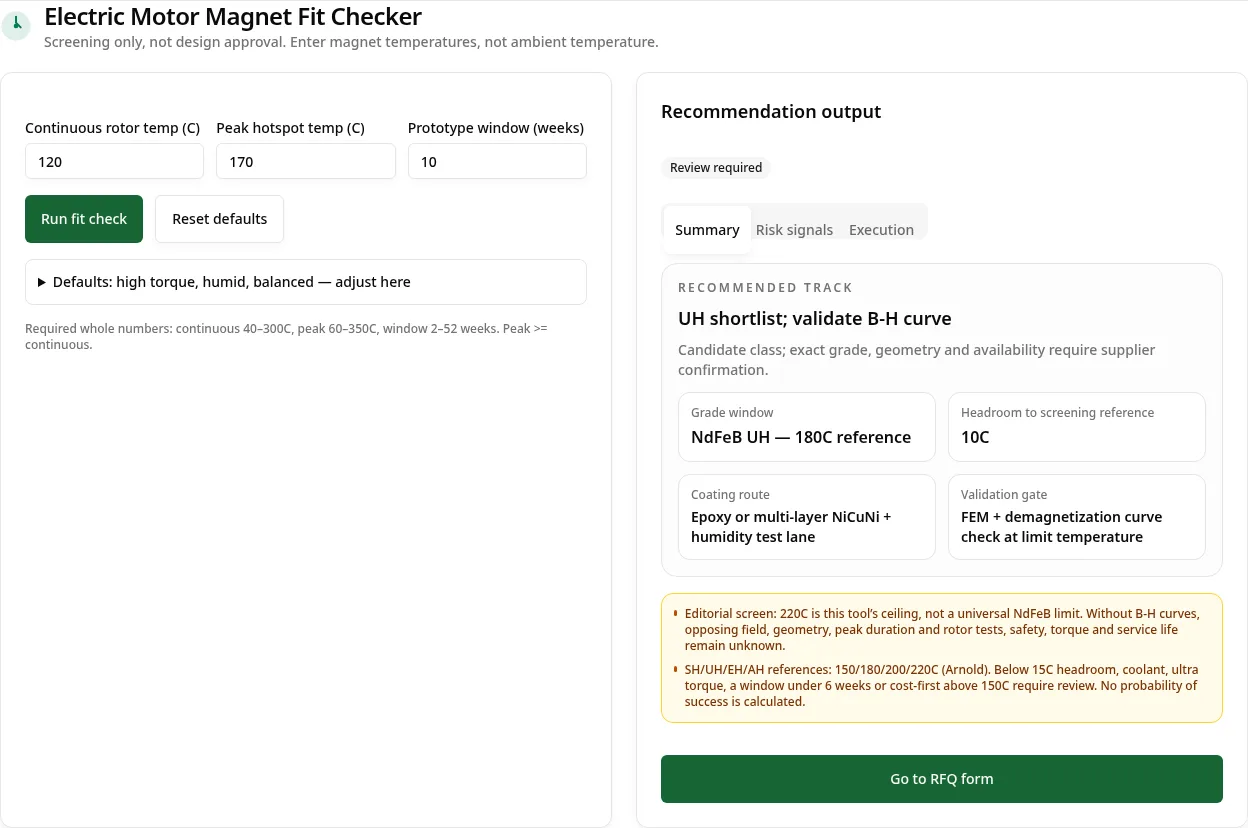
Process: Inputs 120/170C, 10 weeks, high torque, humid, balanced: UH with 10C reference headroom; review required.
Outcome: Request curves and a corrosión test scoped to actual media; no universal test duration is prescribed.
Scenario B: Compressor motor, peak 235C
Premise: Thermal hotspot exceeds AH comfort zone in sustained operation.
Process: Inputs 180/235C: outside this NdFeB screen; evaluate SmCo or cooling without qualifying either.
Outcome: Request a separate review of material, cooling, geometry and sourcing before selecting an alternative.
Scenario C: Industrial servo, peak 140C, aggressive cost target
Premise: Team wants lower cost without sacrificing launch reliability.
Process: Inputs 100/140C, 4 weeks, cost-first: SH with 10C headroom and a short window; review required.
Outcome: Request SH curves and a UH alternative, and confirm the window with suppliers.
Scenario D: Existing AH design, but Dy/Tb export route is disrupted
Premise: Thermal target remains valid but one import route is delayed after a controlled-item review.
Process: Manual review outside the tool inputs: confirm chemistry, origin, licensing and alternatives before ordering.
Outcome: Review alternate routes and test equivalence; switching to SmCo does not automatically remove export controls.
Answers for thermal validation and a supplier quotation brief.
Thermal screening and RFQ
Enter continuous and peak magnet hotspot temperatures and a prototype window. This preliminary screen selects SH, UH, EH or AH catalog references, then flags headroom, exposure and schedule concerns for supplier review. It does not calculate rotor safety, torque or service life.
These are Arnold catalog references for SH, UH, EH and AH. Actual performance depends on grade, geometry, opposing field, peak duration and operating-temperature B-H curves. The 220C ceiling limits this tool; it is not a universal NdFeB limit.
Headroom is the catalog reference minus the entered peak temperature. The 15C review trigger and 25C planning band are editorial rules, not standards, measured coercivity reserves or safety factors. Even a candidate result needs engineering validation.
Above this tool’s 220C ceiling, evaluate SmCo or thermal redesign with engineering. A SmCo alternative is not approved by this output and can have its own sourcing and export-control constraints.
There is no universal conversion from salt-spray hours to service life. Define the coating, actual coolant or humidity exposure, acceptance criteria and application-specific tests with the supplier before comparing quotes.
Include a drawing, magnetization direction, tolerances, continuous and peak magnet temperatures, peak duration, opposing field or load-line assumptions, media exposure, quantity and prototype schedule. Request operating-temperature curves and magnetic, coating and dimensional acceptance criteria.
Prepare your motor magnet RFQ
Share a drawing, tolerances, magnetization direction, magnet temperatures and peak duration, media exposure, quantity and schedule. Include your screen inputs and result when requesting supplier curves and acceptance criteria.
Primary CTA supports immediate WhatsApp/email outreach; secondary path keeps a documented engineering handoff.

EV motor with permanent magnets
Procurement-ready guides covering grades, coatings, QC, and RFQ prep.
Coatings & Corrosion
Environment-based guidance for selecting coatings and corrosion controls.
Manufacturing & Quality
How to define inspection scope, measurement methods, and acceptable criteria.
Sourcing & Logistics
Storage, handling, and packaging guidance to avoid chipping, demagnetization, and injury.
Send your drawing, grade, coating, and quantity. We coordinate a supplier quote and follow up with confirmed specs.
Product data is sourced from partner suppliers and confirmed per order.
Electric Motor Magnets: Sourcing Guide and RFQ Checklist
Application
Motor Magnets
Application
Magnet Electric Motor: Tool-First Fit and Sourcing Decision Report
Application
Permanent Magnet Electric Motor: Tool-First Fit and Decision Report
Application
Samarium Cobalt vs Neodymium: Which Magnet Fits Your Operating Risk?
Comparison
NdFeB Magnet Grades: Selector Tool and Evidence Report
Educational
Custom Neodymium Magnets for OEM RFQ
Sourcing