
Neodymium earth magnets: check your duty profile
Check NdFeB duty requirements and get an RFQ evidence checklist. This preliminary screen does not calculate field, holding force or final grade.
Published 2026/03/31 · Updated 2026/11/08
1) Check your magnet requirements
Example values are prefilled. Replace them with your requirements; the result gives a preliminary category and RFQ checklist.
No result yet
Run the duty screen to generate a preliminary rule-based duty category, boundary notes, and the next RFQ evidence checklist.
The output includes suitability boundaries and a fallback route when NdFeB is not a safe primary lane.
Hypothetical actuator example matching the form defaults; no physical test or customer result is claimed.
- Target flux density: 780 mT
- Max operating temp: 125C
- Peak temp: 155C
- Corrosion exposure: Humid / intermittent condensation
- Shape complexity: Standard geometry
- Compliance lane: General industrial; 60,000 units/year; balanced cost
Illustrative interpretation: Typical output is "Conditional screen" at an entered planning temperature of 155°C: sintered NdFeB remains a candidate, but release depends on coating evidence, temperature-class confirmation, and an SmCo fallback lane if validated thermal reserve remains narrow.
Why this matters: NdFeB is one rare-earth family. Humidity triggers evidence review rather than adding a fictitious temperature penalty.
2) Report summary (decision-ready conclusions)
These cards summarize the key decisions, core numbers, and applicability boundaries so teams can align quickly.
Run the screen
Internal rules organize evidence requests; no probability or qualification is implied.
Use your peak temperature
Entered temperatures only. No corrosion or geometry penalties are converted into degrees.
NdFeB or SmCo?
Compare actual output at duty temperature and total system cost using supplier curves [E1][E2].
Package + product scope
Shipment field and consumer-product scope require separate checks; preliminary fit cannot approve either [E3][E4].
- Engineering teams defining first-pass material lanes before RFQ.
- Procurement teams that need explicit evidence gates before supplier ranking.
- Programs balancing compact size requirements with thermal and corrosion boundaries.
- Teams expecting universal grade answers without duty-cycle evidence.
- Projects that cannot execute minimum thermal/corrosion validation.
- Cost-only sourcing workflows with no fallback lane definition.
3) Key numbers and scope boundaries
Numeric claims are disclosed with date markers. Unknown or uncertain items are explicitly labeled to avoid false certainty.
| Metric | Value | Date marker | Decision implication | Source ref |
|---|---|---|---|---|
| N52 temperature example | 60°C in the cited Arnold N52 row | Catalog checked 2026-11-08 | Do not infer an 80°C guarantee from the N prefix or energy grade; verify the specific supplier curve and working point. | [E1] |
| U.S. air-carriage exclusion threshold | >0.00525 gauss at 4.5 m | FAA guidance checked 2026-11-08 | Measure shipment-ready packaging; material selection cannot certify air shipment. | [E3] |
| U.S. subject consumer magnets | Flux index <50 kG² mm² for small-parts-cylinder magnets | CPSC guidance checked 2026-11-08 | Applies only within rule scope; the tool does not calculate flux index or determine certification. | [E4] |
| EU Article 28 format-act deadline | 24 November 2025, as corrected | 2024 corrigendum checked 2026-11-08 | The deadline has passed. Confirm implementing-act publication and entry into force before scheduling label/data-carrier duties. | [E5][E6] |
| EU Article 29 mass trigger | >0.2 kg total of the specified magnets in a covered product | Base regulation checked 2026-11-08 | The base text uses 24 May 2027 or two years after the methodology act enters into force, whichever is later; verify subsequent enacted changes. | [E5] |
Note: Grade suffix windows shown here are supplier planning conventions. Final qualification always depends on measured magnetic curves, thermal reserve checks, and application-specific validation.
Evidence snapshot checked on selected source checks: 2026-11-08; EU implementation status remains unconfirmed.
Share your duty profile, shipment lane, and channel assumptions. We will return an RFQ-ready action list with fallback triggers.
3.5) Policy and compliance trigger matrix (neodymium route)
This section adds time-bound regulatory and market triggers that materially change NdFeB procurement decisions for EU-facing and globally exposed programs.
| Trigger | What changed | Timing | Sourcing impact | Minimum action | Source ref |
|---|---|---|---|---|---|
| EU Article 28 labels and data carrier | The corrected format-act deadline is 24 November 2025; this is an implementing act, not an Article 29 delegated act. | Base text links duties to two years after implementing-act entry into force. Its current publication/status is not confirmed here. | A statutory deadline alone cannot establish a product go-live date. | Check current enacted text, product scope and the Official Journal before committing dates. | [E5][E6] |
| EU Article 29 recycled-content disclosure | Base text covers specified magnets totaling more than 0.2 kg in covered products. | Base-text date: 24 May 2027 or two years after the delegated methodology act enters into force, whichever is later. The original methodology deadline was 24 May 2026. | Subsequent legislation and act status require confirmation; no compliance-ready claim is made here. | Collect element-specific post-consumer recycled-content records; verify the enacted method and applicable dates. | [E5] |
| U.S. shipment and consumer-product checks | FAA package-field guidance and CPSC product-scope guidance require separate evidence. | Guidance checked 2026-11-08; re-check for each market release or booking. | A magnet can pass this duty screen and still fail shipment or product requirements. | Measure the final package; determine product scope and required testing/certification. | [E3][E4] |
| Pending item | Current status | Impact | Minimum action | Source ref |
|---|---|---|---|---|
| EU implementation status | Base regulation and corrigendum checked 2026-11-08; current implementing/delegated acts and subsequent amendments are not confirmed here. | No firm label or disclosure launch date can be derived from this page. | Confirm current Official Journal publications and product scope with the responsible compliance owner. | [E5][E6] |
Article 28 and Article 29 status checked 2026-10-17. Verify the current enacted text and Official Journal before relying on an implementation date.
4) Methodology
The method combines technical feasibility and sourcing execution in one path so output can directly drive next actions.
1. Use entered temperatures
Planning temperature is max(peak, sustained operating temperature). Corrosion, geometry and compliance do not add degrees. The peak-to-operating gap is not a demagnetization safety margin.
2. Apply disclosed screening rules
Above 220°C: outside this tool’s NdFeB screening range. Above 180°C, non-dry exposure, non-standard geometry, cost-first sourcing, special controls or annual volume below 3,000: conditional. Cost-first + non-dry + target flux ≥1,200 mT is also outside the screen. These are internal triage rules, not validated physical limits.
3. Keep performance unknown
Target flux is a requirement supplied by you. Without geometry, measurement location, air gap and a load line, this tool cannot predict field, force, coercivity reserve or final grade. No statistical confidence is reported.
4. Request evidence before selection
Use the result to request supplier curves at temperature, orientation, coating tests in the actual media, shipment checks and a comparable quote. Keep SmCo or geometry changes open where needed [E1–E4].
5) Data sources and evidence trail
Every key conclusion maps to a source and date marker so reviewers can validate or challenge assumptions quickly.
| Ref | Source | Signal used on this page | Date marker |
|---|---|---|---|
| E1 | Arnold Magnetic Technologies: NdFeB grades and application limits | NdFeB properties depend on alignment, size and shape. Temperature, output and system cost determine material choice; humid applications need coating review. | Manufacturer page checked 2026-11-08; catalog data, not application qualification |
| E2 | Arnold Magnetic Technologies: RECOMA SmCo | Supplier-specific SmCo alternatives for elevated-temperature applications; compare the actual grade curves rather than a family-wide ceiling. | Manufacturer page checked 2026-11-08 |
| E3 | FAA PackSafe: magnets | Packages exceeding 0.00525 gauss at 4.5 m from any surface cannot fly. Passing this threshold alone is not carrier acceptance. | FAA page checked 2026-11-08; U.S. air-transport context |
| E4 | CPSC: magnets business guidance | For subject products, loose/separable magnets that fit the small-parts cylinder must have flux index below 50 kG² mm². Product scope, exclusions and certification matter. | Guidance checked 2026-11-08; rule applies to subject products manufactured after 2022-10-21 |
| E5 | EUR-Lex: Regulation (EU) 2024/1252, Articles 28–29 | Article 28 ties label/data-carrier duties to an implementing act. Article 29 ties recycled-content disclosure to covered products, magnet mass and a delegated methodology act. | Base regulation checked 2026-11-08 alongside E6; subsequent act status remains unconfirmed here |
| E6 | EUR-Lex: Corrigendum (EU) 2024/90330 | Corrects the Article 28(2) implementing-act deadline to 24 November 2025. A deadline is not an entry-into-force date. | Published 2024-06-03; checked 2026-11-08 |
Selected manufacturer, FAA, CPSC and EU base-text sources checked 2026-11-08. Subsequent EU acts/amendments remain unconfirmed; verify before market release.
6) Concept boundaries and applicability rules
These boundaries are used to prevent over-interpretation of catalog labels and to define where additional evidence is mandatory.
| Boundary | Meaning | Use when | Do not use when | Source ref |
|---|---|---|---|---|
| Neodymium is a rare-earth magnet family | The query normally refers to NdFeB. SmCo is another rare-earth family, not another name for NdFeB. | Compare actual temperature/output/cost requirements. | Do not assume identical properties across families. | [E1][E2] |
| Grade and temperature are application-specific | A commercial suffix is a prompt for supplier review, not qualification. | Request grade-specific curves at actual hotspot temperature. | Do not infer pull force or thermal margin from a grade name. | [E1] |
| Coating requires media-specific evidence | Humid NdFeB applications generally need protective coating; material quality affects effectiveness. | Define humidity, splash, coolant, temperature cycling and pass/fail criteria. | Do not turn a coating name or chamber-test duration into a service-life guarantee. | [E1] |
| Shipping and market access stay separate | Package field and consumer-product scope require their own checks. | Confirm the package and final product before shipment or launch. | A preliminary fit result is not shipment or compliance approval. | [E3][E4] |
7) Material comparison and tradeoffs
Compare material routes using reproducible dimensions instead of marketing-only descriptors.
| Decision dimension | Sintered NdFeB | Bonded NdFeB | SmCo | Comment | Source ref |
|---|---|---|---|---|---|
| Compact output | Candidate for high output in a small envelope | Consider where molding and shape freedom matter; binder changes magnetic properties | Compare supplier output at actual duty temperature | No universal energy-density index is used. Bonded grade performance requires a supplier datasheet. | [E1][E2]; bonded route subject to supplier confirmation |
| Temperature | Grade and load-line dependent | Also limited by binder and process; exact limit unknown here | Candidate fallback for elevated temperatures | Compare curves at the same working point and thermal cycle. | [E1][E2] |
| Corrosion | Protective coating review, especially in humidity | Confirm binder and media compatibility | Check the actual grade and media rather than assuming immunity | Qualify complete parts in their service environment. | [E1][E2]; application-specific validation required |
| Cost and lead time | Quote geometry, coating, volume and inspection together | Include mold/tooling and process qualification | Compare total system cost rather than unit price alone | Prices, tooling cost and available capacity are unknown until quoted. | [E1][E2]; procurement checklist, not market-price data |
| Release evidence | Supplier curves, dimensional and coating acceptance | Supplier curves plus binder/process evidence | Supplier curves and thermal-cycle evidence | Same field location, air gap and acceptance conditions for every candidate. | [E1][E2] |
| Shipping and consumer use | Measure package field and review product scope | Same checks; lower output is not an exemption | Same checks; material family is not an exemption | Keep logistics and product-safety reviews independent of material screening. | [E3][E4] |
8) Risk matrix and mitigation
Misuse risk, cost risk, and scenario mismatch risk are shown together so the team can sequence mitigation actions.
Qualitative rule flags from the inputs; no statistical probabilities or measured failure rates. Confirm application risks with the responsible engineer.
| Risk | Rule flag | Impact | Mitigation |
|---|---|---|---|
| Thermal misclassification versus real hotspot duty | Low | Medium | Recalculate adjusted operating + peak duty with measured cycle data and confirm class with demag-curve checks before PO. |
| Coating-lifecycle mismatch under real media exposure | Medium | Medium | Map media profile to explicit corrosion + thermal-cycle tests and define pass/fail criteria up front. |
| Supplier data non-comparability (test method mismatch) | Medium | Medium | Require method disclosure (IEC 60404 family) and normalize working points before ranking quotes. |
| High-temperature lane heavy-rare-earth exposure | Medium | Medium | When adjusted duty approaches EH/AH lanes, request Dy/Tb exposure disclosure and define export-control fallback triggers before award. |
| Supply concentration shock during launch window | High | Medium | Maintain contingency lane and pre-define switch triggers for temperature, lead time, and cost tolerance. |
9) Open evidence gaps and minimum closure path
Where public evidence is incomplete, this page does not force a hard conclusion. Each gap includes a minimal executable closure action.
| Evidence gap | Current status | Decision impact | Minimum closure action | Source ref |
|---|---|---|---|---|
| Achievable field, force and demagnetization reserve | Unknown: no drawing, circuit, air gap or measurement position is supplied to this screen. | Target flux cannot establish material fit or holding capacity. | Send geometry, orientation, load-line analysis and curves at temperature; verify on the assembly. | [E1][E2] |
| Coating lifetime and media compatibility | Unknown for the actual part and coating process. | Nominal coating choice may not withstand real duty. | Agree media and thermal-cycle tests, inspection and acceptance criteria before purchase. | [E1] |
| Delivered price and shipping readiness | No live supplier quote or package-field measurement. | Unit price omits tooling, testing, rejects, shielding and logistics. | Request itemized quotes at matching volume and Incoterms; measure shipment-ready packages. | [E1][E3]; cost checklist is procurement guidance |
| EU implementation status | Base regulation and corrigendum checked 2026-11-08; current implementing/delegated acts and subsequent amendments are not confirmed here. | No firm label or disclosure launch date can be derived from this page. | Confirm current Official Journal publications and product scope with the responsible compliance owner. | [E5][E6] |
Labeling policy: when reliable public data is insufficient, status is marked as "no reliable public data" and converted into a validation task instead of a forced conclusion.
10) Scenario examples
Each scenario includes assumptions, tool outcome, and minimum executable next step.
Assumptions
780 mT target, 50°C operating, 70°C peak, 60,000/year, indoor dry, standard shape, balanced cost, general industrial.
Outcome
Preliminary fit: no rule trigger. Achievable field and final grade remain unverified.
Next step
Request a drawing-based supplier review and curves at 70°C.
Assumptions
780 mT target, 125°C operating, 155°C peak, 60,000/year, humid, standard shape, balanced cost, general industrial (the form defaults).
Outcome
Conditional screen because of humidity. Planning temperature stays 155°C; humidity does not add degrees.
Next step
Compare high-coercivity grades and coating evidence in actual service media; keep a fallback open.
Assumptions
780 mT target, 220°C operating, 238°C peak, 60,000/year, indoor dry, standard shape, balanced cost, general industrial.
Outcome
Preliminary not fit: above this tool’s 220°C screening range. This does not prove all NdFeB grades impossible.
Next step
Obtain specialist supplier review; compare SmCo and thermal redesign before grade selection.
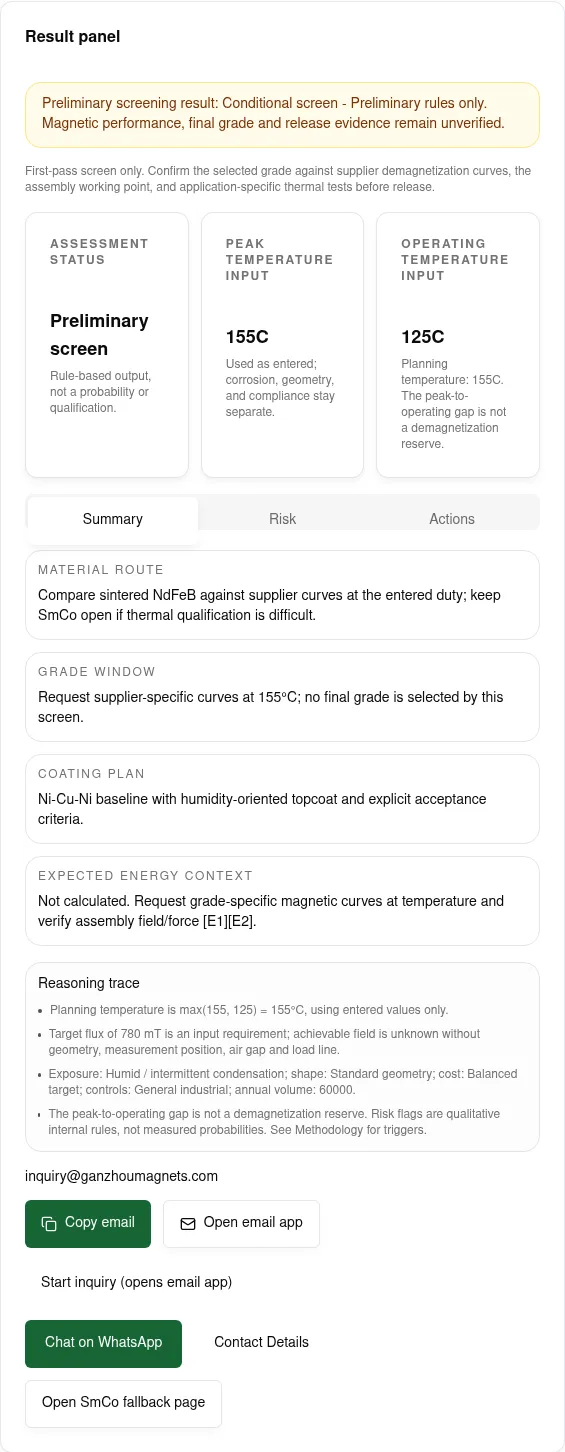
Reproduce the default duty screen
Captured from this tool on 8 November 2026 using hypothetical inputs: 780 mT target, 125°C operating, 155°C peak, 60,000 units/year, humid exposure, standard geometry, balanced cost and general industrial controls. Reset the form and generate a result to reproduce it.
11) FAQ (decision-focused)
Questions are grouped by decision intent so teams can move from explanation to execution.
Are neodymium earth magnets the same as rare-earth magnets?
The phrase usually means NdFeB. NdFeB and SmCo are distinct rare-earth magnet families; compare supplier data for the actual duty [E1][E2].
Does the tool calculate field or pull force?
No. Target flux is your requirement. Field location, geometry, orientation, air gap and load line remain unknown; request an assembly-specific calculation and test [E1].
What does preliminary fit mean?
No internal triage rule was triggered. It is not proof of magnetic performance, final grade, safety, certification or purchase approval.
How are temperatures used?
The screen uses the higher of entered peak and operating temperature. Non-thermal risks stay separate. The gap between those two inputs is not a demagnetization margin.
Can every N52 magnet run at 80°C?
No. The cited Arnold N52 row lists 60°C. Temperature limits depend on grade, geometry, load line and vendor evidence [E1].
When should SmCo be compared?
Keep it open where elevated temperature makes NdFeB qualification difficult. Compare output at duty temperature and total system cost using actual supplier curves [E1][E2].
When should bonded NdFeB be considered?
Use a supplier review when molding or shape freedom matters. Binder, process, field requirement and temperature can change suitability; exact performance is not predicted here.
Does a coating guarantee corrosion life?
No. Define service media, cycling, handling and pass/fail tests. Arnold notes that coating effectiveness also depends on the base material [E1].
What belongs in a comparable RFQ?
Include drawing/tolerances, quantity, orientation, target field location and air gap, temperatures/cycles, media, coating tests, inspection, destination and Incoterms. Request tooling and validation costs separately.
Can a fit result approve air shipment?
No. FAA excludes packages above 0.00525 gauss at 4.5 m from any surface; carrier acceptance and other transport requirements must also be checked [E3].
Does the U.S. consumer magnet rule cover every industrial part?
No. CPSC defines subject consumer-product uses and exclusions. Subject loose/separable magnets fitting the small-parts cylinder must have flux index below 50 kG² mm²; determine scope and certification for the actual product [E4].
When do EU magnet labels and recycled-content disclosures apply?
Article 28 depends on an implementing act; its corrected format-act deadline was 24 November 2025. Article 29 has separate mass/scope and methodology triggers. This page has not confirmed subsequent acts or amendments: check current enacted text before committing dates [E5][E6].
12) Next action
Share your duty profile and we will return a material-lane recommendation with grade window, coating strategy, validation checklist, and RFQ normalization notes.
Product Gallery

Disc magnets in various sizes
Specifications
| Primary material lane | Sintered NdFeB as the first-pass route for compact high-force assemblies |
| Rare-earth family scope | Neodymium magnets are one rare-earth permanent-magnet family; SmCo remains the main high-temperature fallback |
| Typical grade planning | Supplier-specific temperature curves and magnetic circuit validation; no final grade is selected by the tool |
| Critical release controls | Thermal reserve, corrosion/coating evidence, supply-route risk, and fallback-lane ownership |
| Tool output payload | Preliminary screening category, entered temperature, evidence limits, and next-step RFQ actions |
| Minimum fallback rule | Keep SmCo or bonded NdFeB open when validated thermal, corrosion, or geometry reserve is too narrow |
Need a quote-ready specification review?
Share your drawing, grade target, coating, and quantity. We align supplier feasibility before full RFQ submission.
Reference Guides
Procurement-ready guides covering grades, coatings, QC, and RFQ prep.
Coatings & Corrosion
Corrosion protection for rare earth magnets
Environment-based guidance for selecting coatings and corrosion controls.
Manufacturing & Quality
Inspection and testing for NdFeB magnets
How to define inspection scope, measurement methods, and acceptable criteria.
Sourcing & Logistics
Magnet storage and handling safety
Storage, handling, and packaging guidance to avoid chipping, demagnetization, and injury.
Request a Quote
Get a Quote
Send your drawing, grade, coating, and quantity. We coordinate a supplier quote and follow up with confirmed specs.
Product data is sourced from partner suppliers and confirmed per order.
Related Pages
Neodymium Magnets: Fit Tool and Procurement Decision Report
Product
Neodymium Magnet: Tool-First Fit and Decision Report
Product
Neodymium NdFeB: Fit Tool and Procurement Evidence Report
Product
Rare Earth Magnets vs Neodymium: What Buyers Actually Need to Compare
Comparison
Rare Earth Magnets for Sale: Tool-First Buying and Risk Report
Sourcing
Samarium Cobalt Magnets Fit Tool and Sourcing Report
Product
NdFeB Magnet Grades: Selector Tool and Evidence Report
Educational
Neodymium Magnet Strength: Calculator and Evidence Report
Educational
Custom Neodymium Magnets for OEM RFQ
Sourcing
NdFeB Magnet: Fit Tool and Sourcing Decision Report
Product