
Bulk Custom Magnets: Plan Route First, Then Commit with Evidence
This one-page hybrid flow is built for mixed intent. Run the bulk custom magnets fit tool immediately, then validate cost, lead, compliance, and fallback choices through structured data before releasing RFQ.
1) Tool layer: input, evaluate, and execute
Enter your bulk constraints, run the model, and get route-specific actions without leaving this page.
Empty state
Run the tool to generate your project-specific fit signal. The baseline reference below uses sample defaults for orientation only and is not your result.
2) Report summary: core conclusions and fit boundaries
These conclusions translate model output into actionable decisions for sourcing and engineering teams.
USGS 2024 estimate: China is ~69% of global rare-earth mining
IEA (2025) adds a stronger bottleneck signal: ~91% in separation/refining and ~94% in sintered permanent magnets.
2025-04-04 export controls and IATA UN2807 air-freight screening can change the route
If the route uses SmCo or terbium-containing NdFeB, or if field strength trips the 2 degree at 4.6 m threshold, licensing or shielding checks must be planned before expediting.
RoHS caps, REACH 0.1% SVHC, and SCIP duties can block release
For February 2026 Candidate List additions, REACH article notification timing runs to 4 August 2026.
Geometry-specific yield, Cpk, and pilot sizing remain non-public
When evidence is missing, keep lane conditional/hold and ask for pilot-lot capability data before annual lock-in.
3) Stage1b signals: source-backed market and compliance deltas
New in this enhancement round: dated facts and trigger thresholds that directly change sourcing decisions.
| Signal | Data point | As of | Decision impact |
|---|---|---|---|
Global upstream concentration USGS MCS 2025 World Data (Rare earths) | USGS 2024 estimate: China 270,000 t REO equivalent out of 390,000 t world total (~69%). | 2025-01 release (2024 estimate) | Single-country disruption planning should be treated as a default sourcing risk for bulk programs. |
U.S. import reliance remains high USGS MCS 2025 Salient data (mcs2025-rareee_salient.csv) | USGS salient data reports U.S. net import reliance for rare-earth compounds/metals at 80 (2024). | 2025-01 release | North America-oriented projects should reserve schedule and qualification buffers for supply shocks. |
Price series moved sharply in 2 years USGS MCS 2025 Salient data (Price_Nd2O3_dkg) | USGS Nd2O3 price indicator moved from 134 (2022) to 56 (2024), about -58%. | 2025-01 release | Use indexed re-openers and quote validity windows instead of fixed assumptions across long approval cycles. |
Midstream and magnet manufacturing bottleneck IEA critical minerals commentary | IEA (2025) reports ~60% mining share, ~91% separation/refining share, and ~94% sintered permanent magnet share for China. | 2025-10 commentary | Mine diversification alone is insufficient; refining and magnet-conversion paths must be qualified in parallel. |
Regulatory list expansion is active ECHA Candidate List update notice | ECHA announced Candidate List expansion to 253 entries on 4 February 2026. | 2026-02-04 | Material declaration scope can change during the quote cycle; add periodic evidence refresh checkpoints. |
Export-control path became a schedule variable MOFCOM Announcement No.18 of 2025 | MOFCOM Announcement No.18, issued on 2025-04-04, covers samarium-cobalt permanent magnet materials and terbium-containing NdFeB permanent magnet materials. | 2025-04-04 | If your route depends on SmCo fallback or Tb-added NdFeB, quote lead time should state whether export-licence handling is already included. |
Rare-earth magnet export volume still matters to scheduling risk IEA export-control commentary | IEA reports that China exported 58,000 tonnes of rare-earth magnets in 2024, enough to feed millions of motors, vehicles, or other strategic systems. | 2025-10 commentary | For high-volume programs, prolonged licence delays or denials can affect not just price, but line continuity and customer service levels. |
| Trigger | Threshold | Applies when | Required action |
|---|---|---|---|
RoHS concentration limit in EEE EU RoHS Directive 2011/65/EU consolidated text | Homogeneous material thresholds in Annex II: 0.1% for most listed substances and 0.01% for cadmium. | Product scope falls under RoHS and no specific exemption is used. | Collect BOM-level declarations and exemption mapping before CE/market release gates. |
REACH communication duty for articles ECHA Candidate List obligations summary (2026 update) | SVHC concentration above 0.1% weight by weight in an article. | Supplying articles in EU/EEA channels. | Provide safe-use information to customers and support consumer right-to-know responses. |
REACH notification to ECHA ECHA substances in articles obligations page | SVHC above 0.1% w/w in imported or produced articles. | You are an importer or producer of affected articles. | Notify ECHA within six months of inclusion date (for 2026-02-04 additions, checkpoint is 2026-08-04). |
SCIP submission requirement ECHA SCIP page | SVHC above 0.1% w/w in articles covered by Waste Framework rules. | EU/EEA producers or suppliers place affected articles on market. | Prepare SCIP dossier before shipment release; ECHA notes the duty has applied since 2021-01-05. |
| Execution trigger | Threshold or dated signal | Applies when | Required action |
|---|---|---|---|
Chinese export-control route check MOFCOM Announcement No.18 of 2025 | Announcement No.18 (2025-04-04) covers samarium-cobalt permanent magnet materials and terbium-containing NdFeB permanent magnet materials, plus related compounds and metals. | The design or fallback route uses medium/heavy rare-earth additions, SmCo, or supplier processing steps linked to those controlled items. | Ask the supplier to confirm whether the quoted route needs export licensing and whether the quoted lead already includes that step. |
Air-freight magnetic-field screen IATA DGR 66 Addendum 1 | UN 2807 applies if the field causes compass deflection greater than 2 degrees at 4.6 m (0.00525 gauss at 4.6 m); IATA points to Packaging Instruction 953. | A bulk order may ship by air, or a recovery plan assumes air freight after a schedule slip. | Run shielding and field-strength tests before booking air freight; if it fails, redesign packaging or keep the ocean/rail route. |
U.S.-bound tariff schedule refresh USITC HTS announcements | The USITC published the 2026 Basic Edition on 2025-12-31 and revisions on 2026-01-16, 2026-01-30, 2026-02-11, and 2026-02-25. | Landed-cost comparisons are being used for U.S.-bound imports or older broker assumptions are reused. | Recheck the current HTS release and broker classification before final commercial approval; do not reuse stale tariff snapshots. |
| Decision topic | Publicly verified | Model only on this page | Must confirm before PO |
|---|---|---|---|
| Lead window and queue assumptions | Public sources confirm export-control, air-cargo, and compliance checkpoints can add delay, but they do not publish supplier-normalized queue benchmarks. | The tool output and the 3-6 week comparison range are planning proxies only, not market-wide performance guarantees. | Get written slot availability, tooling timing, licence handling, and pilot approval dates from each shortlisted supplier. |
| Landed cost and duties | USITC shows that the U.S. tariff schedule kept changing through February 2026, so public duty assumptions can age quickly. | This page applies a simplified landed-cost uplift for planning. It does not resolve current tariff treatment, brokerage, or destination surcharges. | Confirm origin, current HTS release, broker ruling, duty treatment, and Incoterm before final commercial approval. |
| Pilot lot and sample sizing | ISO 2859-1 covers acceptance-sampling logic, but it does not define a universal magnet-industry pilot-lot percentage. | The sample-lot output and FAQ planning range on this page are internal heuristics meant to size early risk exposure. | Set pilot size from the inspection plan, destructive-test requirement, and customer validation sequence instead of copying a fixed percentage. |
| Geometry capability and reject rate | No reliable public benchmark was found in this research round for geometry-specific Cpk, yield, or coating-failure rates by route. | Complexity, tolerance, and coating weights approximate this risk inside the tool, but they do not replace supplier capability data. | Request Cpk/Ppk, reject map, coating-failure history, and measurement-method evidence before locking annual volume. |
| Known unknown | Status | Impact | Minimum executable path |
|---|---|---|---|
| Is there a reliable public benchmark for geometry-specific Cpk and yield by grade/tolerance route? | No reliable public benchmark | Cost and scrap assumptions can drift materially if you rely on public summaries only. | Request pilot-lot process capability evidence (Cpk/Ppk + reject pattern) before annual volume lock. |
| Is there an open dataset for queue lead by coating route (Ni-Cu-Ni / epoxy / parylene)? | No reliable public benchmark | Schedule confidence can be overstated during launch spikes or shared-line congestion. | Add route-specific queue commitments and backup slot options into RFQ terms. |
| Can destination duties and customs handling be finalized from public data alone? | Pending confirmation | Landed-cost decisions may be wrong even when ex-works unit price appears favorable. | Validate broker quote using final HS code, origin statement, and Incoterm before commercial approval. |
| Is there a reliable public benchmark for pilot-lot ratio by magnet family and tolerance route? | No reliable public benchmark | Treating one percentage as an industry standard can either under-test destructive checks or overbuy early lots. | Keep pilot percentage as a planning heuristic only, then size the lot against tooling, inspection, and customer validation needs. |
4) Key numbers and decision context
Key figures are paired with context notes so teams can decide without guessing hidden assumptions.
Secondary CTA: review with sourcing support
Use this handoff when the model is conditional, hold, or you need supplier-side confirmation before final RFQ release.
5) Applicable boundaries and limits
This table clarifies when to trust the model and when to escalate or change route.
| Boundary | Trust when | Do not trust when | Minimum action |
|---|---|---|---|
| Lead-time target | Target lead >= estimated lead + 2 days buffer. | Target lead is shorter than estimate, especially with precision tolerance or export compliance route. | Switch to split-lot delivery and run pilot approval before mass release. |
| Thermal window | Operating temperature stays within selected grade-family recommendation with safety margin. | High-energy grades are planned above 100C without high-temp fallback route. | Evaluate high-temp grade family and request demagnetization test data in RFQ. |
| Tolerance class | Standard/tight tolerance with geometry that matches proven fixture route. | Precision tolerance requested on complex profiles without tooling maturity evidence. | Ask for fixture plan, measurement method, and Cpk target before committing annual volume. |
| Compliance scope | Destination market is fixed and threshold checks are mapped (RoHS limits, REACH 0.1% SVHC, SCIP where applicable). | Consumer or regulated export route starts without named owner, threshold mapping, or timed declaration checkpoints. | Freeze document owner, checklist, and deadline gates before PO release (including six-month REACH notification window where triggered). |
| Demand pattern | Steady draw with rolling forecast and flexible delivery slots. | Launch spike demand with one-shot delivery and no alternate lot sequencing. | Split demand into pilot + ramp + steady lots and lock reorder trigger points. |
| Logistics and customs route | Shipping mode, destination market, and landed-cost assumptions are fixed against current transport and tariff checkpoints. | The route may switch to air freight, or U.S.-bound duty assumptions are copied from an older HTS snapshot. | Confirm air-cargo screening, packaging route, current tariff release, and broker classification before landed-cost approval. |
6) Methodology
Method flow explains how tool output is produced and where uncertainty remains.
| Step | What we model | Why it matters | Boundary signal |
|---|---|---|---|
| 1) Parse and validate inputs | Quantity, geometry, tolerance, temperature, lead target, price target, and compliance route. | Invalid ranges create false confidence, so every numeric field has visible boundaries and recovery guidance. | Out-of-range values trigger immediate error state and no result release. |
| 2) Build complexity pressure index | Shape family, tolerance class, coating route, and compliance scope are converted into complexity weights. | Complexity has compound effects on yield, inspection load, and line balancing. | High complexity plus short lead target usually pushes result into conditional or hold. |
| 3) Estimate cost and lead windows | Unit cost, landed cost proxy, tooling cost, and production lead based on volume and technical route. | Procurement decisions need more than unit price: tooling, queue delay, and pilot load are part of real cost. | If estimated lead exceeds target by >7 days, the model flags route instability. |
| 4) Score risk and readiness | Risk score combines thermal mismatch, tolerance strain, compliance exposure, and demand variability. | Bulk orders fail when one silent risk is ignored; aggregate score keeps tradeoffs visible. | Risk score > 70 forces hold lane regardless of raw unit price fit. |
| 5) Output action and fallback path | Band classification, assumptions list, next actions, and minimum fallback route. | Result must drive execution, not just analysis. Every state includes a practical next step. | Hold lane always returns a minimum continuation path so teams can keep momentum. |
7) Evidence register and source quality
Each source includes date, confidence status, and usage limit so the decision trail is auditable.
| Source | Date | Signal used | Status | Boundary note |
|---|---|---|---|---|
| USGS MCS 2025 data release (sciencebase item + attached CSV sets) | 2025-01 (rev. 2025-04) | Provides reproducible 2024 rare-earth production, import reliance, and Nd2O3 price-series inputs used in this page. | Verified | Core market figures in this page are calculated from MCS 2025 world + salient rare-earth tables. |
| IEA commentary on critical mineral export controls and concentration risks | 2025-10 | Adds concentration evidence for magnet rare-earth mining (~60%), separation/refining (~91%), and sintered permanent magnets (~94%). | Verified | Use as market-risk context; product-level qualification still requires supplier-specific data. |
| ECHA Candidate List update (2 substances added) | 2026-02-04 | Candidate List reached 253 entries and confirms REACH obligations for articles above 0.1% SVHC concentration. | Verified | Supports compliance timing gates and document ownership in the RFQ route. |
| EU RoHS Directive 2011/65/EU consolidated text (current version) | 2025-01 | Annex II lists threshold logic used in this page: 0.1% limits for most listed substances and 0.01% for cadmium (homogeneous material). | Verified | Scope and exemptions can differ by product category; legal review remains project-specific. |
| ECHA obligations page for substances in articles | checked 2026-03-26 | Suppliers must communicate safe-use information above 0.1% SVHC, and importers/producers notify ECHA within six months. | Verified | For inclusions dated 2026-02-04, the six-month notification checkpoint lands on 2026-08-04. |
| ISO 2859-1 sampling procedures for inspection by attributes | 2022-08 | Reference framework for acceptance sampling logic in pilot and mass-lot inspection plans. | Partial | Standard defines sampling logic but not magnet-specific test protocols; pair with project test plans. |
| IEC 60404-8-1 permanent magnet material terminology and classes | 2023-11 | Terminology baseline used to keep grade and magnetic-property language consistent across suppliers. | Partial | Terminology standard only; no supplier lead-time, queue, or economics are provided. |
| Incoterms 2020 guidance (ICC framework) | 2020-09 | Landed cost assumptions differ materially by shipping term (EXW/FOB/CIF/DDP). | Needs update | This tool uses a simplified landed-cost proxy. Final terms must be confirmed in quotation stage. |
| MOFCOM Announcement No.18 of 2025 on medium/heavy rare-earth export controls | 2025-04-04 | Primary-source confirmation that samarium-cobalt permanent magnet materials and terbium-containing NdFeB permanent magnet materials are in scope. | Verified | Use to decide whether quoted lead times need an explicit export-control checkpoint. |
| IATA Dangerous Goods Regulations 66th edition Addendum 1 | 2025-04-30 | Confirms UN 2807 handling for magnetized material and the 2 degree compass-deflection threshold at 4.6 m referenced in air-freight planning. | Verified | Use as the transport-screen trigger before switching a bulk order from ocean to air. |
| USITC HTS announcement archive | 2025-12-31 to 2026-02-25 | Shows the 2026 Basic Edition and four revisions published by 25 February 2026, which is enough to make stale tariff assumptions unsafe. | Verified | Use to justify a current-release HTS check before approving U.S.-bound landed-cost comparisons. |
| ECHA SCIP page | 2021-01-05 requirement live; checked 2026-03-26 | Confirms that EU-market articles containing Candidate List SVHCs above 0.1% w/w must be submitted to SCIP. | Verified | Use when consumer or regulated routes need shipment-release evidence beyond RoHS and REACH declarations. |
8) Route comparison
Use this comparison to avoid unit-price-only decisions and pick a route that matches your risk posture.
| Option | Setup cost | Lead window | Unit economics | Flexibility | Risk profile | Best for |
|---|---|---|---|---|---|---|
| Custom magnets bulk (factory-routed) | Tooling + validation required | Model planning window: often 3-6 weeks after drawing lock; queue, licensing, and pilot gates can extend it. | Best at repeat volumes with stable specifications; landed-cost assumptions still need current customs and broker checks. | High geometry/grade/coating flexibility | Medium: front-loaded setup and quality gates; can become high when compliance timing is unresolved | OEM programs with repeat demand and controlled specs |
| Catalog stock magnets | Low | Fast when inventory exists | Can be higher at scale for non-standard fit | Low; constrained by available SKUs | Medium: design compromise and fit mismatch risk | Urgent replacements or short pilot runs |
| Marketplace mixed suppliers | Low initially | Variable and seller-dependent | N/A until assumptions are normalized | Medium on paper, inconsistent in practice | High: comparability, traceability, and consistency gaps (counterexample: low headline price but unscoped compliance obligations) | Low-criticality spot buys where documentation is not strict |
| Regional distributor with private label | Medium | Moderate; depends on upstream buffer stock | Often between direct factory and marketplace routes | Medium; customization limited to supported families | Medium: margin overhead and change-order latency | Teams needing regional logistics with moderate customization |
9) Risk matrix and mitigations
Risks are mapped with impact and probability so teams can prioritize mitigation in the correct order.
| Risk | Probability | Impact | Mitigation |
|---|---|---|---|
| Thermal mismatch between grade and real duty cycle | Medium | High | Lock operating and peak temperature assumptions in RFQ and request degradation test method. |
| Precision tolerance drift in scale-up lots | Medium | High | Require fixture/process capability summary and staged inspection thresholds before volume release. |
| Compliance document delays near ship date | Medium | Medium | Assign owner for declarations at quote stage and track document readiness as a release gate. |
| Demand spike exceeding planned coating or magnetization capacity | High | Medium | Use split-lot schedule and reserve optional production slots for launch months. |
| Supplier comparison based on incomplete assumptions | High | High | Send the same assumption pack and go/no-go checklist to all RFQ participants. |
10) Scenario examples
Each scenario includes assumptions, expected outcome, and a minimum executable next step.
Assumptions: 8k lot, tight tolerance, 24-day target lead, 80C operating window, industrial compliance route.
Outcome: Usually lands in go lane with manageable tooling load and predictable replenishment rhythm.
Next step: Release pilot lot with agreed Cpk and incoming inspection sampling plan.
Assumptions: 20k lot, medium complexity, 16-day target lead, consumer route, launch-spike demand pattern.
Outcome: Often falls into conditional lane due to queue compression and documentation pressure.
Next step: Split order into pilot + ramp lots and freeze document checklist before final release.
Assumptions: 5k lot, precision tolerance, 150C operating range, high-temp grade family required.
Outcome: Can shift to conditional/hold if thermal proof data is missing or high-energy grade is forced.
Next step: Ask for thermal demagnetization evidence and evaluate high-temp fallback grade.
Assumptions: 3k lot, standard tolerance, moderate temperature, flexible lead target.
Outcome: Tool may suggest stock or distributor route as lower-risk short-cycle option.
Next step: Run dual quotes (custom and stock) and choose by total landed cost plus service risk.
11) Go / no-go gates
These gates prevent premature release and make supplier comparisons reproducible.
| Gate | Go when | No-go when | Evidence required | Fallback path |
|---|---|---|---|---|
| Technical fit gate | Grade + temperature + tolerance assumptions are internally consistent. | Any key variable is unknown or contradicts the selected route. | Part drawing, duty profile, and tolerance priorities. | Use conservative grade lane and standard tolerance for pilot. |
| Cost gate | Estimated landed unit cost is within target plus buffer. | Budget gap exceeds tolerance and no scope tradeoff is defined. | Normalized quote assumptions and incoterm alignment. | Adjust lot size, lead target, or route to stock for first release. |
| Schedule gate | Lead estimate and validation steps fit launch milestones. | Tooling and compliance timelines overlap critical ship windows. | Pilot approval plan and lot split schedule. | Phase release by milestone and defer noncritical SKUs. |
| Compliance gate | Document owner, checklist, and review timing are named. | Consumer/export obligations are unclear near shipment. | Declaration matrix and destination market scope. | Ship industrial-only lot first where legally acceptable. |
12) FAQ
Answers focus on decision and execution questions, not glossary-only definitions.
13) Conversion and related paths
Choose the next action immediately, or move to a related page if your decision question changes.
Include tool output snapshot, boundary status, and go/no-go gates so suppliers quote on the same assumptions.
If result is conditional or hold, attach fallback path and pilot acceptance criteria to avoid quote drift.
Custom neodymium magnets sourcing page
Use when you already have drawing-level requirements and need supplier-matched RFQ support.
Custom printed magnets hybrid page
Use when your project is media-driven and surface/print durability tradeoffs are primary.
Custom vs stock magnets comparison
Use when you need to decide between immediate stock availability and custom route fit.
NdFeB grade selector tool
Use when the open question is grade-to-temperature fit before final RFQ routing.
Specifications
| Primary use case | Custom magnets bulk sourcing for repeat OEM/industrial demand with route-level risk controls |
| Core decision variables | Volume, geometry, tolerance, operating temperature, compliance route, lead target, and landed unit target |
| Tool output package | Fit lane, confidence, risk/readiness score, lead-cost estimate, assumptions, and fallback path |
| Boundary model | Thermal, tolerance, schedule, compliance, and demand-pattern gates with minimum continuation actions |
| Decision artifacts | Method table, evidence register, comparison matrix, risk matrix, scenarios, and go/no-go checklist |
| Primary CTA | Submit RFQ with tool snapshot and gate checklist for quote normalization |
Need a quote-ready specification review?
Share your drawing, grade target, coating, and quantity. We align supplier feasibility before full RFQ submission.
Reference Guides
Procurement-ready guides covering grades, coatings, QC, and RFQ prep.
Coatings & Corrosion
Corrosion protection for rare earth magnets
Environment-based guidance for selecting coatings and corrosion controls.
Manufacturing & Quality
Inspection and testing for NdFeB magnets
How to define inspection scope, measurement methods, and acceptable criteria.
Sourcing & Logistics
Magnet storage and handling safety
Storage, handling, and packaging guidance to avoid chipping, demagnetization, and injury.
Quote Calculator
Estimate lead time and prepare a precise RFQ.
Buyer feedback
Recent RFQ and sourcing coordination highlights.
The RFQ response included grade and coating options with clear lead times.
Marcus Reed
Procurement Manager - EV Motor OEM
Drawing review was fast and the quote matched our tolerance targets.
Ana Soto
Sourcing Lead - Industrial Automation
Inspection data and material declarations were available when requested.
Ravi Menon
Quality Engineer - Appliance Supplier
Trusted by buyer segments
OEM and industrial teams sourcing NdFeB and SmCo magnets.
Request a Quote
RFQ checklist
- Dimensions and shape (include drawing if possible).
- Grade and operating temperature range.
- Coating or surface treatment requirements.
- Quantity, target price, and delivery schedule.
- Tolerance, magnetization direction, and application notes.
Spec sheet downloads
Reference assets to speed up RFQ prep. Confirm specs before ordering.
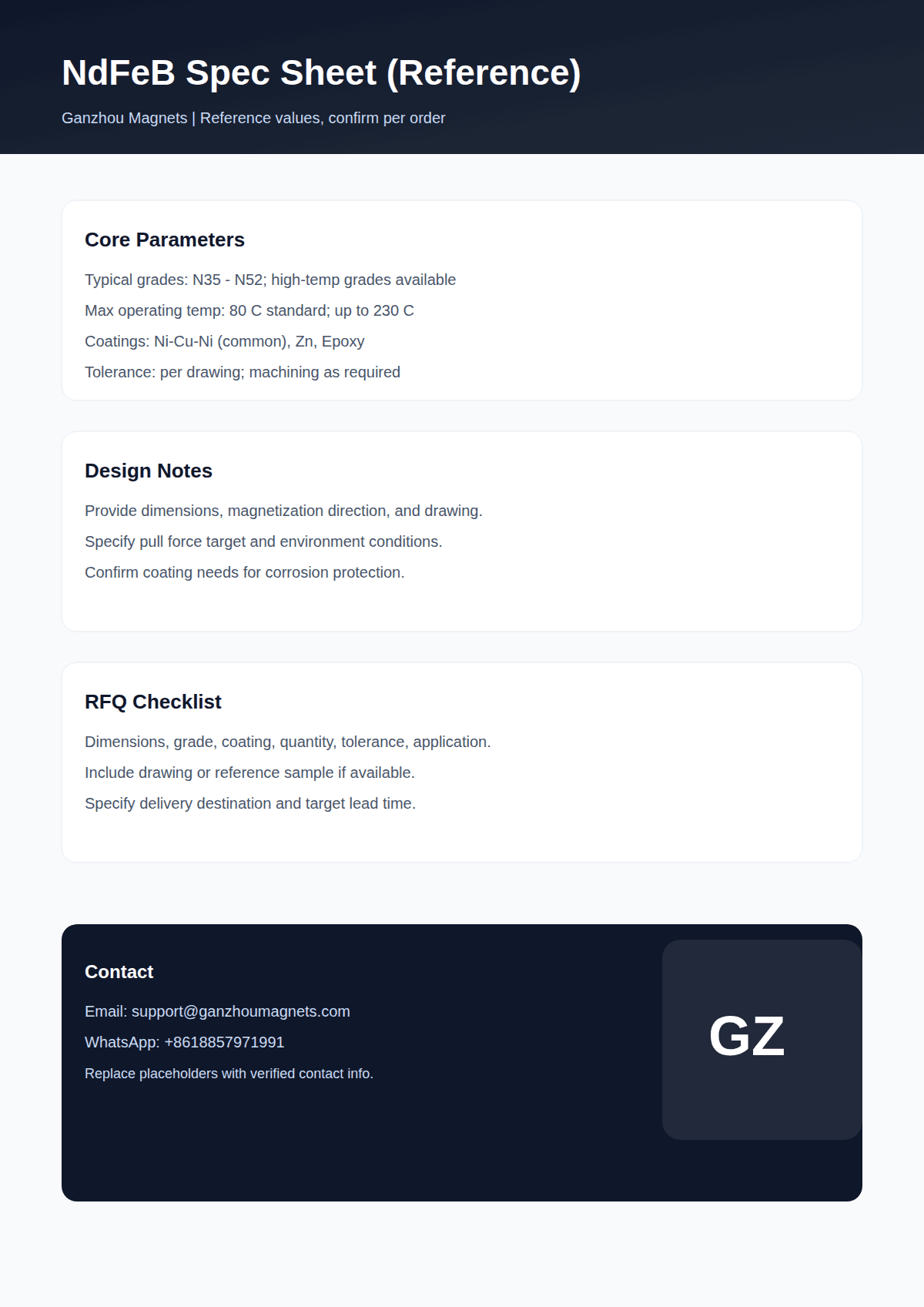
NdFeB spec sheet (reference)
Grades, coatings, and RFQ checklist for NdFeB magnets.
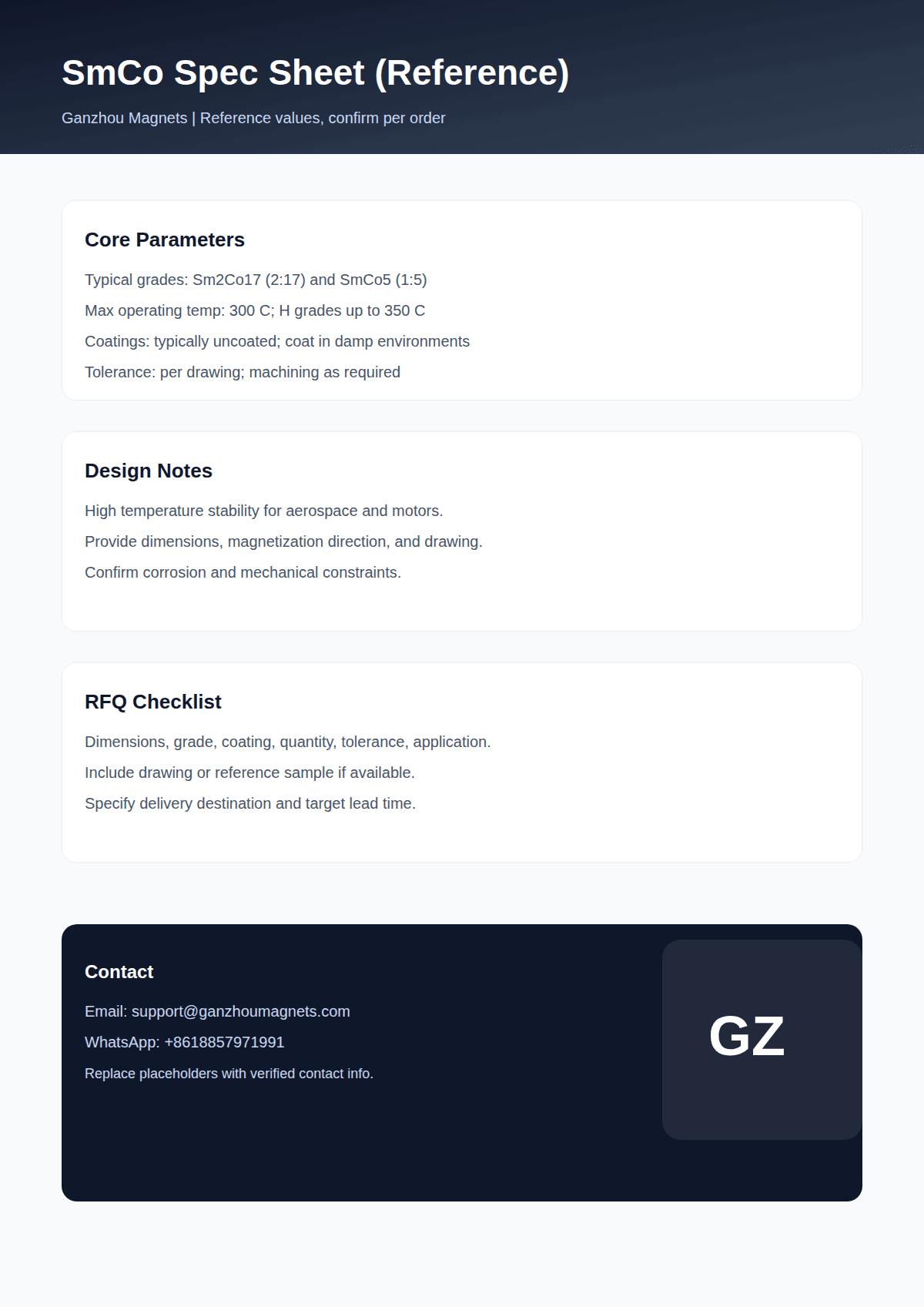
SmCo spec sheet (reference)
High-temperature SmCo summary and RFQ checklist.
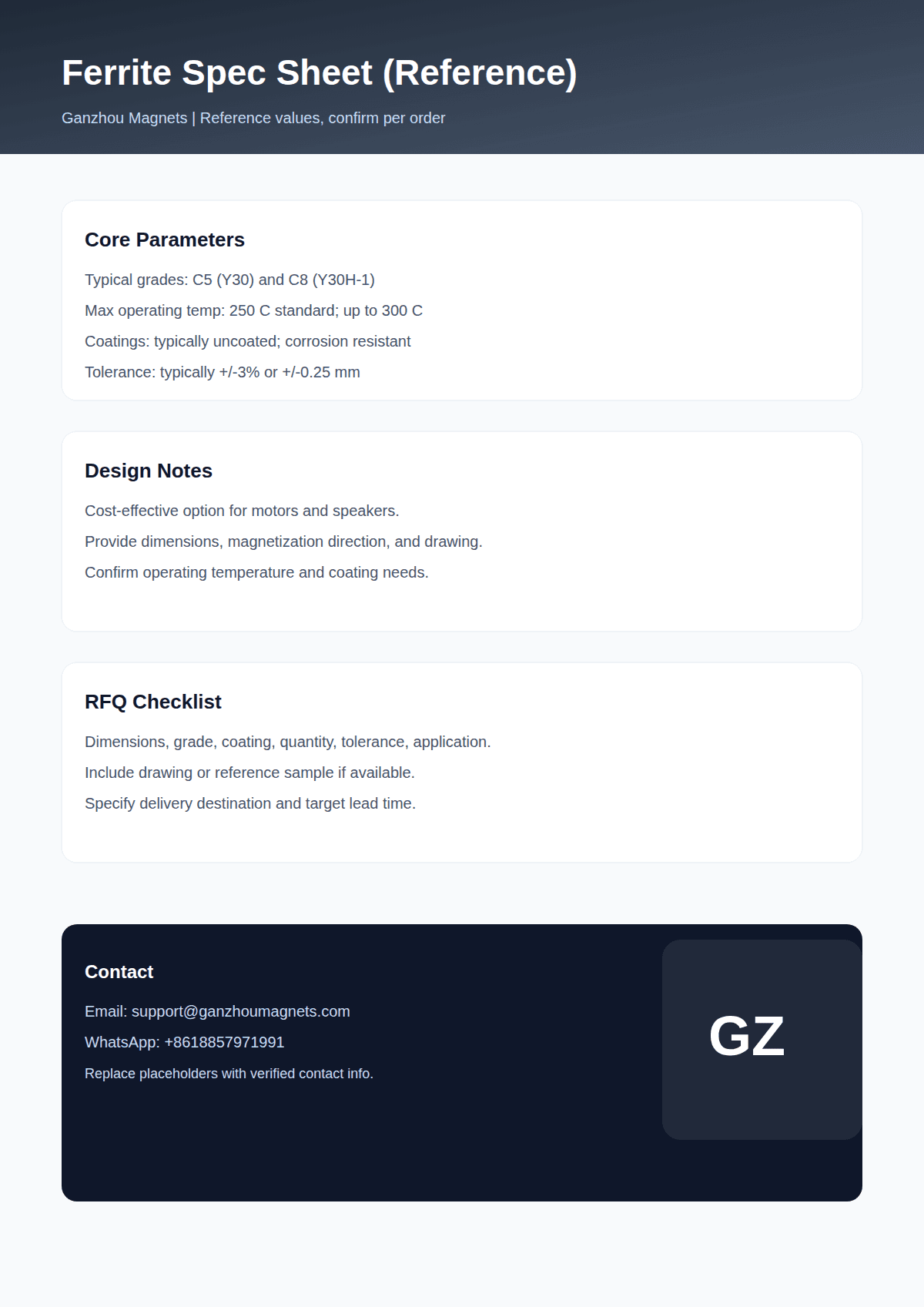
Ferrite spec sheet (reference)
Cost-optimized ferrite basics and RFQ checklist.
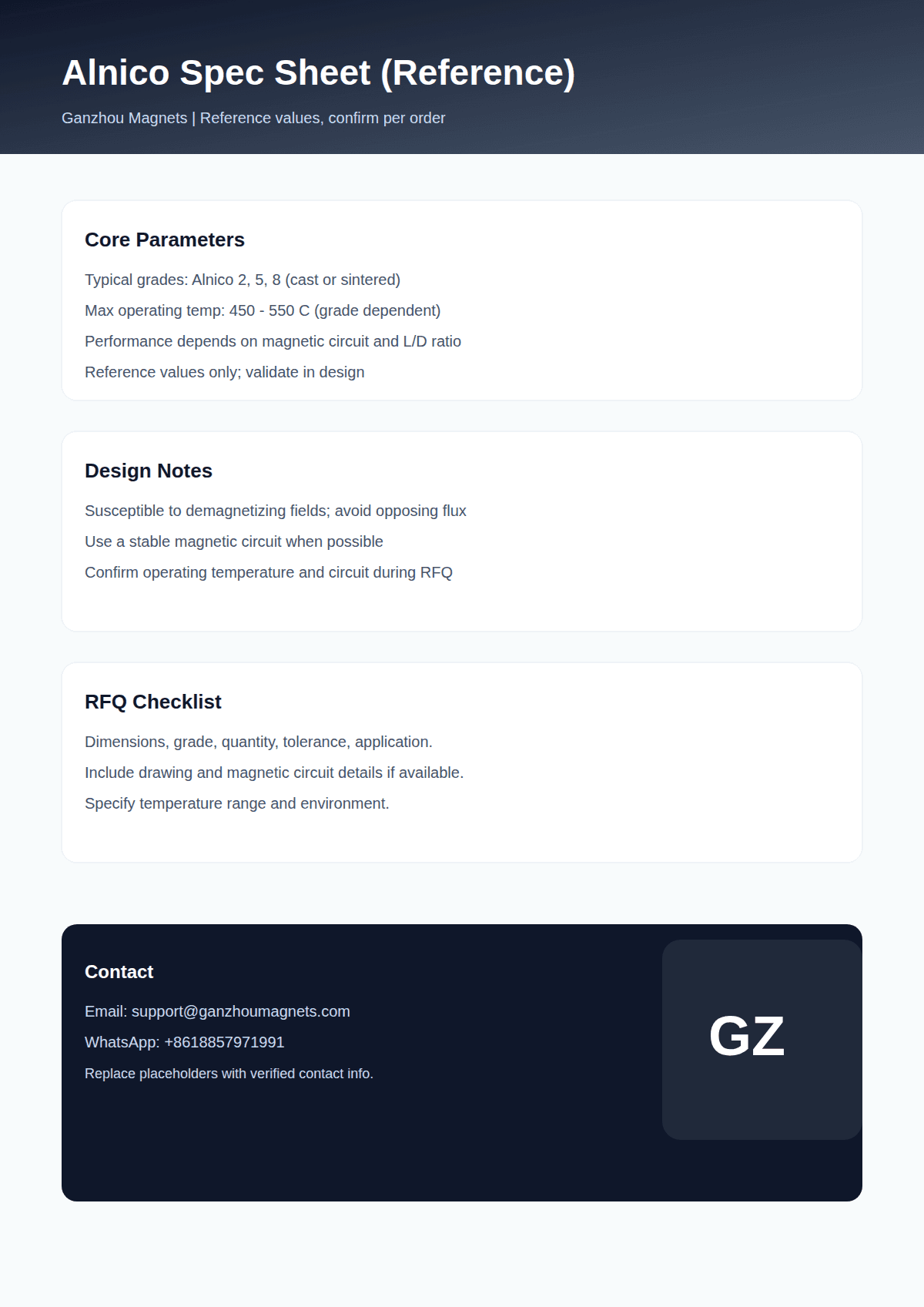
Alnico spec sheet (reference)
High-temperature Alnico grades and RFQ checklist.
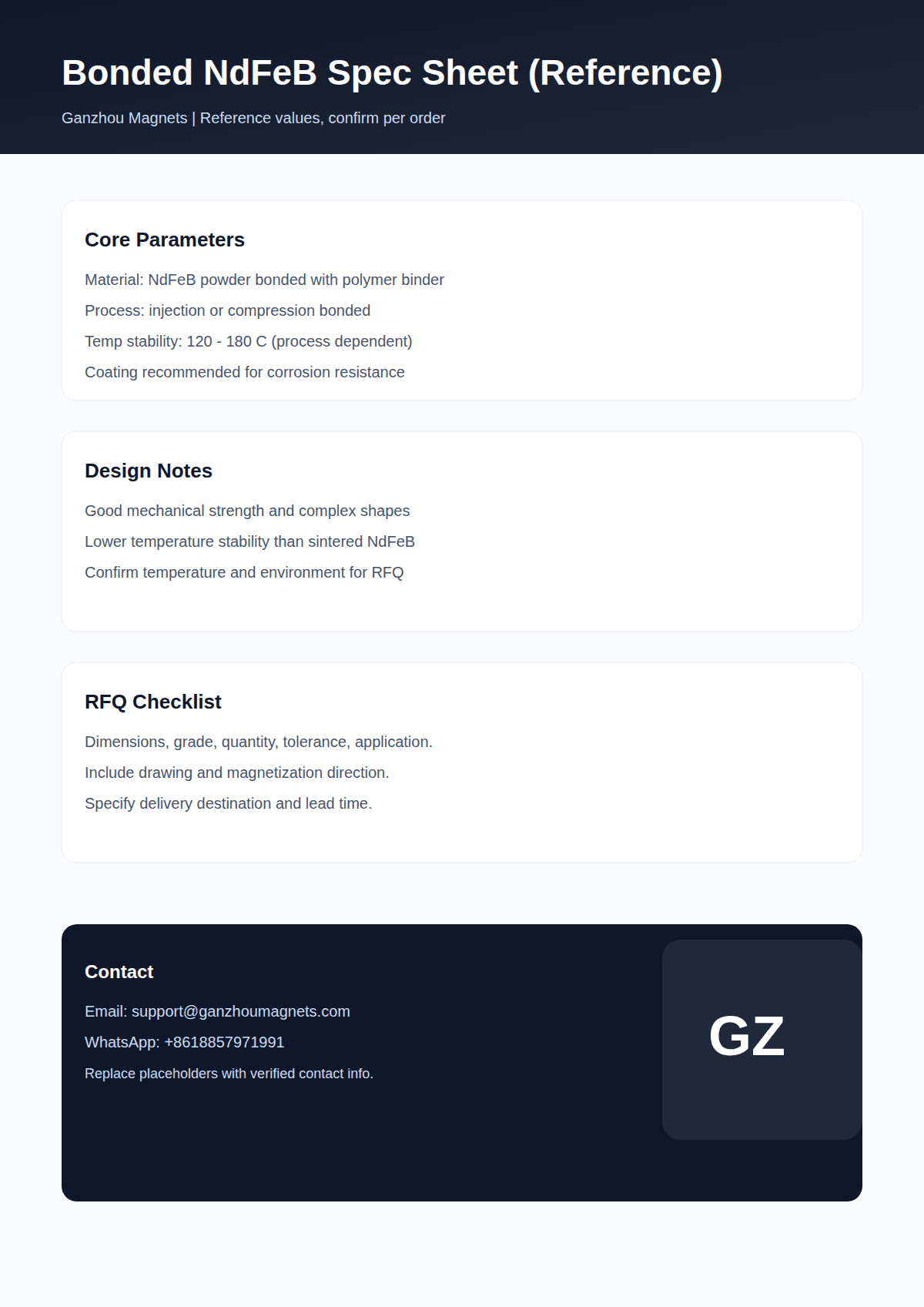
Bonded NdFeB spec sheet (reference)
Bonded NdFeB process notes and RFQ checklist.
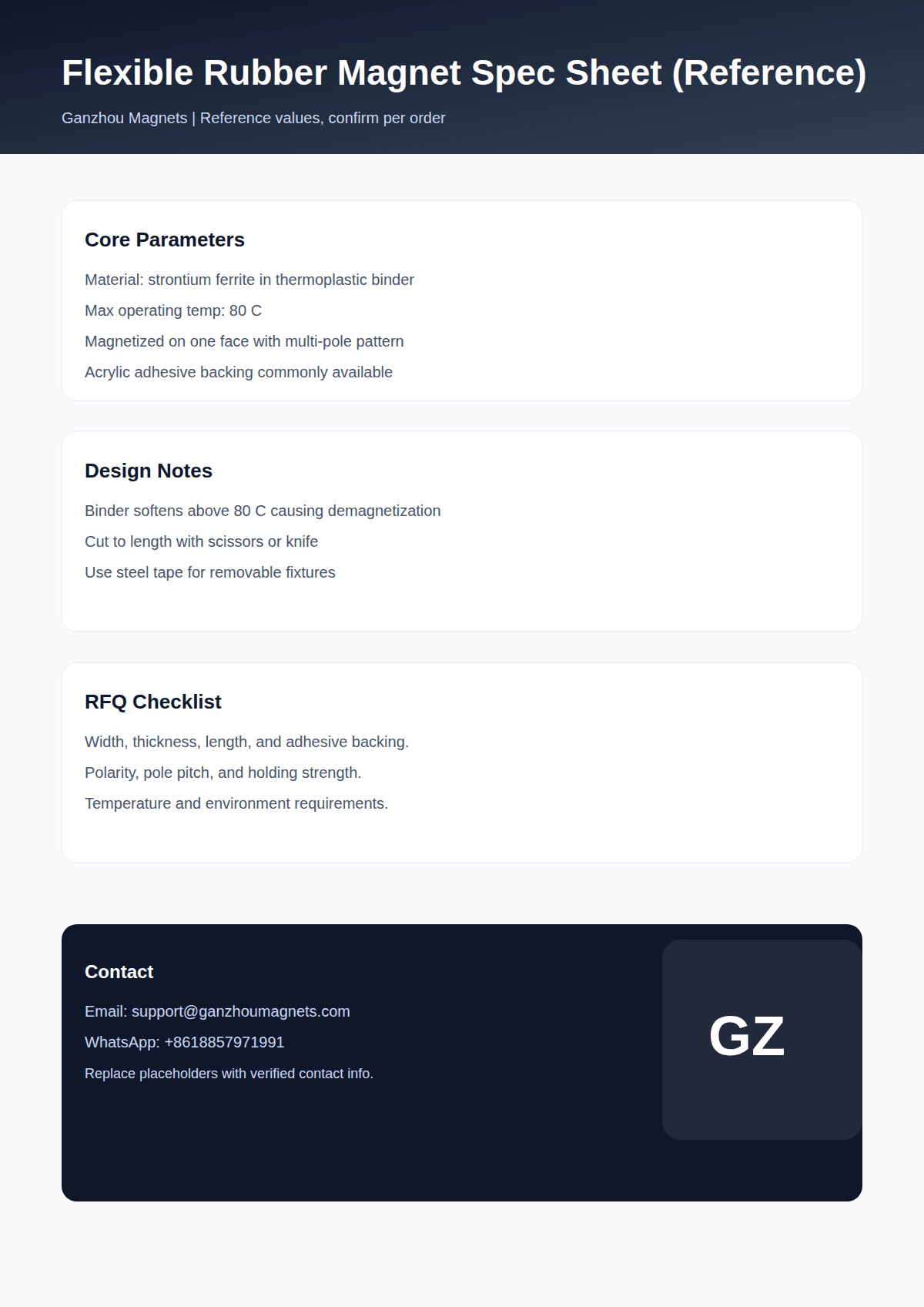
Flexible rubber magnet spec sheet (reference)
Flexible magnet tape basics and RFQ checklist.
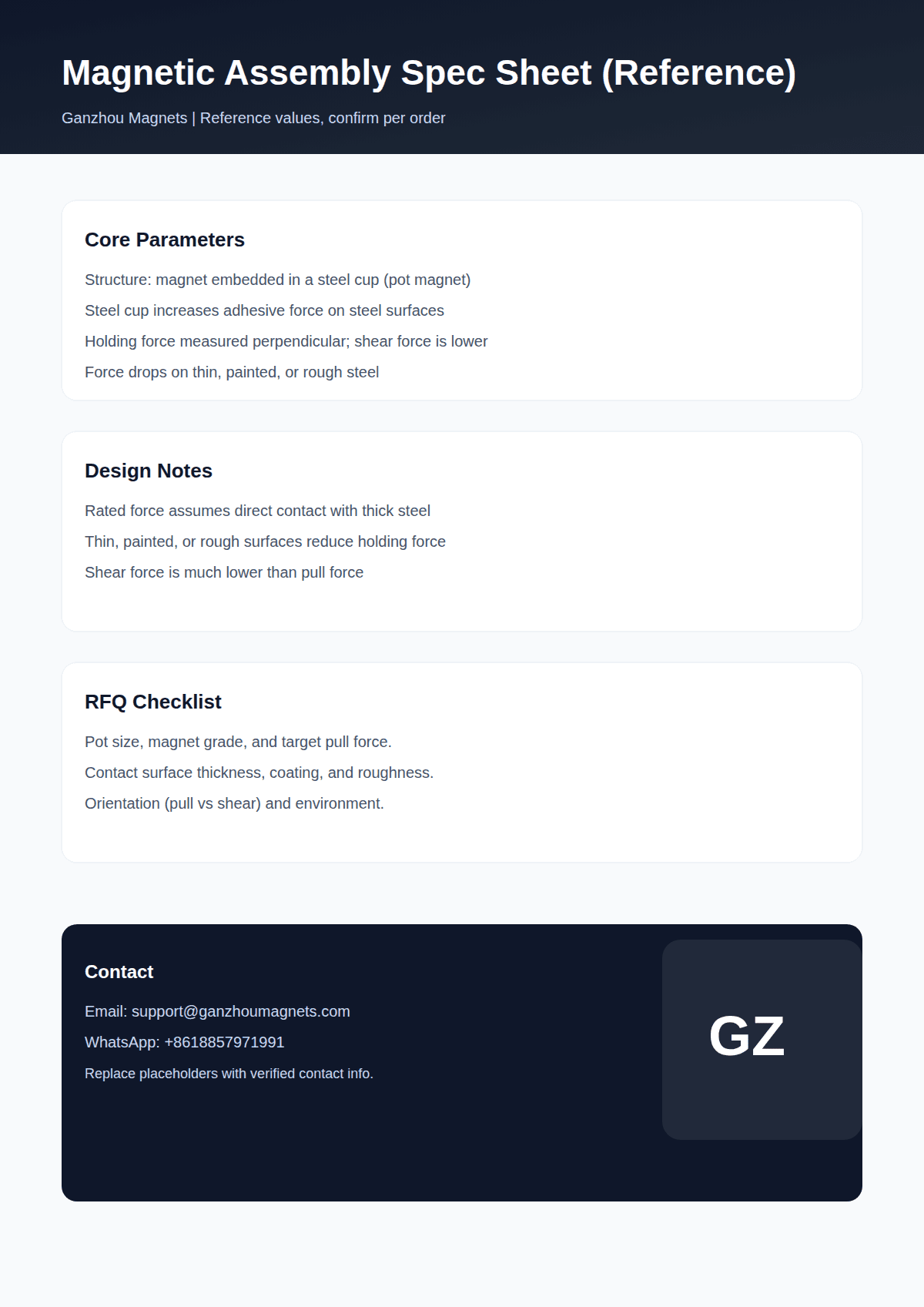
Magnetic assembly spec sheet (reference)
Pot magnet assembly fundamentals and RFQ checklist.
Trust & Compliance
Certifications and QC checkpoints aligned to industrial procurement.

ISO 9001
Quality management system

RoHS
Restricted substances compliance

REACH
SVHC compliance on request
Factory Capability
- Custom shapes and grades per drawing
- Tolerances confirmed by supplier QC
- Coating options: Ni-Cu-Ni, Zinc, Epoxy
QC Process
- Raw material verification and grade checks
- Dimensional inspection to critical tolerances
- Surface and coating integrity inspection
Get a Quote
Send your drawing, grade, coating, and quantity. We coordinate a supplier quote and follow up with confirmed specs.
Product data is sourced from partner suppliers and confirmed per order.
Related Pages
Custom Neodymium Magnets for OEM RFQ
Sourcing
Custom Printed Magnets: Tool-First Plan and Decision Report
Product
Custom Magnets Vs Stock Magnets
Comparison
NdFeB Magnet Grades: Selector Tool and Evidence Report
Educational
Neodymium Magnets for Sale: Tool-First Buying and Sourcing Report
Sourcing
NdFeB Magnet Supplier Sourcing for OEM Buyers
Sourcing